
News
RUSSIA versus NATO and BRICS vs. NATO Military SWOT
Recall that Poland’s Minister Sikorski’s core claim is partially supported by the numbers, but the framing “quite quickly” and “without the U.S.” does not…
TAMFIS NIG LTDRC 8067447CAC ACTIVEFinima, Bonny Island, Rivers State

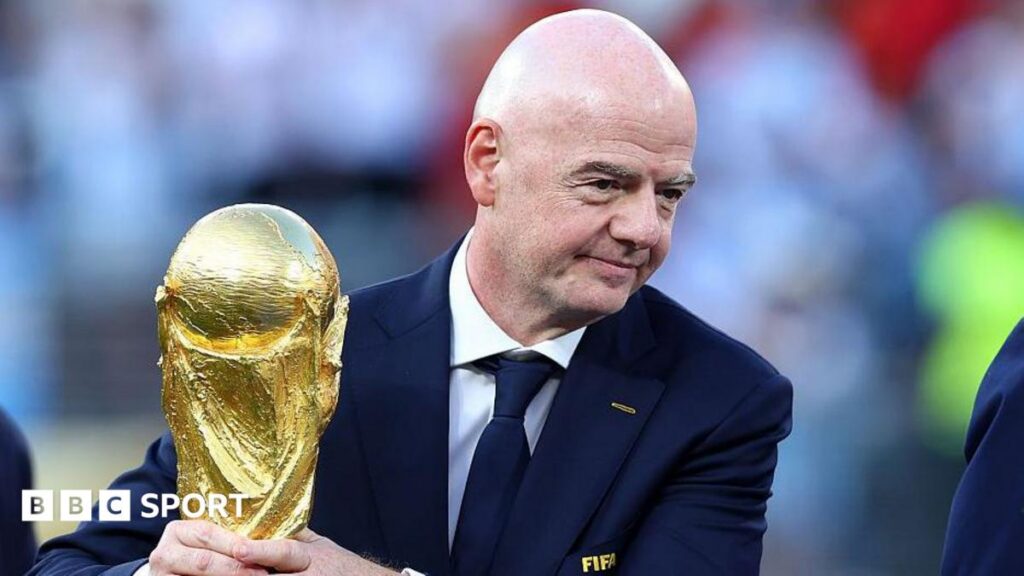
Image source, Getty ImagesImage caption, Gianni Infantino rose to prominence via a number of roles at UefaByGareth RobertsBBC Sport WalesPublished6 minutes agoWales have become the first nation to publicly withdraw backing for Gianni Infantino's bid to continue his leadership of Fifa.It follows the loss of confidence in the Fifa president following his scrapped plans to sell stakes in its competitions to private investment firms.The Football Association of Wales (FAW) has confirmed "its withdrawal of support for the candidature of Mr Gianni Infantino for re-election as Fifa president for the 2027-2031…
Image source, Getty ImagesImage caption, Gianni Infantino rose to prominence via a number of roles at UefaByGareth RobertsBBC Sport WalesPublished6 minutes agoWales have become the first nation to publicly withdraw backing for Gianni Infantino's bid to continue his leadership of Fifa.It follows the loss of confidence in the Fifa president following his scrapped plans to sell stakes in its competitions to private investment firms.The Football Association of Wales (FAW) has confirmed "its withdrawal of support for the candidature of Mr Gianni Infantino for re-election as Fifa president for the 2027-2031 term".Infantino's lucrative plan sparked a global outcry, with European football's governing body Uefa threatening to boycott all Fifa competitions, including the World Cup. Uefa and Concacaf – which oversees football in North, Central America and the Caribbean – both released statements on Saturday criticising the leadership of the world governing body following Infantino's decision to withdraw the plan.The FAW added: "The recent failures in good governance, processes, leadership, values, stakeholder management, communications and sound judgement have led us to a position where Mr Infantino has lost the confidence of the FAW to remain at the helm of world football."Failing to put the best interests of football first is a failure we cannot accept."Related topicsFootballWales Men's Football TeamFIFA World Cup 2026More on this storyA bruising 24 hours – what next for…
Editor’s note: The following is AI-generated commentary and context on this topic, not original reporting.
The report above, “Wales first nation to withdraw support for Infantino,” sits within a broader set of developments that readers may find useful to understand in more depth. The following context is offered to help place the story within its wider setting.
As reported: “Image source, Getty ImagesImage caption, Gianni Infantino rose to prominence via a number of roles at UefaByGareth RobertsBBC Sport WalesPublished6 minutes agoWales have become the first nation to publicly withdraw…”
International competitions add another layer of complexity, with clubs and associations often navigating competing calendars and release obligations for their players. Recruitment strategy has become increasingly data-driven, with clubs employing analysts to assess potential signings alongside traditional scouting methods. Recruitment strategy has become increasingly data-driven, with clubs employing analysts to assess potential signings alongside traditional scouting methods.
Context and background are often as important as the immediate headline in understanding why a story has resonated with the public. Stories of this kind often sit within broader trends that are not always immediately visible from a single report. Governance at the top of the sport, whether at national federation or global confederation level, shapes the environment in which clubs and players operate.
As more information becomes available, the picture described in initial reports often becomes more nuanced. As more information becomes available, the picture described in initial reports often becomes more nuanced. Player welfare, form, and public statements from managers or players themselves are closely parsed by supporters hungry for insight into a club’s direction.
Player welfare, form, and public statements from managers or players themselves are closely parsed by supporters hungry for insight into a club’s direction. Ownership structures across European football vary widely, from fan-owned clubs to state-backed investment groups, each bringing different priorities to how a club is run. Disputes over finances, competition formats, or disciplinary matters often expose tensions between commercial interests and the traditions that many supporters feel are central to the game’s identity.
Managers and technical staff are frequently judged not just on results but on how coherently their tactical philosophy is executed over a season. Understanding the wider context can help readers form a more complete picture of what is being described. Decisions made in boardrooms and on training pitches ripple outward into transfer strategy, squad morale, and the broader competitive balance of a league or tournament.
The financial dimension of modern football cannot be overstated, with broadcast deals, sponsorship arrangements, and prize money increasingly determining which clubs can compete at the highest level. The physical toll on players representing both club and country across a congested season has become a growing talking point among coaches and medical staff. Comments made in press conferences can take on outsized significance, shaping fan sentiment well beyond the specific context in which they were made.
Continental competition places significant financial and reputational stakes on clubs, with qualification often affecting budgets for the following season. Ongoing coverage from established outlets remains valuable as a story like this develops further. Understanding the wider context can help readers form a more complete picture of what is being described.
A single signing, departure, or contract dispute can shift the narrative around a club for months, influencing everything from ticket sales to sponsorship conversations. Governance at the top of the sport, whether at national federation or global confederation level, shapes the environment in which clubs and players operate. Context and background are often as important as the immediate headline in understanding why a story has resonated with the public.
Shifts in these financial arrangements can have knock-on effects for smaller clubs further down the football pyramid, who rely on solidarity payments and transfer income. Decisions made in boardrooms and on training pitches ripple outward into transfer strategy, squad morale, and the broader competitive balance of a league or tournament. Ownership structures across European football vary widely, from fan-owned clubs to state-backed investment groups, each bringing different priorities to how a club is run.
Football clubs at every level operate within tightly interlinked ecosystems of finance, sporting ambition, and supporter expectation. International competitions add another layer of complexity, with clubs and associations often navigating competing calendars and release obligations for their players. Fan reaction to major club decisions, whether about signings, sales, or managerial appointments, is now amplified rapidly through social media, adding a further layer of pressure on decision-makers.
Institutions involved in stories of this kind typically respond through established communication channels rather than informal statements. Continental competition places significant financial and reputational stakes on clubs, with qualification often affecting budgets for the following season. Shifts in these financial arrangements can have knock-on effects for smaller clubs further down the football pyramid, who rely on solidarity payments and transfer income.
The coming days and weeks will likely bring further clarity. Until then, this overview is intended to provide useful context rather than new factual claims beyond what has already been reported.
Originally reported by bbc.co.uk. Adapted for our readers with AI assistance.
Keep reading
News
Recall that Poland’s Minister Sikorski’s core claim is partially supported by the numbers, but the framing “quite quickly” and “without the U.S.” does not…
News
Thousands of young protesters in Delhi continue to demand education reforms and the resignation of Education Minister Dharmendra Pradhan after a police crackdown. The…
News
Facing a looming financial collapse, Thames Water’s main lenders have offered the UK government a ‘golden share’ and increased local authority involvement to avoid…
TAMFIS NIG LTD
Electrical and instrumentation engineering, bid preparation and consulting, IT and software.