UK Faces Wildfires Amid Heatwave and Football Governing Bodies Clash Over World Cup Investment Plan
This summer has proven to be a challenging period for the United Kingdom and European football alike. The country grapples with extreme heatwaves that have sparked significant wildfires, including a major blaze near a nuclear power station in Suffolk, leading to mass evacuations. Concurrently, the football world is embroiled in a dispute over a controversial investment plan proposed by FIFA, which has prompted UEFA and its 55 member nations to threaten a boycott of the 2030 World Cup. These developments underscore pressing issues in public safety, climate resilience, and sports governance.
UK Faces Wildfires Amid Heatwave and Football Governing Bodies Clash Over World Cup Investment Plan
Heatwaves and Wildfires: A 'Cruel Summer' for the UK
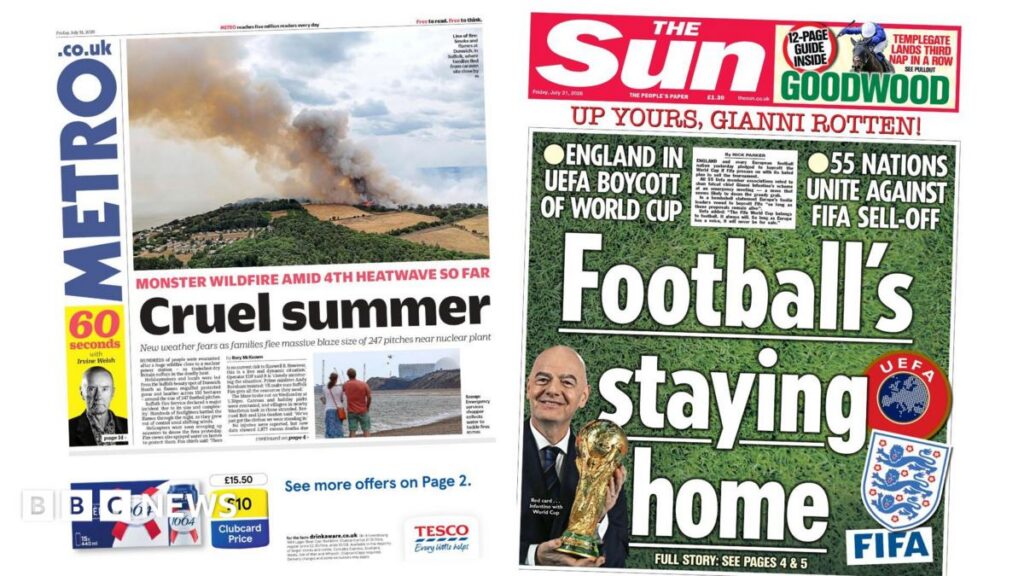
The UK is experiencing its fourth heatwave of the summer, with temperatures soaring to unprecedented levels. This extreme weather has contributed to widespread wildfires, including a significant blaze in Dunwich, Suffolk. The fire, described as covering an area equivalent to 247 football pitches, forced the evacuation of hundreds of residents due to its proximity to a nuclear power station, raising serious safety concerns.
Firefighting efforts have been intensive, with helicopters actively scooping water from the sea to combat the flames. The combination of hot, dry, and windy conditions has exacerbated the situation, making containment difficult. Similar wildfires continue to affect parts of Europe, including France, indicating a broader regional challenge linked to climate change and prolonged drought conditions.
These events highlight the increasing vulnerability of the UK’s infrastructure and communities to extreme weather phenomena. Authorities are under pressure to enhance emergency response capabilities and develop long-term strategies to mitigate wildfire risks amid rising temperatures.
Football’s Governance Crisis: UEFA’s Stand Against FIFA’s Investment Plan
In the realm of sports, European football is facing a significant governance crisis. UEFA, the continent’s football governing body representing 55 nations, has announced a potential boycott of the 2030 World Cup qualification matches. This unprecedented move is in response to FIFA’s controversial plan to sell stakes in its competitions to private investors, a strategy that UEFA and many of its members oppose.
The proposal, backed by FIFA President Gianni Infantino, aims to attract private capital to fund football tournaments. However, critics argue that this could undermine the integrity of the sport and shift control away from member associations. UEFA’s firm stance includes threats to withdraw teams, including England’s national squad led by captain Harry Kane, as well as co-host nations Morocco, Portugal, and Spain.
Media outlets have widely covered the unfolding dispute, with some calling for Infantino’s resignation amid accusations of overreach and mismanagement. The divide extends beyond Europe, with federations in Asia and the Americas also expressing reservations about the investment plan, suggesting a global rift within football’s governing bodies.
Economic and Political Developments Amidst the Summer Challenges
Beyond environmental and sports news, the UK’s economic landscape is also in focus. The Bank of England recently held interest rates steady, signaling caution amid global uncertainties such as the ongoing conflict in Iran. While borrowing costs remain high, the central bank indicated that further rate hikes might be necessary if inflationary pressures persist.
On the political front, the Labour Party faces scrutiny over projected increases in council tax revenues. Reports reveal that national council tax income could rise by 43% by 2030, reaching nearly £59 billion annually. This would translate to an average increase of £500 per household, sparking debate over the financial burden on local residents.
Additionally, Prime Minister Andy Burnham has acknowledged the potential benefits of resuming oil drilling in the North Sea. Experts estimate that lifting the current ban could generate up to £25 billion in additional tax revenue over the next decade, offering a possible avenue to ease the cost of living crisis. This stance reflects a pragmatic approach to balancing environmental concerns with economic necessities.
What this means
This summer encapsulates a period of intense challenges for the UK and European football. The combination of extreme weather events and governance disputes reflects broader themes of resilience and accountability. As wildfires threaten communities and critical infrastructure, urgent attention to climate adaptation is essential. Simultaneously, the football world’s internal conflicts over investment and governance highlight the need for transparent and inclusive decision-making to preserve the sport’s integrity. Economic and political developments further complicate the landscape, underscoring the interconnected nature of environmental, social, and financial issues facing the UK today. Navigating these complexities will require coordinated efforts from government, industry, and civil society to ensure sustainable and equitable outcomes.
Editor’s note: The following is AI-generated commentary and context on this topic, not original reporting.
Broader Context and Outlook
Volunteer fire brigades often play an outsized role in rural areas during events like this, supplementing professional crews who are frequently stretched across multiple active fronts simultaneously.
Local authorities dealing with situations comparable to this one generally rely on a mix of early-warning systems, controlled burns, and public education campaigns to reduce the risk of similar outbreaks in future fire seasons.
Climate researchers have repeatedly linked the lengthening fire season in parts of Europe to drier soils, hotter summers, and vegetation that has become increasingly primed to burn, a trend that context like this helps illustrate in concrete terms.
Community resilience and coordinated regional firefighting resources are frequently cited by officials as the biggest factors in how quickly an area bounces back once the immediate crisis described here has passed.
Insurance industry data from recent fire seasons across southern Europe suggests that claims tied to wildfire damage have risen sharply, a trend that is prompting insurers to reassess risk pricing in fire-prone regions.
The events described in “UK Faces Wildfires Amid Heatwave and Football Governing Bodies Clash Over World Cup Inv…” fit a pattern seen across much of Europe this decade: wildfires that spread faster and burn hotter than firefighting resources were originally built to handle, forcing agencies to rethink staffing, equipment, and mutual-aid agreements between regions.
Emergency planners responding to situations like this one typically juggle several competing priorities at once — active suppression, evacuation logistics, road closures, and public health advisories tied to smoke inhalation — often with limited visibility into how conditions will change hour to hour.
Recovery after a fire like the one at the centre of this story usually involves more than rebuilding structures; land often needs to be stabilised and replanted to prevent erosion and flash flooding once rain eventually returns.
Air quality monitoring stations downwind of major fires typically record spikes in particulate pollution that can persist for days, prompting health advisories even in towns and cities far from the flames themselves.
Originally reported by bbc.co.uk. Adapted for our readers with AI assistance.
Thousands of young protesters in Delhi continue to demand education reforms and the resignation of Education Minister Dharmendra Pradhan after a police crackdown. The…
Facing a looming financial collapse, Thames Water’s main lenders have offered the UK government a ‘golden share’ and increased local authority involvement to avoid…
Facing record-breaking temperatures and severe drought, Thames Water has introduced a hosepipe ban impacting over 10 million customers across parts of southern England to…