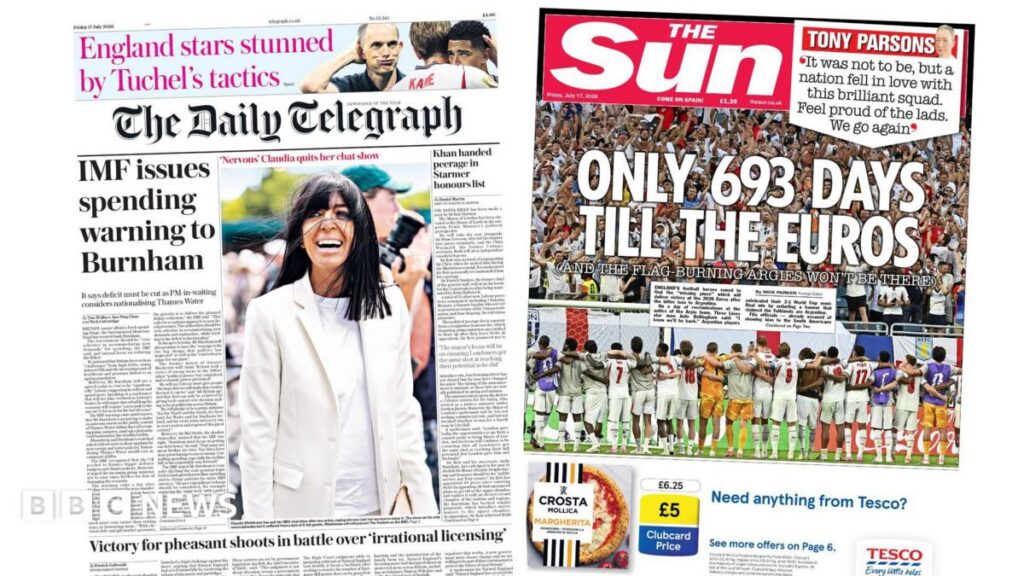
UK Faces Economic and Political Challenges as Burnham Prepares to Take Office Amid Global and Domestic Pressures
With Andy Burnham set to assume the role of prime minister within days, the United Kingdom finds itself at a crossroads marked by significant economic warnings, political tensions within the ruling Labour Party, and international disputes that have captured public attention. The International Monetary Fund has issued a stark caution against increased government spending, while Labour insiders debate key cabinet appointments. Simultaneously, the aftermath of the World Cup and diplomatic controversies over the Falklands sovereignty claim have stirred national debate. This article provides a comprehensive analysis of these developments, offering insight into their implications for the UK’s future.
UK Faces Economic and Political Challenges as Burnham Prepares to Take Office Amid Global and Domestic Pressures
IMF Urges Fiscal Restraint as Burnham Prepares to Lead
The International Monetary Fund (IMF) has delivered a clear message to Andy Burnham, who is expected to become the UK’s prime minister imminently. The IMF warns that Britain cannot afford a renewed surge in government spending, emphasizing the need to reduce the national deficit. This caution comes as Burnham reportedly considers nationalizing Thames Water, a move that would require significant public investment.
The IMF’s position highlights concerns about fiscal sustainability amid rising public expectations for increased social spending under a Labour government. Burnham has pledged to be 'unashamedly' Labour, signaling intentions to expand public services and possibly increase taxation to fund these ambitions. However, the IMF’s warning underscores the tension between political promises and economic realities, suggesting that any expansion of spending must be carefully balanced against the imperative of deficit reduction.
Labour Party Faces Internal Divisions Over Cabinet Appointments
As Burnham prepares to take office, the Labour Party is grappling with internal disagreements regarding key cabinet positions, particularly the Treasury. Reports indicate a 'left-wing revolt' over the potential appointment of Home Secretary Shabana Mahmood as chancellor. Some Labour MPs express reservations about her suitability for the role, reflecting broader debates about the party’s economic direction.
Another contender for the Treasury role, Energy Secretary Ed Miliband, is also a subject of contention. While some see him as a strong candidate, others warn that his appointment could attract criticism and become a focal point for opposition attacks against the government. These divisions illustrate the challenges Burnham faces in uniting his party and establishing a coherent economic strategy that satisfies both the party’s left wing and pragmatic governance considerations.
World Cup Aftermath: National Pride and Diplomatic Tensions
England’s exit from the World Cup semi-finals has left fans heartbroken but hopeful, with the Sun newspaper highlighting the 693 days remaining until the next European Championship as a rallying point. The team’s commitment to finding the 'missing piece' to secure future victory reflects a resilient national spirit.
However, the tournament’s conclusion also sparked diplomatic controversy. Several Argentine players were photographed holding a banner stating 'Las Malvinas son Argentinas' ('The Falklands are Argentine'), a provocative assertion of sovereignty over the Falkland Islands. British media outlets characterized this act as a 'final insult' and a 'World Cup disgrace,' with calls for a FIFA investigation supported by Downing Street.
Veteran Falklands campaigner Simon Weston described the banner as 'childish and petulant,' underscoring the sensitivity of this geopolitical issue. The incident has heightened diplomatic tensions between the UK and Argentina, illustrating how sporting events can intersect with longstanding political disputes.
International Developments: Aid, AI, and Global Diplomacy
Beyond domestic politics and sports, other international stories are shaping the UK’s global engagement. The Foreign Office has approved £153 million in aid to Pakistan despite controversies surrounding the country’s refusal to repatriate a convicted grooming gang leader. This decision reflects the complexities of balancing humanitarian commitments with diplomatic challenges.
In technology, the Financial Times reports on Chinese AI startup Moonshoot’s efforts to challenge the US lead in frontier artificial intelligence. The company is preparing to launch a large language model with capabilities approaching those of leading American labs, signaling intensifying global competition in AI development.
Meanwhile, the Guardian highlights a significant scaling back of an ambitious plan to rebuild Gaza, with the original blueprint shrinking to a small pilot project. This development points to the difficulties of achieving large-scale reconstruction in conflict-affected areas.
Additionally, the UK’s Prime Minister Keir Starmer’s recent meeting with Ukrainian President Volodymyr Zelensky underscores the ongoing commitment to international diplomacy and support amid the conflict in Ukraine.
Editor’s note: The following is AI-generated commentary and context on this topic, not original reporting.
Economic Headwinds Facing Any Incoming Government
New governments in the UK have historically inherited a mix of structural economic pressures, including public debt servicing costs, inflationary pressure on household budgets, and demands for increased spending on health and social care from an ageing population. Global factors such as energy prices and international trade tensions further complicate any incoming administration’s room for fiscal manoeuvre, often limiting the scope for the kind of large-scale spending pledges made during opposition.
Economists and think tanks typically publish early assessments of a new government’s fiscal position within the first weeks of taking office, offering a baseline against which subsequent policy announcements are judged. How a new leader balances competing demands from different wings of their own party, while managing market and public expectations, is often seen as one of the clearest early tests of political skill.
What this means
As Andy Burnham stands on the cusp of becoming the UK's next prime minister, he inherits a landscape fraught with economic caution, political factionalism, and international sensitivities. The IMF’s fiscal warnings highlight the financial constraints that will shape his government’s policy choices, while internal Labour debates underscore the challenge of forging unity. Meanwhile, the fallout from the World Cup and ongoing international issues remind us that domestic leadership is inseparable from global dynamics. Navigating these intersecting pressures will be critical for Burnham’s administration as it seeks to balance ambition with pragmatism and national cohesion with international diplomacy.
Thousands of young protesters in Delhi continue to demand education reforms and the resignation of Education Minister Dharmendra Pradhan after a police crackdown. The…
Facing a looming financial collapse, Thames Water’s main lenders have offered the UK government a ‘golden share’ and increased local authority involvement to avoid…
Facing record-breaking temperatures and severe drought, Thames Water has introduced a hosepipe ban impacting over 10 million customers across parts of southern England to…