Business
Nigeria’s Economic Performance: Domestic Debt Rise and Agriculture Trade Shift in Q2 2026
Nigeria's economic landscape in the second quarter of 2026 presents a mixed picture of fiscal press...
TAMFIS NIG LTDRC 8067447CAC ACTIVEFinima, Bonny Island, Rivers State

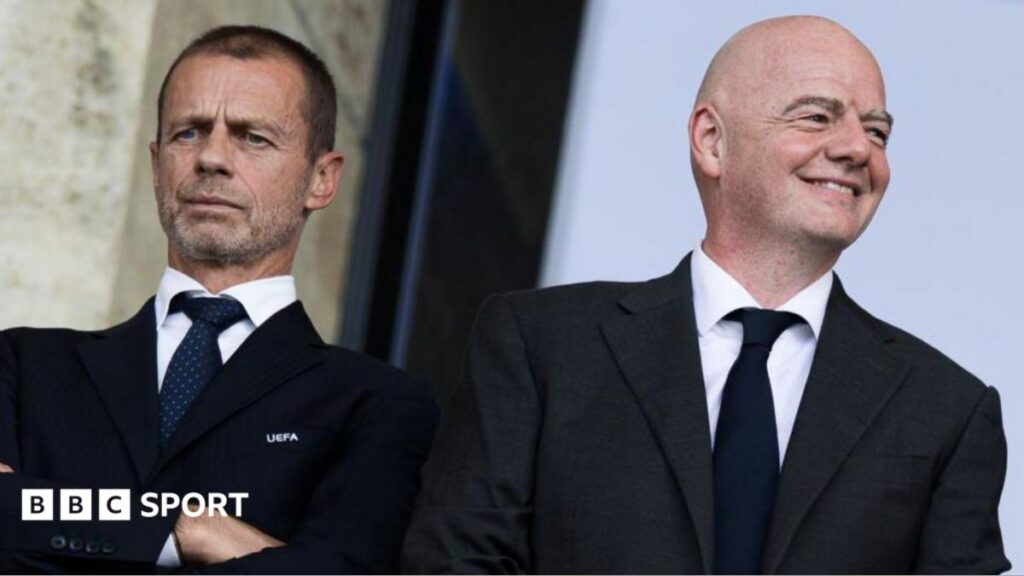
European football's governing body, Uefa, has issued a stark warning that it could boycott all Fifa-organised tournaments, including the men's and women's World Cups, should Fifa move ahead with controversial plans to privatise ownership of its flagship events. The threat follows Fifa president Gianni Infantino's proposal to create a commercial subsidiary that would allow external investors to purchase stakes in tournaments like the World Cup. Uefa, backed unanimously by its 55 member associations, argues that such a move would commodify football's greatest sporting legacy and undermine the sport's integrity. This development marks a significant escalation in the ongoing tension between global and continental football authorities, with potential repercussions for upcoming tournaments and the future structure of international football governance.
Fifa recently unveiled plans to establish a commercial subsidiary tasked with managing its premier competitions, including the men's and women's World Cups and the Club World Cup. This subsidiary would enable private investors to acquire ownership stakes in these tournaments, effectively opening parts of football's most prestigious events to external financial interests. The proposal is presented by Fifa as a means to generate substantial revenue streams from the growing commercial value of global football.
To incentivise support from member associations, Fifa president Gianni Infantino offered financial inducements, including an initial payment of $40 million for associations that back the plan, with access to an initial $20 million tranche contingent on acceptance by a September 19 deadline. The initiative forms part of Fifa's broader strategy to monetise its tournaments amid rising broadcasting, sponsorship and merchandising revenues.
Critics, however, contend that the plan risks transforming sporting events into investment products, prioritising financial returns over the intrinsic values of competition, accessibility and sporting merit. The speed and scale of the financial offers have raised concerns about undue influence and the potential for self-enrichment among Fifa's leadership and select insiders.
In response to Fifa's announcement, Uefa convened an emergency meeting of its 55 member associations, resulting in a unanimous and unequivocal rejection of the privatisation plans. Uefa president Aleksander Ceferin has been a leading critic of Infantino's approach, insisting that the World Cup represents a sporting legacy built over generations and must not be surrendered to private investors.
Uefa's official statement emphasised that the World Cup 'cannot be treated as an investment product' and is 'one of football's greatest sporting legacies, built over generations by players, national teams, and supporters across every continent.' The body declared that 'no part of it should ever be surrendered to private investors' and affirmed that 'the World Cup is not for sale.'
The proposed boycott would extend beyond the World Cups to encompass all Fifa competitions, including the women's tournament and the Club World Cup. The first major test of this stance is expected in October during the Women's World Cup play-offs, where the absence of European teams could significantly alter the competition's dynamics.
Uefa's opposition is grounded in both financial and ethical apprehensions. The organisation alleges that Fifa's leadership is attempting to exploit football as a vehicle for personal enrichment and the benefit of a narrow circle of insiders, rather than serving the broader interests of the global football community.
There are fears that introducing private equity ownership could shift decision-making priorities from sporting integrity and fan accessibility towards profit maximisation, potentially affecting ticket pricing, host selection and tournament format. Smaller football associations and grassroots organisations worry they may be marginalised if commercial interests begin to dominate governance.
The dispute also highlights a structural imbalance in global football governance: while Fifa seeks to expand its commercial reach as the worldwide governing body, continental confederations like Uefa emphasise the preservation of sporting heritage, equitable participation and the protection of football's cultural and social value. This clash raises fundamental questions about who controls football's future and whose interests should prevail in shaping its direction.
Should Uefa carry out its boycott threat, the absence of European national teams and clubs would profoundly impact the quality, competitiveness and global appeal of Fifa's tournaments. The men's and women's World Cups have traditionally derived much of their prestige from the participation of strong European sides, and their withdrawal could diminish viewer interest, broadcasting value and commercial returns—ironically undermining Fifa's own financial objectives.
The looming September 19 deadline for member associations to accept Fifa's privatisation plan, coupled with the October Women's World Cup play-offs, presents an imminent inflection point. If the boycott proceeds, it may trigger negotiations, legal challenges or a forced reconsideration of Fifa's proposals. Alternatively, Fifa might revise its model to address concerns, perhaps by limiting private involvement or enhancing transparency and stakeholder consultation.
Beyond the immediate tactical implications, the standoff underscores a deeper debate about the future model of football governance: whether the sport should remain under collective stewardship as a public good or evolve towards a privatised, investor-driven framework. The outcome will influence not only tournament structures but also the relationship between fans, players, associations and commercial interests in the decades to come.
The confrontation between Uefa and Fifa over the proposed privatisation of World Cup ownership represents a pivotal moment for international football. As the September deadline approaches, the sport stands at a crossroads between maintaining its traditional model of collective stewardship and embracing a new era of investor involvement in its most prestigious tournaments. Uefa's firm resistance reflects a widespread belief that football's greatest events should remain protected as sporting legacies rather than transformed into financial assets. Whether this stance leads to negotiation, compromise or outright boycott, the coming weeks will determine not only the fate of upcoming World Cups but also the principles that govern football's global future. For fans, players and associations worldwide, the outcome will shape how the beautiful game is played, experienced and cherished for generations to come.
Originally reported by bbc.co.uk. Adapted for our readers with AI assistance.
Keep reading
Business
Nigeria's economic landscape in the second quarter of 2026 presents a mixed picture of fiscal press...
Business
Liverpool manager Andoni Iraola is confronting a significant selection headache as two key forwards, Cod...
News
Health News tamfitronics [Editor’snote:[Editor’snote: This transcript was generated using both transcription ...
TAMFIS NIG LTD
Electrical and instrumentation engineering, bid preparation and consulting, IT and software.