
News
RUSSIA versus NATO and BRICS vs. NATO Military SWOT
Recall that Poland’s Minister Sikorski’s core claim is partially supported by the numbers, but the framing “quite quickly” and “without the U.S.” does not…
TAMFIS NIG LTDRC 8067447CAC ACTIVEFinima, Bonny Island, Rivers State

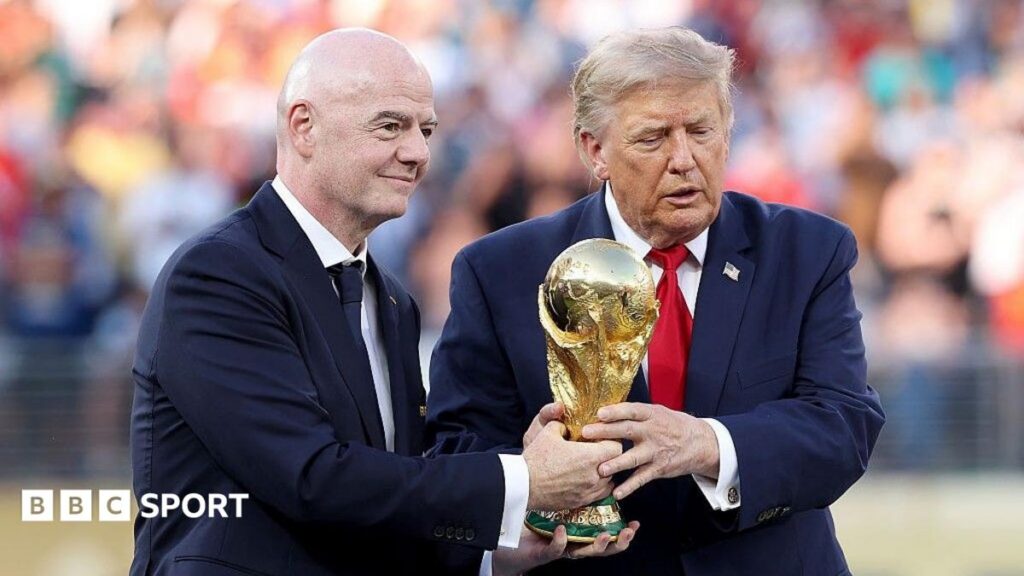
FIFA’s recent announcement to seek private investment to fund the expansion of football development and its major tournaments, notably the World Cup, has sparked significant controversy within the sport’s governing bodies. UEFA, Europe’s football authority, has expressed vehement opposition, arguing that the proposal undermines the collective ownership and spirit of the game. This article explores the background, the proposed plans, UEFA’s response, and the broader implications for football’s governance and future.
FIFA, the global governing body for football, has unveiled plans to attract private investment exceeding $10 billion (£7.5 billion) to support the growth and development of football worldwide. This initiative aims to significantly increase the financial resources available for football development programs and the staging of major tournaments, including the FIFA World Cup.
The proposal is currently subject to approval by FIFA’s member associations, reflecting the organization’s attempt to modernize its funding mechanisms and expand its reach. According to reports from the Financial Times and The Times, these plans could also lead to substantial personal financial gains for FIFA President Gianni Infantino, potentially amounting to tens of millions of pounds.
UEFA has responded with strong condemnation of FIFA’s proposal, describing it as a move that “crosses a line that football’s governing institutions should never cross.” The European football authority emphasized that football does not belong to any single organization or individual, stating unequivocally that the World Cup is not FIFA’s property to sell or monetize through private investment.
This reaction highlights a fundamental disagreement over the governance and commercialization of football’s most prestigious events. UEFA’s stance reflects a concern that private investment could compromise the integrity, accessibility, and collective ownership that have traditionally defined international football competitions.
The tension between FIFA and UEFA over this issue underscores broader challenges in football governance. FIFA, as the global body, seeks to innovate and secure financial sustainability amid rising costs and expanding ambitions. Meanwhile, continental bodies like UEFA prioritize maintaining the sport’s traditions, equitable access, and the interests of member associations.
The World Cup, as the pinnacle of international football, has historically been managed with a focus on collective stewardship rather than commercial exploitation. Introducing private investors could shift this balance, potentially prioritizing profit over the sport’s values and the interests of fans and players.
Moreover, the involvement of private capital raises questions about transparency, influence, and the potential for conflicts of interest within football’s governing structures.
If FIFA’s plan proceeds, the influx of private investment could lead to significant changes in how the World Cup and other competitions are organized and financed. Increased funding might enhance infrastructure, global outreach, and development programs, potentially accelerating the growth of football in emerging markets.
However, these benefits come with risks. The commercialization of football’s flagship events could alienate traditional stakeholders, including national associations, fans, and players, who may feel sidelined by profit-driven motives. There is also concern that private investors could exert undue influence over tournament decisions, scheduling, and governance.
Balancing these competing interests will be critical to ensuring that football’s growth does not come at the expense of its core values and universal appeal.
The debate sparked by FIFA’s proposal is likely to intensify as member associations deliberate on the plan’s approval. UEFA’s public opposition sets a precedent for other football bodies to voice their positions, potentially leading to a broader discussion about the future of football financing and governance.
Stakeholders across the football community—including clubs, players, fans, and sponsors—will be watching closely to see how this issue unfolds. The outcome could redefine the relationship between football’s governing institutions and private capital, with long-lasting effects on the sport’s global landscape.
FIFA’s leadership will need to address concerns about transparency, governance, and the preservation of football’s collective ownership to build consensus and legitimacy for their funding strategy.
FIFA’s initiative to introduce private investment into football’s flagship competitions marks a pivotal moment in the sport’s governance and financing. While the potential influx of capital could accelerate football development globally, it also raises profound questions about ownership, influence, and the preservation of the game’s core values. UEFA’s vehement opposition underscores the delicate balance between innovation and tradition in football’s evolving landscape. As this debate unfolds, the decisions made will have far-reaching consequences for the World Cup, football’s global governance, and the sport’s future direction. Stakeholders must navigate these challenges carefully to ensure that football remains a game for all, governed by principles that transcend profit.
Editor’s note: The following is AI-generated commentary and context on this topic, not original reporting.
For younger athletes and up-and-coming talent, high-profile moments comparable to this can serve as both inspiration and a benchmark for what is achievable with the right support structures in place.
The broader competitive landscape — including transfer activity, coaching appointments, and shifting team form — will likely continue to shape how a story like this one is remembered in the context of the wider season.
Fans and pundits alike tend to view outcomes of this kind through the lens of what they signal for the rest of the season, weighing short-term form against longer-term structural questions facing the team or athlete involved.
Results and moments like the one described in “UEFA Condemns FIFA’s Proposal for Private Investment in World Cup as Crossing a Critica…” are often the product of years of behind-the-scenes work — coaching changes, training regimens, and squad-depth decisions that only become visible to the public in moments of high drama.
Grassroots participation numbers often see a temporary boost following high-profile moments of this kind, as young fans are inspired to take up the sport themselves.
Broadcast and sponsorship revenue tied to major competitions increasingly shapes decisions once made purely on sporting grounds, a tension that regularly surfaces in discussions like this one.
Sports scientists and analysts increasingly point to marginal gains — in recovery, nutrition, and data-driven tactical preparation — as a growing factor behind performances and decisions of the sort covered here.
Governing bodies in sport are frequently balancing commercial pressures against the traditions and expectations of supporters, a tension that plays out publicly whenever a decision or result like this one draws scrutiny.
Injury prevention and squad rotation have become central talking points across professional sport, as data on player workload increasingly informs decisions that once relied mostly on instinct.
The framing chosen by different outlets covering “UEFA Condemns FIFA’s Proposal for Private Investment in World Cup as Crossing a Critica…” can vary considerably depending on editorial priorities, which is one reason it is often useful to read more than a single account of a developing story.
Originally reported by bbc.co.uk. Adapted for our readers with AI assistance.
Keep reading
News
Recall that Poland’s Minister Sikorski’s core claim is partially supported by the numbers, but the framing “quite quickly” and “without the U.S.” does not…
News
Thousands of young protesters in Delhi continue to demand education reforms and the resignation of Education Minister Dharmendra Pradhan after a police crackdown. The…
News
Facing a looming financial collapse, Thames Water’s main lenders have offered the UK government a ‘golden share’ and increased local authority involvement to avoid…
TAMFIS NIG LTD
Electrical and instrumentation engineering, bid preparation and consulting, IT and software.