
Top Stories
Discovery beneath soccer field reveals massive medieval convent lost for centuries
NEWYou can now listen to Fox News articles! Researchers recently uncovered a long-lost medieval convent in an unusual location in Denmark: a soccer field…
TAMFIS NIG LTDRC 8067447CAC ACTIVEFinima, Bonny Island, Rivers State

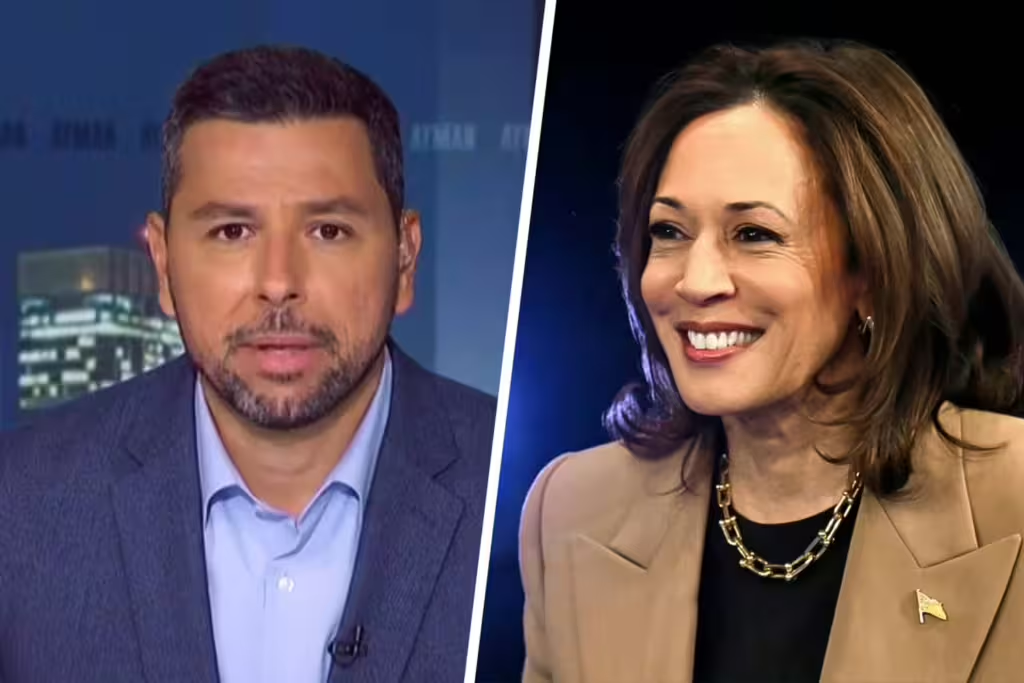
As the 2024 Election Day approaches, new NBC News polling shows a strikingly close contest between Vice President Kamala Harris and former President Donald Trump, both tied at 48% among registered voters nationally. This statistical dead heat marks a significant shift from previous polls that favored Harris, sparking concern within Democratic circles. The narrowing gap highlights deeper issues within the Democratic campaign strategy and messaging, raising questions about voter engagement, policy positioning, and the party’s ability to counter Trump’s unconventional campaign tactics. Understanding these dynamics is essential for Democrats to recalibrate their approach and avoid potential losses in a pivotal election.
Recent polling data from NBC News paints a sobering picture for the Democrats, with Vice President Kamala Harris and Donald Trump locked in a dead heat at 48% each among registered voters. This marks a noticeable decline from earlier polls where Harris held a modest lead, suggesting shifting voter sentiments and increased competition as Election Day nears.
The tightening race underscores the volatility of the electorate and the impact of campaign strategies on public opinion. It also reflects broader national anxieties and the polarized political environment, where voter decisions are increasingly influenced by identity, media narratives, and perceived authenticity of candidates.
For Democrats, these numbers are not just statistics but a warning sign. The close margins indicate vulnerabilities in Harris’s campaign, particularly in swing states and among key demographic groups. This polling data demands a critical reassessment of messaging, outreach, and policy emphasis to regain momentum.
Vice President Harris has largely followed traditional presidential campaign norms—holding town halls, engaging in media blitzes, and maintaining a composed, presidential demeanor. While these tactics align with expectations for a serious candidate, they may be limiting her ability to connect with voters on a deeper, more emotional level.
In contrast, Donald Trump’s unconventional approach—eschewing debates, leveraging viral media moments, and engaging directly with his base through less formal channels—has energized his supporters and maintained high visibility. His unpredictable style contrasts sharply with Harris’s measured conduct, potentially making her campaign appear less dynamic or relatable.
This adherence to norms may inadvertently hinder Harris’s ability to galvanize disaffected or undecided voters who seek a candidate who breaks the mold and offers a compelling, differentiated vision. The challenge lies in balancing presidential decorum with the need to energize and expand the voter base.
Harris’s close alignment with President Joe Biden and his policies, especially on contentious issues like the Gaza conflict, has become a liability rather than an asset. Biden’s administration faces criticism on various fronts, and Harris’s unwillingness to distance herself risks alienating voters who desire fresh leadership and new policy directions.
By doubling down on Biden’s stances, Harris may be perceived as an extension of the status quo rather than a transformative candidate. This perception undermines her initial appeal as a candidate representing a new generation with innovative solutions to America’s challenges.
Furthermore, her campaign’s emphasis on bipartisanship, including promises to collaborate with Republicans, may dilute her progressive credentials and fail to inspire the Democratic base. Voters increasingly demand clarity and conviction, which may be compromised by attempts to appease a broad political spectrum.
Donald Trump’s political brand is well-established—characterized by authoritarian tendencies, nationalist rhetoric, and controversial immigration policies. Despite this, his supporters remain unwavering, and recent polls show his approval ratings improving compared to previous election cycles.
In contrast, Harris struggles to define a clear and compelling identity that distinguishes her from both Biden and Trump. Her repeated framing of herself simply as “not Joe Biden or Donald Trump” lacks substantive policy differentiation and fails to inspire enthusiasm or confidence among undecided voters.
This ambiguity poses a strategic challenge. Voters increasingly seek candidates who articulate a distinct vision and policy roadmap. Without this clarity, Harris risks being overshadowed by Trump’s polarizing but unmistakable presence, leaving Democrats vulnerable in key battlegrounds.
The close polling margins raise concerns about Democratic voter enthusiasm and turnout, which are crucial determinants of electoral success. If Harris’s campaign fails to energize core constituencies, including young voters, minorities, and progressives, the party’s chances of victory diminish significantly.
Voter fatigue with establishment politics and perceived lack of boldness in addressing systemic issues contribute to apathy within the Democratic base. This apathy, coupled with effective Republican mobilization efforts, could tip the balance in tight races across the country.
To counteract this, Democrats must reinvigorate their messaging by emphasizing policy innovation, social justice, and economic opportunity. Engaging grassroots organizations and leveraging digital platforms can also help rebuild enthusiasm and drive turnout.
Harris’s campaign has faced criticism for strategic missteps, including a lack of clear differentiation from Biden and insufficient responses to Trump’s aggressive tactics. This has allowed Republicans to control the narrative and frame the election as a referendum on the status quo versus radical change.
Moreover, the campaign’s focus on bipartisan cooperation may be perceived as weakness or indecision in a highly polarized environment. Voters often prefer decisive leadership that confronts challenges head-on rather than attempts to placate opposing factions.
Effective messaging requires a balance of authenticity, policy clarity, and emotional resonance. Harris’s team must refine their communications to articulate a compelling vision that addresses voter concerns while contrasting sharply with Trump’s divisive rhetoric.
Given the current polling trends and campaign dynamics, Democrats face an urgent need to recalibrate their strategy. This involves reassessing policy priorities, enhancing voter outreach, and adopting more innovative campaign tactics that resonate with a diverse electorate.
Harris’s campaign must consider distancing itself from unpopular policies and articulating a distinct, forward-looking agenda that addresses pressing issues such as economic inequality, climate change, and social justice. Clear messaging on these fronts can re-engage disillusioned voters.
Additionally, embracing unconventional campaign methods—such as targeted social media engagement, grassroots mobilization, and direct voter contact—can help rebuild momentum and counteract Trump’s media dominance. Time is limited, making swift and decisive action imperative.
The current polling situation serves as a critical wake-up call not only for Harris but for the entire Democratic Party. It highlights the dangers of complacency and the necessity of continuous adaptation in a rapidly evolving political landscape.
Democrats must learn from past electoral setbacks and recognize the importance of authenticity, clear policy distinctions, and voter engagement. The party’s success depends on presenting a unified yet dynamic front that inspires confidence and hope among Americans.
Ultimately, the election outcome will hinge on whether Democrats can effectively communicate what they stand for and why their vision offers a better future than Trump’s authoritarian approach. This moment demands bold leadership, strategic clarity, and relentless commitment to winning back the electorate.
The tightening race between Vice President Kamala Harris and Donald Trump revealed by recent polling is a stark reminder for Democrats that complacency and ambiguity can be costly. As the election draws near, the Democratic Party must confront these challenges head-on by redefining their message, energizing their base, and distinguishing themselves clearly from Trump’s divisive brand. Success will require bold leadership, innovative strategies, and a renewed commitment to addressing the issues that matter most to American voters. Failure to act decisively risks handing the country over to an authoritarian vision that Democrats have long opposed. This moment is a pivotal test of the party’s resilience and capacity for renewal.
Originally reported by msnbc.com. Adapted for our readers.
Keep reading
Top Stories
NEWYou can now listen to Fox News articles! Researchers recently uncovered a long-lost medieval convent in an unusual location in Denmark: a soccer field…
News
By Engr. Tamunofiniarisa BrownReading Time: 6 Minutes The conflict between Russia and Ukraine is often framed in the media as a simple battle between…
TAMFIS NIG LTD
Electrical and instrumentation engineering, bid preparation and consulting, IT and software.