Top Stories
Discovery beneath soccer field reveals massive medieval convent lost for centuries
NEWYou can now listen to Fox News articles! Researchers recently uncovered a long-lost medieval convent in an unusual location in Denmark: a soccer field…
TAMFIS NIG LTDRC 8067447CAC ACTIVEFinima, Bonny Island, Rivers State

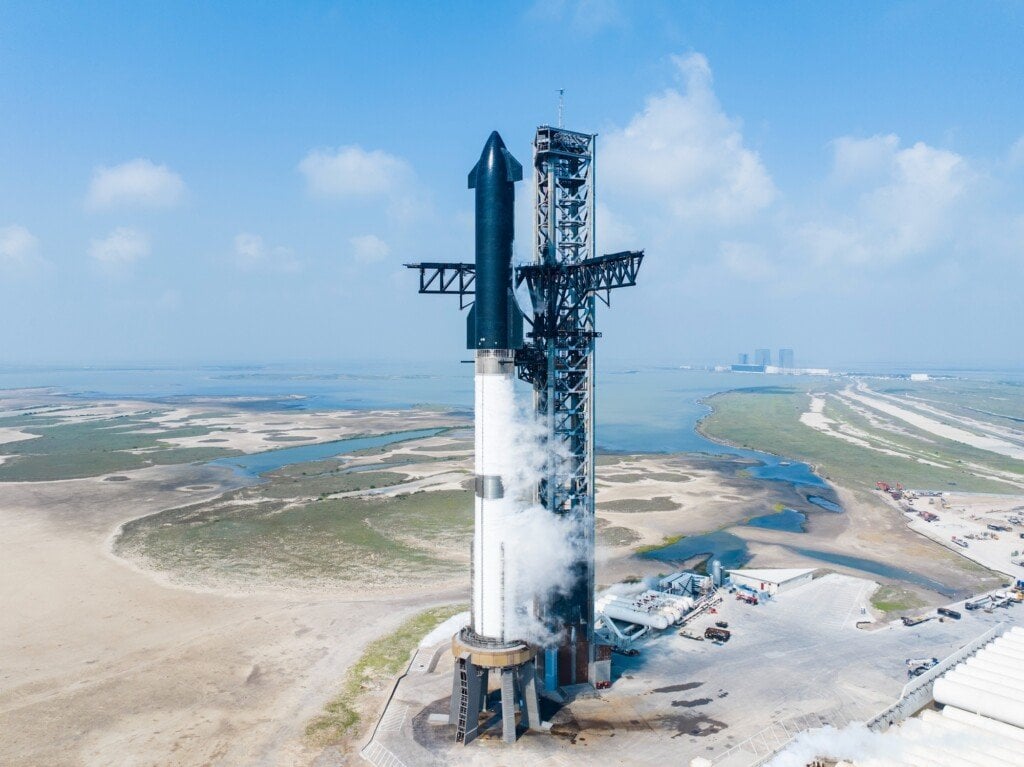
SpaceX is preparing for the next major milestone in its Starship development program with a scheduled launch date set for June 5, pending regulatory approval. This upcoming integrated flight test, known as IFT-4, marks a strategic shift from merely reaching orbit to demonstrating the ability to recover and reuse both stages of the Starship vehicle. With improvements informed by earlier missions, SpaceX aims to showcase controlled landings and enhanced reliability, bringing the ambitious goal of rapid spacecraft turnaround closer to reality.
Following three previous integrated test flights, SpaceX’s upcoming mission will focus less on achieving orbital insertion and more on proving the vehicle’s capability to return safely and be reused. The Starship system consists of the Super Heavy booster and the Starship spacecraft, both designed to be fully reusable. While earlier tests demonstrated the upper stage’s ability to reach space, the new flight will emphasize controlled descent and splashdown of both components.
SpaceX has outlined key objectives for this flight, including performing a landing burn and a safe splashdown of the Super Heavy booster in the Gulf of Mexico, alongside a controlled reentry of the Starship spacecraft. This marks a critical step toward operational reusability, which is essential for reducing launch costs and increasing flight cadence.
The company’s statement highlights that this fourth flight test shifts the focus “from attaining orbit to demonstrating the ability to attain recovery and reuse Starship and Super Heavy.” This evolution reflects SpaceX’s broader vision for rapid and cost-effective space access, where both stages of the launch vehicle can be flown multiple times with minimal refurbishment.
Unlike the third integrated flight in March, the upcoming test will not include in-flight operations such as opening the payload bay doors or transferring propellant. The flight trajectory is designed to avoid a deorbit burn, allowing the spacecraft to reenter the atmosphere naturally and splash down in the Indian Ocean. This approach minimizes risks to public safety while still enabling SpaceX to evaluate controlled reentry performance.
The booster’s planned boostback burn after separation will be followed by jettisoning the interstage section that connects the booster and spacecraft. This modification reduces the booster’s mass during the final flight phase, potentially improving its landing performance.
By eliminating the interstage after the boostback burn, SpaceX aims to optimize the booster’s mass and dynamics for the final descent. This change is part of a series of hardware upgrades designed to enhance the vehicle’s overall performance and reliability during critical flight phases.
SpaceX has openly shared insights into the difficulties encountered during the third Starship test flight. Although the spacecraft reached space, it was lost during reentry due to loss of attitude control. Several minutes after engine shutdown, the vehicle began rolling uncontrollably, which prevented a planned engine relight and led to an off-nominal, high-heating reentry. Telemetry was lost at approximately 65 kilometers altitude.
Investigations pointed to valve clogging in thrusters responsible for roll control as the root cause. To mitigate this, SpaceX has added additional thrusters for redundancy and upgraded thruster hardware to resist blockage better. These enhancements aim to improve the spacecraft’s stability during critical flight phases.
The loss of attitude control was a significant setback, as it led to an uncontrolled reentry with heating levels exceeding expectations on both protected and unprotected areas of the vehicle. This experience underscores the challenges of managing spacecraft orientation during high-speed atmospheric reentry, a key factor for vehicle integrity and crew safety in future missions.
The Super Heavy booster experienced significant engine failures during its descent on the previous flight. Of the 33 Raptor engines, only 13 fired after separation for the boostback burn, with six shutting down prematurely. For the final landing burn, only two engines ignited, insufficient for a safe ocean landing. Contact with the booster was lost at an altitude of 462 meters.
SpaceX attributed these failures to filter blockages in the liquid oxygen lines, which restricted propellant flow to the engines. Similar issues had been observed in past launches. To address this, the company plans to install additional hardware inside the oxygen tanks to enhance propellant filtration and implement further unspecified hardware and software improvements to improve engine startup reliability.
These engine issues highlight the complexity of managing a large cluster of engines during critical flight phases. The company’s commitment to upgrading filtration systems and engine startup procedures aims to prevent recurrence of such failures, which are crucial for achieving successful booster landings and rapid reusability.
Elon Musk has expressed optimism about the upcoming flight’s potential to demonstrate a landing on a ‘megatower’ platform in the Gulf of Mexico. Success in this endeavor would pave the way for future missions to land boosters on the tower at Starbase, facilitating rapid turnaround and reuse of Starship vehicles.
While Musk acknowledges the aggressive timeline, he considers these goals achievable within the near term. Achieving reliable booster landings on a fixed platform would represent a significant advancement in reducing launch costs and increasing operational frequency.
This vision aligns with SpaceX’s broader strategy to transform spaceflight by enabling rapid vehicle reuse, which could drastically lower the cost of access to space and support ambitious exploration and commercial objectives. The upcoming flight is therefore a critical step in validating technologies and procedures that could revolutionize the aerospace industry.
SpaceX’s upcoming fourth integrated Starship test flight represents a pivotal moment in the company’s quest to develop a fully reusable launch system. By shifting focus from merely reaching space to demonstrating controlled recovery and reuse of both the booster and spacecraft, SpaceX is tackling some of the most challenging aspects of rocket engineering. The upgrades and lessons learned from previous flights underscore the iterative nature of this development process. If successful, this mission will bring SpaceX closer to realizing its vision of rapid, cost-effective space access, with profound implications for space exploration and commercial spaceflight.
Originally reported by spacenews.com. Adapted for our readers with AI assistance.
Keep reading
Top Stories
NEWYou can now listen to Fox News articles! Researchers recently uncovered a long-lost medieval convent in an unusual location in Denmark: a soccer field…
News
By Engr. Tamunofiniarisa BrownReading Time: 6 Minutes The conflict between Russia and Ukraine is often framed in the media as a simple battle between…
TAMFIS NIG LTD
Electrical and instrumentation engineering, bid preparation and consulting, IT and software.