Top Stories
KFF Health News’ ‘What the Health?’: The Supreme Court and the Abortion Pill
Since the Supreme Court overturned Roe v. Wade in 2022, the landscape of abortion rights in the United S...
TAMFIS NIG LTDRC 8067447CAC ACTIVEFinima, Bonny Island, Rivers State

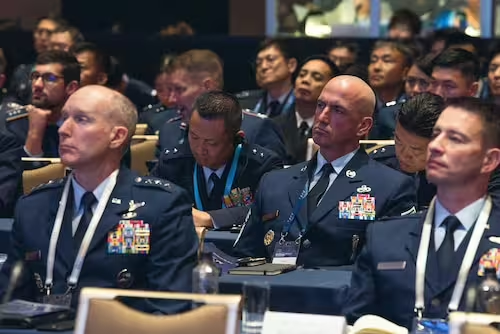
In an era marked by shifting global security dynamics, senior leaders from the United States Air Force recently participated in a high-level international forum in Tokyo, Japan, to deepen defence ties with allied nations. Hosted by the Japan Air Self-Defense Force, the Air Force Forum brought together air chiefs from over 20 nations to address shared challenges in the Indo-Pacific theatre. The discussions underscored a collective commitment to strengthening alliances, enhancing interoperability, and promoting stability through coordinated action. This engagement reflects broader strategic priorities as nations navigate complex logistics, contested environments, and the growing importance of multilateral cooperation in maintaining a free and open Indo-Pacific.
Chief of Staff of the Air Force General David W. Allvin and Chief Master Sergeant of the Air Force David Flosi represented the United States at the forum, emphasising that no single nation can effectively address contemporary security challenges in isolation. Speaking during a panel discussion, General Allvin highlighted the importance of leveraging existing partnerships to build a resilient, networked security architecture capable of deterring aggression and ensuring freedom of access to international domains. His remarks underscored the US Air Force’s ongoing commitment to the Indo-Pacific as a priority theatre outlined in the National Defense Strategy.
Chief Master Sergeant Flosi echoed this sentiment, noting that engagements such as the Air Force Forum serve to reaffirm shared values while expanding practical cooperation. He stressed that these dialogues are not merely symbolic but actively enhance the collective capacity of allied forces to respond to emerging threats. The leadership’s presence at the event signalled a deliberate effort to maintain momentum in defence partnerships, particularly with key regional actors like Japan, Canada, and France.
A central theme emerging from the forum was the critical need for true interoperability among allied forces. General Allvin pointed out that while political will and mutual trust are essential, operational effectiveness hinges on the ability of nations to seamlessly integrate systems, share information, and operate under a common framework. He identified specific barriers that must be addressed, including divergent communication protocols, policy restrictions on data exchange, and logistical complexities arising from the 'tyranny of distance' across the vast Indo-Pacific region.
When questioned about the prerequisites for a successful coalition air campaign, Allvin stated that the solution lies in the very room where the discussions were taking place – a commitment to harmonising technical systems, removing bureaucratic obstacles, and expanding real-time information sharing. He argued that achieving a common operating picture would enable allied forces to recognise threats, make decisions, and take action at the speed required in modern conflict. This focus on speed – of recognition, decision-making, and execution – was presented as a decisive advantage when nations operate as a unified entity rather than as disconnected actors.
Beyond formal sessions, General Allvin held bilateral and trilateral meetings on the sidelines of the forum, including discussions with Japan’s Minister of Defence, Gen Nakatani, and senior officials from the Philippines and Japan’s Air Self-Defense Force. These interactions highlighted a deliberate shift from traditional bilateral engagements toward more inclusive multilateral formats. Allvin described this evolution as 'real progress,' arguing that expanding the circle of partners amplifies impact and creates an asymmetric advantage over shared pacing challenges.
He further noted that the United States is not only investing in its own capabilities but also actively supporting allies and partners in their defence modernisation efforts. This reciprocal approach, he said, strengthens the overall resilience of the network and encourages regional states to deepen cooperation not just with Washington, but with each other. Such dynamics, he suggested, are vital for building a self-reinforcing cycle of trust and coordination across the Indo-Pacific.
The forum took place against a backdrop of increasing strategic competition in the Indo-Pacific, where territorial disputes, military modernisation, and grey-zone tactics have heightened tensions. General Allvin acknowledged these complexities, describing the region as the 'pacing theater' in US defence planning due to its rapid evolution and outsized influence on global stability. His second visit to the area within six months reflects the sustained attention being given to the theatre by senior US military leadership.
Discussions at the forum consistently returned to the idea that traditional approaches to security are insufficient in the face of interconnected challenges. Instead, participants advocated for adaptive, alliance-based strategies that combine technological innovation with diplomatic engagement. The emphasis on dialogue, joint exercises, and capacity-building initiatives illustrated a broader move toward preventive diplomacy and cooperative security as tools for long-term regional stability.
The participation of US Air Force leaders in the Tokyo-hosted Air Force Forum reaffirms the enduring value of international defence cooperation in an increasingly complex global landscape. By prioritising dialogue, interoperability, and multilateral engagement, senior officials are working to transform shared aspirations into tangible operational readiness. As the Indo-Pacific continues to evolve as a central arena of strategic competition, the emphasis on strengthening alliances – not just between Washington and its partners, but among the partners themselves – offers a pragmatic path toward enhanced stability. The forum’s outcomes suggest that while national capabilities remain important, it is the strength of the connections between them that may ultimately determine the region’s security trajectory.
Originally reported by miragenews.com. Adapted for our readers with AI assistance.
Keep reading
Top Stories
Since the Supreme Court overturned Roe v. Wade in 2022, the landscape of abortion rights in the United S...
Top Stories
Top Stories Tamfitronics One evening in May, nursing assistant Debra Ragoonanan’s vision blurred during her shift at a state-run Massachusetts vet...
TAMFIS NIG LTD
Electrical and instrumentation engineering, bid preparation and consulting, IT and software.