
Top Stories
KFF Health News’ ‘What the Health?’: The Supreme Court and the Abortion Pill
Since the Supreme Court overturned Roe v. Wade in 2022, the landscape of abortion rights in the United S...
TAMFIS NIG LTDRC 8067447CAC ACTIVEFinima, Bonny Island, Rivers State

Top Stories Tamfitronics
Consultants say it’s necessary to gauge how the low-emissions fuel is used.

This article is from The Spark, MIT Technology Review’s weekly climate newsletter. To receive it in your inbox every Wednesday, sign up here.
From toaster ovens that work as air fryers to hair dryers that can also curl your hair, single tools that perform multiple jobs have an undeniable charm.
In the local weather world, hydrogen is probably going to be the final multi-tool. It might maybe presumably well also additionally be historic in fuel cells or combustion engines and is mostly called the Swiss Military knife for cleaning up emissions. I’ve written about efforts to make use of hydrogen in steelmaking, automobiles, and aviation, factual to title just a few. And a fresh narrative for our most unusual print divulge explores the probability of hydrogen trains.
Hydrogen will likely be many tools in one, but some experts argue that it can’t do it all, and some uses may in fact be distractions from real progress on emissions. So let’s dig into where we might expect to see hydrogen used and where it could deliver the largest emissions cuts.
Hydrogen might play a role in cleaning up nearly every sector of the economy—in theory. The reality today is that hydrogen is more of a local climate challenge than a solution.
Most hydrogen is used in oil refining, chemical production, and heavy industry, and it is nearly completely generated using fossil fuels. In total, hydrogen production and use accounted for approximately 900 million metric tons of carbon dioxide emissions in 2022.
There are technologies available to clean up hydrogen production. But global hydrogen demand reached 95 million metric tons in 2022, and only about 0.7% of that was met with low-emissions hydrogen. (For more on various hydrogen sources and why the details matter, check out this newsletter from last year.)
Remodeling the worldwide hydrogen economic system won’t be quick or cheap, however it is going down. Annual production of low-emissions hydrogen is heading within the correct path to hit 38 million metric heaps by 2030, in accordance to the World Vitality Agency. The pipeline of most unusual projects is rising snappy, however so is hydrogen quiz, which would per chance presumably well also hit 150 million metric heaps by the stop of the decade.
Veritably each time I portray on hydrogen, whether in transportation or energy or industry, experts notify me it’s necessary to be honest about where that low-emissions hydrogen goes. There are, of direction, disagreements about what precisely the explain of priorities ought to tranquil be, however I’ve viewed just a few patterns.
First, the focus should ideally be on cleaning up the production of hydrogen we’re already using for applications like fertilizer. “The key is replacing current uses,” as Geert de Cock, energy and transport manager at the European Federation for Transport and Environment, put it when I spoke with him earlier this year for an article about hydrogen vehicles.
Beyond that, hydrogen is likely to be most useful in industries where there are no other viable alternatives currently available.
This is a central idea behind an infographic I frequently reference: the Hydrogen Ladder, developed and regularly updated by Michael Liebreich, founder of BloombergNEF. In this graphic, he ranks nearly every hydrogen application, from “essential” uses at the top to “non-competitive” ones at the bottom. His criteria include cost, practicality, and economic viability.
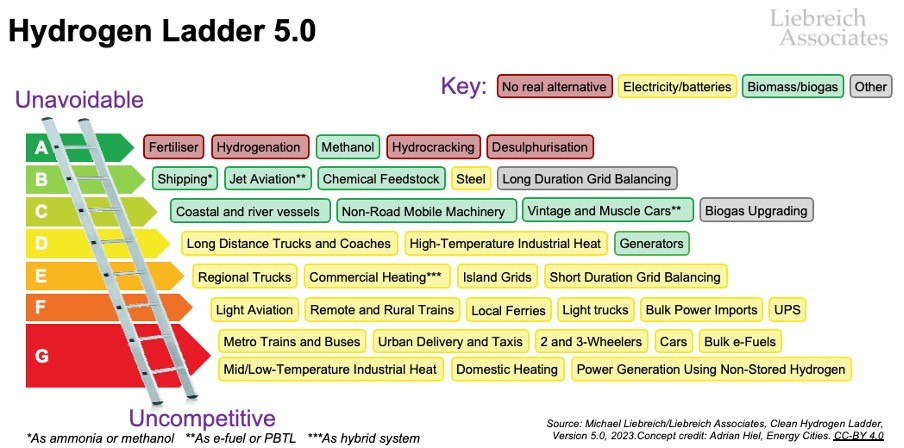
At the top of this ladder are present uses and industries where there’s no change to hydrogen. There, Liebrich agrees with most experts I’ve spoken with about hydrogen.
On the following few rungs are sectors where there’s still no dominant technical solution for cleaning up emissions, such as shipping, aviation, and steel production. You can also view these as famously “hard to abate” sectors.
Heavy industry often requires high temperatures, which have traditionally been costly to achieve with electricity. Cost and technical challenges have pushed firms to explore the use of hydrogen in processes such as steelmaking. For shipping and aviation, there are strict limits on the mass and size of the fueling system, and batteries cannot yet provide the necessary range, leaving hydrogen a plausible option.
In direction of the bottom of Liebreich’s ladder are applications where we already have clear decarbonization alternatives available as of late, making hydrogen a long shot. Rob domestic heating, as an instance. Warmth pumps are breaking through in a huge manner (we effect them on our listing of 10 Step forward Applied sciences this three hundred and sixty five days), so hydrogen has some stiff competition there.
Autos also work well at the bottom of the ladder, alongside two- and three-wheeled vehicles, since battery-powered transit is becoming increasingly common and charging infrastructure is expanding. That leaves little room for hydrogen vehicles to make an impact, at least in the near future.
I’m not ruling out hydrogen as a fuel for any single use, and there’s plenty of room to disagree on specific applications and their respective roles. But given that we now have a growing number of alternatives in our arsenal to combat climate change, I’m betting that, as a general rule, hydrogen will find its niches rather than emerge as the magic multi-tool that saves us all.
A debate over hydrogen trains reveals that cleaning up transportation is a political challenge as significant as it is a technical one. Learn more in this article by Benjamin Schneider featured in our latest issue.
The place aside hydrogen comes from matters immensely when it involves local weather impacts. Be taught more in this e-newsletter from remaining three hundred and sixty five days.
Hydrogen is losing ground in the effort to reduce emissions from vehicles, and I explored why in a story earlier this year.

R. KIKUO JOHNSON
It’s right here! The Create issue of our print journal just dropped, and it’s a great one.
Dive into this story about how man-made snowdrifts could help protect seal pups from climate change. Volunteers in Finland endured freezing temperatures to help create a habitat for endangered seals to thrive.
Or whenever you happen to’re feeling hungry, I’d suggest this gaze at how Climax Meals is the usage of machine discovering out to develop vegan cheeses that can rise up to discerning palates. (I in fact have tasted these and can attest that some of them are actually uncanny.)
Obtain the beefy divulge right here. Happy reading!
A solar boom is gripping manufacturing in the US. Tariffs and tax incentives are reshaping the solar market, but things could get tense quickly, as my colleague Zeyi Yang reported this week. (MIT Technology Review)
In a fresh op-ed, Daniele Visioni makes the case that proposals to crack down on geoengineering are misguided. He calls for more research, including open-air experiments, to make better decisions about climate interventions. (MIT Technology Review)
People have some mixed feelings about EVs. And in a recent survey, fewer than half of US adults said they think EVs are better for the climate than gasoline-powered ones. (Sustainability by numbers)
An Australian provider of fast charging equipment for EVs is in financial distress. Tritium told regulators that it’s insolvent, and it’s unclear whether the company will be able to fulfill orders or service existing chargers. (Canary Media)
Offshore wind has faced its dazzling fragment of challenges, however the loss of life of a mega-turbine might maybe presumably well also have played a indispensable role. GE Vernova canceled plans for a 18-megawatt machine, inflicting ripples that ended in Novel York’s pass to murder contracts for 3 huge projects remaining week. (E&E Recordsdata)
The UK’s closing coal vitality online page is place aside to terminate within the three hundred and sixty five days. Here’s a stare upon the leisure blueprint generating what historic to be the country’s fundamental source of energy. (The Guardian)
Is it time to retire the term “honest energy”? The term is a convenient manner to roll up energy sources that decrease emissions, love renewables and nuclear vitality, however some argue that it glosses over environmental harms. (Internal Native weather Recordsdata)
California noticed batteries change into the single biggest source of vitality on the grid one night remaining week—a indispensable 2nd for energy storage. (Heatmap Recordsdata)
Originally reported by technologyreview.com. Adapted for our readers.
Keep reading
Top Stories
Since the Supreme Court overturned Roe v. Wade in 2022, the landscape of abortion rights in the United S...
Top Stories
Top Stories Tamfitronics One evening in May, nursing assistant Debra Ragoonanan’s vision blurred during her shift at a state-run Massachusetts vet...
Top Stories
2:54 PM Saudi Arabia shouldn’t be part of Iran-U.S. war, Turkish foreign minister says Turkish Foreign Minister Hakan Fidan spoke out Saturday about…
TAMFIS NIG LTD
Electrical and instrumentation engineering, bid preparation and consulting, IT and software.