
Top Stories
Discovery beneath soccer field reveals massive medieval convent lost for centuries
NEWYou can now listen to Fox News articles! Researchers recently uncovered a long-lost medieval convent in an unusual location in Denmark: a soccer field…
TAMFIS NIG LTDRC 8067447CAC ACTIVEFinima, Bonny Island, Rivers State

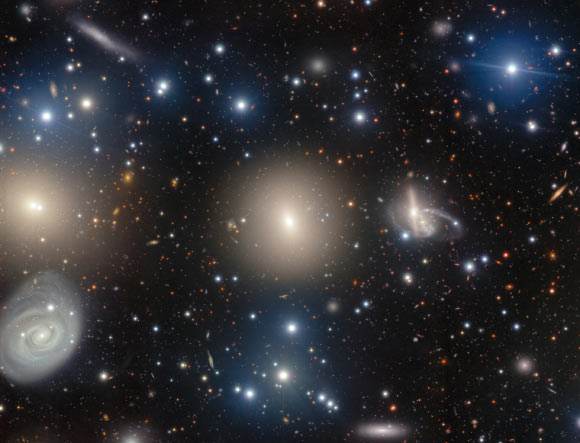
The Gemini North telescope, equipped with the Gemini Multi-Object Spectrograph (GMOS), has recently focused its powerful optics on NGC 1270, a giant elliptical galaxy situated in the heart of the immense Perseus galaxy cluster. Located approximately 240 million light-years away in the constellation Perseus, this galaxy cluster contains thousands of galaxies bound together by gravity. The detailed observations of NGC 1270 provide astronomers with valuable insights into the formation and evolution of massive galaxies, the dynamics within galaxy clusters, and the role of dark matter in shaping cosmic structures.
The Perseus cluster is one of the most massive and studied galaxy clusters in the nearby universe. It contains thousands of galaxies, hot intracluster gas emitting X-rays, and a vast amount of dark matter that binds the cluster gravitationally. Its proximity at roughly 240 million light-years makes it an ideal laboratory for understanding galaxy cluster physics and large-scale cosmic structures.
Clusters like Perseus form at the intersections of the cosmic web, where dark matter filaments converge. The gravitational pull of this dark matter scaffolding draws in galaxies and gas, creating dense environments where galaxies interact and evolve differently compared to isolated systems.
Studying the Perseus cluster allows astronomers to observe environmental effects on galaxies, such as ram-pressure stripping, galaxy mergers, and the influence of supermassive black holes. These processes contribute to the growth of giant elliptical galaxies like NGC 1270, which dominate cluster centers.
NGC 1270 is an elliptical galaxy located near the center of the Perseus cluster. Discovered in 1863 by German astronomer Heinrich d’Arrest, it is also known by catalog names such as LEDA 12350 and UGC 2660. With an estimated age of around 11 billion years, NGC 1270 is a relic from the early universe, representing one of the oldest and most massive galaxies in the cluster.
Elliptical galaxies like NGC 1270 are characterized by their smooth, featureless light profiles and lack of significant star formation. They contain predominantly old stars and are often the product of multiple galaxy mergers. NGC 1270’s size and structure provide clues about the hierarchical assembly of galaxies over cosmic time.
Recent observations with the Gemini North telescope have revealed detailed features of NGC 1270’s stellar population and central region. Of particular interest is evidence suggesting the presence of a supermassive black hole actively accreting material, contributing to the galaxy’s energetic output.
The Gemini Multi-Object Spectrograph (GMOS) on the Gemini North telescope is a powerful instrument designed to capture high-resolution images and spectra of astronomical objects. Its ability to observe multiple targets simultaneously makes it ideal for studying dense galaxy clusters like Perseus.
GMOS provides detailed spectroscopic data that help astronomers analyze the motion, composition, and age of stars within galaxies. For NGC 1270, this data reveals the velocity dispersion of stars, indicating the galaxy’s mass distribution and offering indirect evidence for the size of its central black hole.
The imaging capabilities of GMOS also allow for the detection of faint structures such as tidal tails or shells, remnants of past galactic mergers. These features offer a window into the galaxy’s evolutionary history and its interaction with the cluster environment.
When Heinrich d’Arrest discovered NGC 1270 in 1863, the nature of such “nebulae” was hotly debated. Many astronomers believed these fuzzy objects were simply clouds within our own Milky Way. The concept that these were separate galaxies, or “island universes,” was not widely accepted at the time.
The Great Debate of 1920 between Heber Curtis and Harlow Shapley epitomized this uncertainty, with each scientist arguing different views about the scale of the universe and the nature of spiral nebulae. It was not until Edwin Hubble’s observations in 1924 that these objects were definitively proven to be distant galaxies beyond the Milky Way.
NGC 1270 and its peers in the Perseus cluster are now understood as fundamental components of the large-scale structure of the universe. Their study helps trace the expansion and evolution of the cosmos over billions of years.
One of the intriguing aspects of NGC 1270 is the presence of a supermassive black hole at its core. Observations indicate that this black hole is actively accreting material, creating a bright accretion disk and emitting powerful electromagnetic radiation detectable across multiple wavelengths.
Such active galactic nuclei (AGN) are found in roughly 10% of galaxies and play a crucial role in regulating star formation and galaxy evolution. The energy output from the central black hole can heat surrounding gas, preventing it from cooling and collapsing into new stars, thereby influencing the galaxy’s lifecycle.
Studying the AGN in NGC 1270 also provides valuable information about the relationship between black hole growth and the environment of dense galaxy clusters. This interaction is key to understanding feedback processes that shape massive galaxies.
The existence of galaxy clusters like Perseus poses a significant question: what holds thousands of galaxies together on such vast scales? The answer lies largely in dark matter, an invisible form of matter that exerts gravitational influence but does not emit or absorb light.
Dark matter forms a cosmic web of filaments that guide galaxy formation and clustering. Without this unseen mass, galaxies would be scattered sparsely rather than congregated in dense clusters. The gravitational pull of dark matter halos is essential for the stability of clusters over billions of years.
Despite its importance, the nature of dark matter remains one of the greatest mysteries in modern astrophysics. Observations of clusters like Perseus, combined with simulations, help constrain the properties of dark matter and its role in cosmic evolution.
Technological progress in telescopes and imaging instruments like GMOS has revolutionized our ability to study distant galaxies in exquisite detail. High-resolution imaging enables astronomers to resolve fine structures and faint features previously undetectable.
These advances have transformed our understanding of galaxy formation, cluster dynamics, and the large-scale structure of the universe. They also allow for precise measurements of stellar populations, chemical compositions, and dynamical states within galaxies like NGC 1270.
As imaging techniques continue to improve, future observations will provide even deeper insights into the complex interplay between galaxies, dark matter, and black holes, pushing the boundaries of our cosmic knowledge.
The Gemini North telescope’s observations of NGC 1270 within the Perseus cluster exemplify the power of modern astronomical instruments to unravel the complexities of the universe. By studying this giant elliptical galaxy and its environment, astronomers gain crucial insights into galaxy evolution, the role of supermassive black holes, and the pervasive influence of dark matter. As technology advances, continued exploration of such cosmic structures promises to illuminate the mysteries of our vast and dynamic cosmos, enriching our understanding of the universe’s past, present, and future.
Originally reported by sci.news. Adapted for our readers.
Keep reading
Top Stories
NEWYou can now listen to Fox News articles! Researchers recently uncovered a long-lost medieval convent in an unusual location in Denmark: a soccer field…
News
By Engr. Tamunofiniarisa BrownReading Time: 6 Minutes The conflict between Russia and Ukraine is often framed in the media as a simple battle between…
TAMFIS NIG LTD
Electrical and instrumentation engineering, bid preparation and consulting, IT and software.