
News
RUSSIA versus NATO and BRICS vs. NATO Military SWOT
Recall that Poland’s Minister Sikorski’s core claim is partially supported by the numbers, but the framing “quite quickly” and “without the U.S.” does not…
TAMFIS NIG LTDRC 8067447CAC ACTIVEFinima, Bonny Island, Rivers State

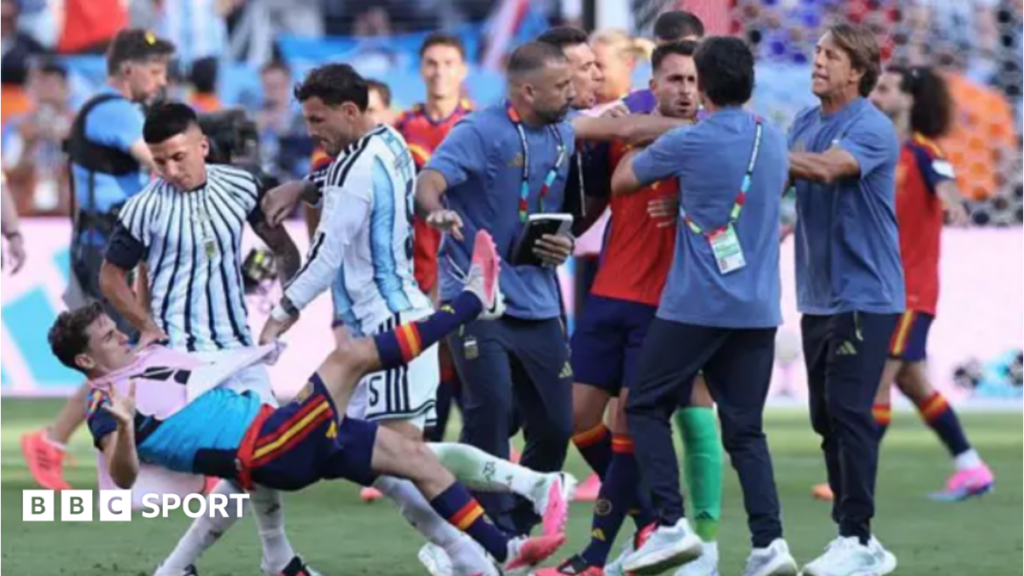
The 2022 FIFA World Cup final between Spain and Argentina ended not only with a narrow 1-0 victory for Spain but also with a contentious altercation involving players and staff from both teams. Central to the post-match fracas was Argentina's Leandro Paredes, whose actions on the pitch have sparked debate over potential disciplinary measures. Spain's young midfielder Gavi has publicly stated his belief that Paredes should not face suspension, providing a perspective that highlights the physical intensity inherent in football. This article examines the incident, the disciplinary context, and the broader implications for sportsmanship and football regulations.
The tension following the World Cup final escalated into a physical confrontation involving several Argentina players and staff, including Leandro Paredes, Nahuel Molina, Thiago Almada, and assistant coach Roberto Ayala. The incident unfolded as Spain celebrated their 1-0 victory, with emotions running high on both sides.
Paredes was seen pushing Spain's Eric Garcia by the throat, an action that drew immediate attention. In an attempt to intervene, Spain's unused substitute Gavi approached the scene but was pushed to the ground by Almada. Subsequently, Paredes pushed Gavi to the turf by placing his hand in the Spaniard's face, intensifying the altercation.
This confrontation was captured on video and widely circulated, prompting FIFA to appoint a disciplinary and ethics prosecutor to investigate the events and determine if any sanctions were warranted.
Initially, FIFA's commentator information system erroneously indicated that Paredes had been sent off by referee Slavko Vincic for his aggressive behavior towards Garcia. However, this red card notification was promptly removed, and FIFA confirmed that no disciplinary action was taken against Paredes during the match.
The only player dismissed during the final was Argentina's Enzo Fernandez, who received a second yellow card in added time of the second half. The absence of an immediate red card for Paredes has fueled debate about whether the referee’s decisions adequately addressed the incident.
FIFA’s appointment of a disciplinary and ethics prosecutor signals the organization's intent to thoroughly examine the post-match events. Potential outcomes include suspensions for involved players or fines for the Argentine Football Association, depending on the findings.
In an interview with El Partidazo de COPE, Gavi expressed his view that Paredes should not be suspended for his role in the fracas. He acknowledged that the incident might not present a good image for children but emphasized that football inherently involves physicality and aggression.
Gavi suggested that the most appropriate moment to address Paredes’ conduct would have been during the match itself, through an immediate red card if warranted. Since this did not occur, he argued that the incident should be considered part of the game’s competitive nature.
This stance reflects a broader debate within football regarding the balance between maintaining discipline and recognizing the sport’s intense emotional and physical demands. Gavi’s comments highlight the complexity of adjudicating incidents that occur in the heat of high-stakes matches.
The post-final altercation raises important questions about how football’s governing bodies manage player conduct, especially in emotionally charged moments. While physicality is a recognized aspect of the sport, actions that cross into aggression or violence challenge the principles of sportsmanship and fair play.
FIFA’s disciplinary process aims to uphold these principles by investigating incidents thoroughly and imposing sanctions when necessary. However, the incident involving Paredes illustrates the difficulties referees face in real-time decision-making and the need for post-match reviews to ensure accountability.
Moreover, the incident underscores the role of players and coaching staff in setting behavioral standards. The involvement of multiple individuals from Argentina’s team suggests a broader issue of managing emotions and maintaining professionalism during critical moments.
Media reports initially miscommunicated the disciplinary status of Paredes, which may have influenced public perception of the incident. The correction by FIFA clarified that Paredes was not sent off during the match, but the controversy remained a topic of discussion among fans and analysts.
Public reactions have been mixed, with some condemning Paredes’ actions as unsportsmanlike and others, like Gavi, advocating for a more nuanced understanding of the incident within the context of competitive football.
This divergence highlights the challenges in balancing emotional responses with objective assessments of player behavior, particularly in high-profile matches that attract global attention.
The post-match confrontation involving Leandro Paredes and Spain’s players after the World Cup final has sparked debate over the appropriate disciplinary response in football’s most intense moments. While the physicality and aggression inherent in the sport are undeniable, maintaining respect and sportsmanship remains crucial. Gavi’s defense of Paredes underscores the complexity of adjudicating such incidents, where emotions run high and split-second decisions by referees are critical. As FIFA’s investigation proceeds, the football community awaits clarity on how these challenges will be addressed to preserve the integrity of the game while recognizing its passionate nature.
Editor’s note: The following is AI-generated commentary and context on this topic, not original reporting.
Confrontations in the tunnel or immediately after a final whistle are not new to elite football, particularly in matches carrying the weight of a World Cup final. The adrenaline of a title decided by fine margins, combined with players and staff who have spent weeks in close proximity under intense pressure, creates conditions where tempers can flare even among professionals with long records of composure. Governing bodies such as FIFA typically review video evidence, referee reports, and witness statements before deciding whether to open disciplinary proceedings, a process that can take days or weeks depending on the complexity of the incident.
Public comments from players on opposing teams, such as the show of support described above, often carry symbolic weight beyond the specific incident. They can signal to disciplinary panels that the football community views an episode as part of the heat of competition rather than a premeditated act, though such statements are not binding on any formal inquiry. Regardless of the outcome, incidents like this tend to renew broader conversations about how sporting bodies balance passion and sportsmanship, especially in matches with the global visibility of a World Cup final.
Originally reported by bbc.co.uk. Adapted for our readers with AI assistance.
Keep reading
News
Recall that Poland’s Minister Sikorski’s core claim is partially supported by the numbers, but the framing “quite quickly” and “without the U.S.” does not…
News
Thousands of young protesters in Delhi continue to demand education reforms and the resignation of Education Minister Dharmendra Pradhan after a police crackdown. The…
News
Facing a looming financial collapse, Thames Water’s main lenders have offered the UK government a ‘golden share’ and increased local authority involvement to avoid…
TAMFIS NIG LTD
Electrical and instrumentation engineering, bid preparation and consulting, IT and software.