Business
Nigeria’s Economic Performance: Domestic Debt Rise and Agriculture Trade Shift in Q2 2026
Nigeria's economic landscape in the second quarter of 2026 presents a mixed picture of fiscal press...
TAMFIS NIG LTDRC 8067447CAC ACTIVEFinima, Bonny Island, Rivers State

The 2026 FIFA World Cup delivered a rollercoaster of emotions for England and their global supporters, with few figures embodying the tournament’s highs and lows as vividly as Sir David Beckham. Once England’s captain and now a global football ambassador, Beckham’s presence in the stands throughout the campaign offered a poignant reminder of his lasting ties to the sport and his country. His reactions—ranging from jubilant celebrations to visible despair—were mirrored by millions of fans, while his family’s involvement added a deeply personal dimension to the narrative. This article explores Beckham’s journey through the tournament, historical ties to England’s World Cup story, and the broader significance of his role as a cultural and business icon in modern football.
Throughout England’s 2026 World Cup campaign, Sir David Beckham was a constant and highly visible presence in the stands, often captured on broadcast footage celebrating goals, key saves and pivotal moments with unmistakable enthusiasm. His attendance was not solitary; he was frequently accompanied by his wife, Victoria Beckham, and three of their children, underscoring the tournament’s importance as a family occasion as much as a sporting event. Beckham’s expressive reactions stood in contrast to those of Victoria, whose more restrained celebrations occasionally drew attention on social media, sparking lighthearted commentary and memes. In response, Beckham took to Instagram to playfully reassure fans that Victoria was indeed celebrating England’s progress, albeit in her own measured way. This exchange highlighted the couple’s shared emotional investment in the team’s fortunes, even as their outward expressions differed.
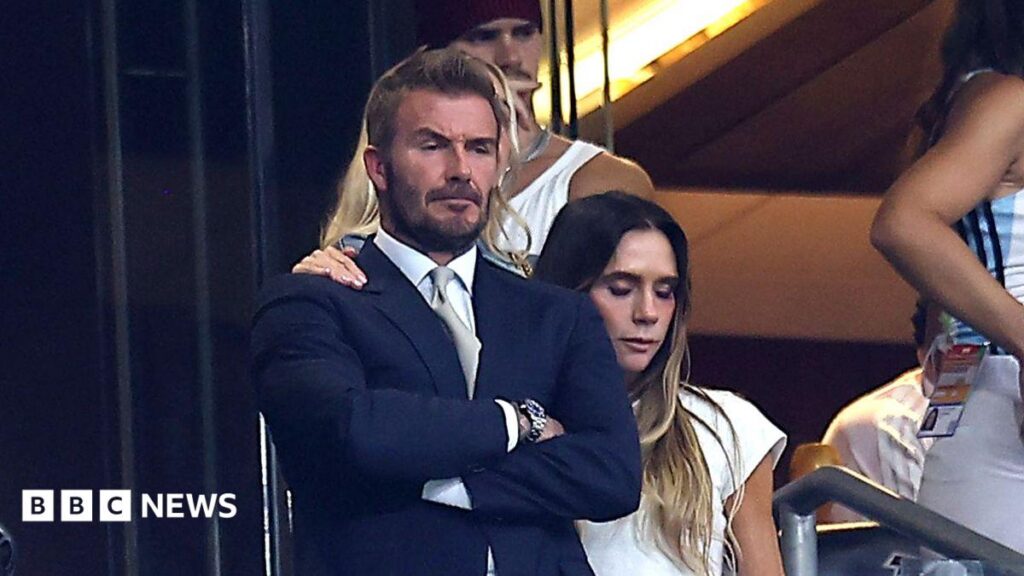
England’s journey ended in the semi-finals with a narrow loss to Argentina in Atlanta, a moment that provoked a deeply human reaction from Beckham. As the final whistle blew, cameras showed him cradling his head in his hands, visibly overcome with disappointment, while Victoria Beckham offered comfort beside him. The image of the former captain in tears resonated strongly with fans worldwide, many of whom saw their own frustrations reflected in his anguish. Following the match, Beckham turned to social media to process the outcome, posting a heartfelt message on Instagram that acknowledged the heartbreak while expressing pride in the team’s efforts and gratitude for the memories created during the campaign. His words struck a balance between disappointment and perspective, emphasising that pride in performance can coexist with the pain of falling short.
Beckham’s emotional response to the semi-final defeat was intensified by the historical weight of England’s encounters with Argentina, a rivalry that has defined parts of his own international career. He represented England in three World Cups—1998, 2002 and 2006—captaining the side in the latter two. His 1998 tournament was infamously marked by a red card against Diego Simeone in the match against Argentina, an incident that subjected him to intense media scrutiny and public backlash. Four years later, in 2002, Beckham helped secure a group-stage victory over Argentina, a moment widely seen as a form of redemption. The 2026 semi-final added another layer to this narrative, as Argentina’s squad included Giuliano Simeone, the son of Diego Simeone, linking past and present in a poignant twist. Beyond his playing days, Beckham’s ongoing involvement in football—particularly through his ownership stake in Inter Miami, the US club that signed Lionel Messi in 2023—continues to tie him to the evolving story of the sport on a global stage.
Victoria Beckham’s presence at matches throughout the tournament also drew attention, reflecting her own transformation from pop culture figure to fashion entrepreneur and committed supporter of her husband’s endeavours. When she first met David Beckham in 1997, she was not known as a football enthusiast, but over the years she has become a regular and visible figure at England matches, often seen offering encouragement from the stands. Her relatively subdued reactions during certain moments—such as Jude Bellingham’s extra-time goal against Norway—were noted by online commentators and turned into memes, yet they also underscored a broader truth about fandom: passion manifests in many ways. While David’s celebrations were overt and effusive, Victoria’s support was expressed through steady, quiet presence. Together, their differing styles illustrated how families experience sport not as a monolithic emotional event, but as a shared journey marked by individual expressions of care and pride.
Sir David Beckham’s influence extends far beyond his achievements as a footballer. Knighted in November 2025 for his services to football and British society, he became the United Kingdom’s first billionaire sportsman, a testament to the success of his ventures off the pitch, including his involvement with Inter Miami and various global business partnerships. His profile has grown significantly in the United States, particularly in the wake of the 2026 World Cup, which was hosted across North America. Through his role with Inter Miami and his association with high-profile figures like Lionel Messi, Beckham has helped position himself as a promoter of football’s growth in the American market. Additional honours, such as his star on the Hollywood Walk of Fame, reflect his crossover appeal as a figure who blends sporting excellence with celebrity, philanthropy and business acumen. His journey from a young footballer in Leytonstone to a global ambassador for the sport exemplifies how athletes can leverage their platforms to shape culture, inspire communities and drive economic opportunity long after retiring from competitive play.
Sir David Beckham’s journey through England’s 2026 World Cup campaign was more than a celebrity’s sideline appearance—it was a vivid illustration of the deep emotional bonds that football can forge between individuals, families and nations. His tears in Atlanta, his joyous celebrations in earlier rounds and his dignified response to defeat all spoke to a man for whom the sport remains deeply personal, even decades after retiring from international duty. Alongside Victoria, he embodied the modern football family: supportive, invested and authentically human in their reactions. Beyond the emotional resonance, Beckham’s ongoing influence as a businessman, cultural figure and ambassador for the sport—especially in growing football’s footprint in the United States—demonstrates how athletes can evolve into multidimensional forces for good. As England looks ahead to future tournaments, Beckham’s story serves as a reminder that football’s power lies not only in goals and trophies, but in its ability to unite generations, stir profound feeling and inspire lasting legacy.
Originally reported by bbc.co.uk. Adapted for our readers with AI assistance.
Keep reading
Business
Nigeria's economic landscape in the second quarter of 2026 presents a mixed picture of fiscal press...
Business
Liverpool manager Andoni Iraola is confronting a significant selection headache as two key forwards, Cod...
News
Health News tamfitronics [Editor’snote:[Editor’snote: This transcript was generated using both transcription ...
TAMFIS NIG LTD
Electrical and instrumentation engineering, bid preparation and consulting, IT and software.