NASA probe expected to make history with closest approach to the sun
In an extraordinary feat of space exploration, NASA's Parker Solar Probe is on track to make the closest approach to the Sun ever achieved by a human-made object. Launched in 2018, this pioneering spacecraft is designed to endure extreme temperatures and radiation as it ventures into the Sun’s outer atmosphere, or corona. Its mission promises to shed light on long-standing scientific questions about solar phenomena, including the heating of the corona and acceleration of solar wind. As the probe hurtles towards the Sun at blistering speeds, scientists eagerly await data that could revolutionize our understanding of solar physics and space weather impacts on Earth.
The Parker Solar Probe: A Mission Like No Other
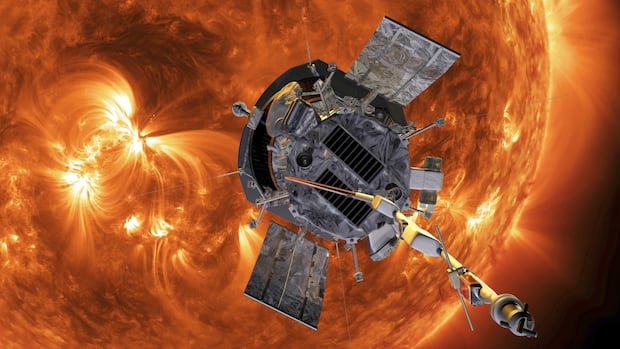
The Parker Solar Probe represents a landmark mission in heliophysics, tasked with exploring the Sun’s atmosphere closer than any spacecraft before it. Launched on August 12, 2018, from Kennedy Space Center, the probe was designed to withstand extreme heat and radiation while gathering detailed data about the solar environment.
Equipped with a revolutionary heat shield made from a carbon-composite material just over 11 centimeters thick, the probe can endure temperatures nearing 1,377 degrees Celsius. This protective barrier enables the spacecraft’s sensitive instruments to function despite the harsh conditions near the Sun.
By traveling into the Sun’s corona—the outermost layer of its atmosphere visible during total solar eclipses—the Parker Solar Probe aims to answer fundamental questions about solar activity that have eluded scientists for decades. Its mission will extend through multiple close passes, collecting invaluable data at each perihelion.
Breaking Records: Closest Approach and Unprecedented Speed
On its latest perihelion, the Parker Solar Probe is expected to reach within approximately 6.1 million kilometers of the Sun’s surface, setting a new record for proximity. To put this in perspective, Earth's average distance from the Sun is about 150 million kilometers, making this approach roughly 25 times closer than our planet’s orbit.
Traveling at an astonishing speed of nearly 700,000 kilometers per hour, the probe moves fast enough to cover the distance between Toronto and Vancouver in just 17 seconds. This velocity allows it to quickly traverse the Sun’s intense environment while collecting real-time data.
Such close proximity and rapid movement present extraordinary challenges not only for the spacecraft’s engineering but also for mission control, as communication blackout periods occur when the probe is engulfed in solar interference. NASA anticipates re-establishing contact days after each close pass to retrieve the stored scientific data.
Scientific Goals: Unraveling the Mysteries of the Solar Corona
One of the Parker Solar Probe’s primary objectives is to investigate why the Sun’s corona is significantly hotter than its surface. Unlike the roughly 5,500 degrees Celsius surface, the corona reaches temperatures of several million degrees, a paradox that has puzzled scientists for decades.
By sampling particles and magnetic fields in the corona directly, the probe aims to identify mechanisms responsible for this extreme heating. Understanding these processes could illuminate fundamental physics related to plasma behavior and magnetic reconnection.
Additionally, the mission seeks to clarify how the solar wind—a continuous stream of charged particles emitted by the Sun—is accelerated to supersonic speeds. These particles influence space weather, which can disrupt satellite communications and power grids on Earth.
Technological Innovations Enabling the Mission
The Parker Solar Probe’s success hinges on advanced technologies that protect it from intense heat and radiation. Its heat shield, known as the Thermal Protection System (TPS), is composed of carbon-carbon composite with a white ceramic coating to reflect sunlight, maintaining instrument temperatures near room temperature.
The spacecraft’s instruments are mounted behind the shield, enabling precise measurements of electric and magnetic fields, plasma waves, and high-energy particles. These instruments are designed to operate reliably despite the extreme conditions.
Furthermore, the probe employs autonomous systems to manage navigation and data collection during periods when direct communication with Earth is impossible. This autonomy ensures mission continuity despite solar interference and communication delays.
Challenges and Risks of Solar Proximity
Approaching the Sun so closely exposes the Parker Solar Probe to intense heat, radiation, and high-velocity particle bombardment, all of which pose significant risks to spacecraft integrity. The mission team carefully monitors the probe’s health, awaiting confirmation after each close pass that it has survived unscathed.
Communication blackouts occur when the probe is near perihelion due to solar radio emissions interfering with signals. NASA must wait several days after each approach to re-establish contact, making the mission a tense waiting game for scientists and engineers.
Despite these challenges, the probe’s engineering excellence and robust design have enabled it to repeatedly survive these extreme conditions, paving the way for unprecedented scientific discoveries.
Implications for Space Weather and Earth’s Safety
Data from the Parker Solar Probe will enhance our understanding of space weather—phenomena caused by solar activity that can affect Earth’s magnetic environment. Solar storms can disrupt satellite operations, navigation systems, and power grids, posing risks to modern infrastructure.
By analyzing solar wind properties and magnetic fields close to their source, scientists aim to improve space weather forecasting models. Better predictions will allow for timely alerts and protective measures to safeguard technology and astronauts in space.
This knowledge is crucial not only for Earth’s safety but also for future crewed missions to the Moon, Mars, and beyond, where exposure to solar radiation presents significant hazards.
Broader Impact on Astrophysics and Stellar Studies
Beyond our solar system, insights gained from the Parker Solar Probe will inform the study of other stars and their planetary systems. Understanding the dynamics of solar wind and corona heating in our Sun provides a template for interpreting stellar phenomena across the galaxy.
The mission’s findings contribute to astrophysics by improving models of stellar atmospheres, magnetic activity, and plasma interactions. These models are essential for exploring star formation, evolution, and the habitability of exoplanets.
Ultimately, the Parker Solar Probe helps place our Sun in a broader cosmic context, deepening humanity’s knowledge of the universe and our place within it.
Looking Ahead: The Future of Solar Exploration
The Parker Solar Probe’s mission is slated to continue with multiple close passes until at least 2025, gradually approaching even closer to the Sun. Each perihelion promises new data and insights as the spacecraft pushes the boundaries of human exploration.
Future missions may build on Parker’s achievements, deploying advanced instruments and possibly sending probes into even more extreme solar environments. These endeavors will further unravel the complexities of solar physics.
As technology advances, combined with the data from Parker, humanity moves closer to fully understanding our star’s behavior, its impact on the solar system, and the fundamental processes powering stars throughout the universe.
Conclusion
NASA’s Parker Solar Probe stands as a testament to human ingenuity and the relentless pursuit of knowledge. By venturing closer to the Sun than ever before, it is poised to unlock secrets that have long eluded scientists, from the enigmatic heating of the solar corona to the dynamics of the solar wind. The data it returns will not only safeguard our technological civilization from space weather hazards but also enrich our understanding of stellar physics across the universe. As we await the probe’s continued discoveries, the mission inspires awe and anticipation for the future of solar exploration and the profound insights yet to come.
Originally reported by cbc.ca. Adapted for our readers.
Recent advances in machine perfusion technology are not only preserving donated livers but also making them biologically younger at a molecular level. This breakthrough…
What happens when human imagination, artificial intelligence, art and technology come together? From September 1 to 6, Samsung Electronics presented a special exhibition themed…