Need to store a tractor, four-wheel or other outdoor country gear? Perhaps your boat, RV or snowmobiles needs an off-season home? How about a spacious workshop? Something generically called fabric structures are worth considering. They’re made by a handful of companies, it’s a mature technology that’s been around since the early 1990s, and I’m putting one up now. This approach offers unique advantages over a regular frame building, as I’ve discovered.

THIS CONTENT IS RESERVED FOR SUBSCRIBERS ONLY
Subscribe now to read the latest news in your city and across Canada.
- Exclusive articles from Elizabeth Payne, David Pugliese, Andrew Duffy, Bruce Deachman and others. Plus, food reviews and event listings in the weekly newsletter, Ottawa, Out of Office.
- Unlimited online access to Ottawa Citizen and 15 news sites with one account.
- Ottawa Citizen ePaper, an electronic replica of the print edition to view on any device, share and comment on.
- Daily puzzles, including the New York Times Crossword.
- Support local journalism.
SUBSCRIBE TO UNLOCK MORE ARTICLES
Subscribe now to read the latest news in your city and across Canada.
- Exclusive articles from Elizabeth Payne, David Pugliese, Andrew Duffy, Bruce Deachman and others. Plus, food reviews and event listings in the weekly newsletter, Ottawa, Out of Office.
- Unlimited online access to Ottawa Citizen and 15 news sites with one account.
- Ottawa Citizen ePaper, an electronic replica of the print edition to view on any device, share and comment on.
- Daily puzzles, including the New York Times Crossword.
- Support local journalism.
REGISTER / SIGN IN TO UNLOCK MORE ARTICLES
Create an account or sign in to continue with your reading experience.
- Access articles from across Canada with one account.
- Share your thoughts and join the conversation in the comments.
- Enjoy additional articles per month.
- Get email updates from your favourite authors.
THIS ARTICLE IS FREE TO READ REGISTER TO UNLOCK.
Create an account or sign in to continue with your reading experience.
- Access articles from across Canada with one account
- Share your thoughts and join the conversation in the comments
- Enjoy additional articles per month
- Get email updates from your favourite authors
Sign In or Create an Account
or
Article content
Article content
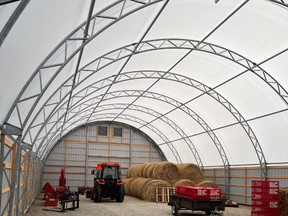
Fabric structures have a permanent and rust-proof metal frame that supports a thick tarp under tension. This option comes in different sizes and qualities, and this quality difference is important. Small, consumer-level fabric structures from big box stores can be weak and short-lived, and that’s why some people have bad experiences with them. A few years ago I helped a neighbour prop up a small bargain basement shelter he was using as a garage until snow made it collapse. But the kind of structures I’m tell you about here are entirely different. The best are engineered for a specific site, they’re permanent (though can be moved) and will last indefinitely with replacement covers. Ongoing costs for maintenance and upkeep are considerably less than a conventional frame building too, as I’ll show you.
Article content
Article content
Faster, easier, more economical
Article content
Article content
I opted for a 42×80-foot Canadian-made structure built by a company called Calhoun Superstructures in Tara, Ont. They’ve been in business since 1992, they’re one of the pioneers of this industry, and the 11,000-lbs package was delivered to my place on a flat-bed trailer pulled by a pickup truck. The structure was custom engineered for wind and snow loads on my site, and we got the parts unloaded in less than an hour using a tractor with pallet forks. Building widths as narrow as 16 feet are available, with lengths as long as you want. The largest I’ve heard of is 52×612 feet long, and is used for sand and salt storage in Windsor, Ont.
Article content
Article content
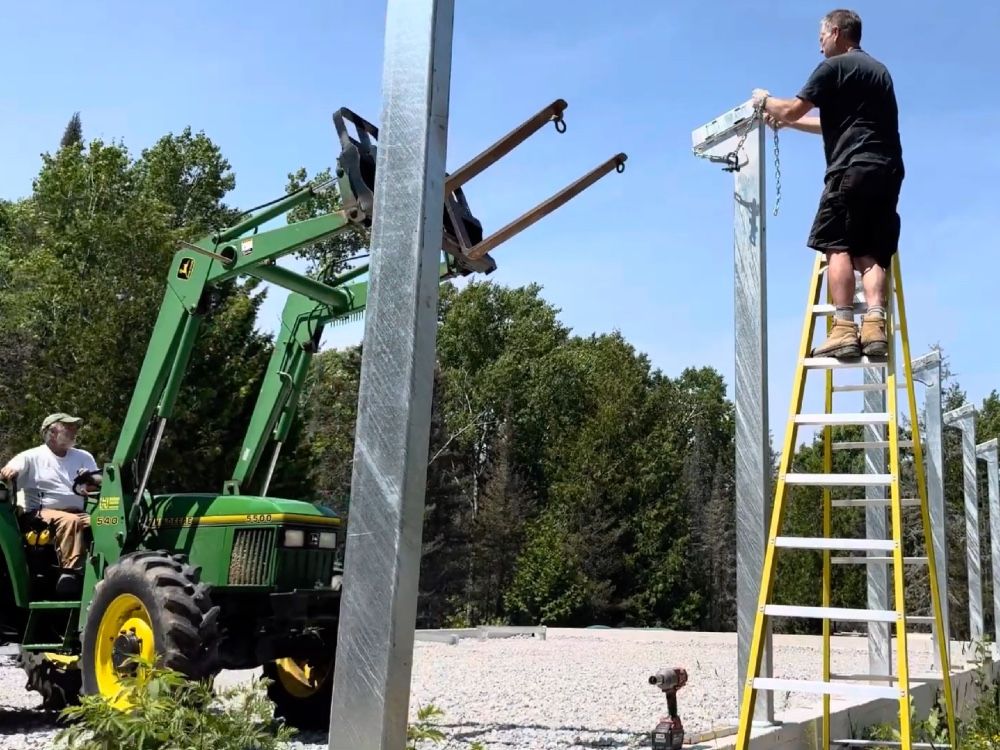
I’m told that half the people buying structures like mine have a contractor put them up. Even though I’ve never build anything like this before, I’m finding construction simple, though the work does required some kind of equipment to raise parts. A tractor with loader works well for putting up the legs (I did this job with a helper in less than a day), and I’ll bring in a small crane for raising the curved trusses that form the roof structure. Pulling the tarp over the completed frame is quick work for about four people once ropes and pulleys are in place. Cost for my building is around $15 per square foot including a concrete foundation, compared with a conventional storage building that cost $25 per square foot and up.
Leave a Reply
You must be logged in to post a comment.