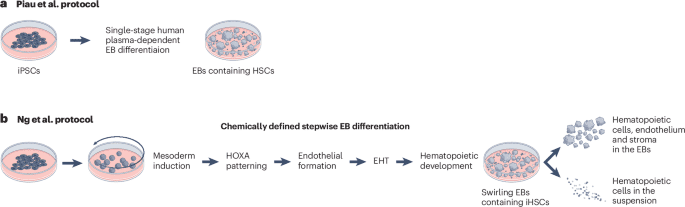
Hematopoietic stem cells (HSCs) are the cornerstone of the blood system, responsible for the lifelong production of all blood cell types. Their unique ability to self-renew and differentiate into multiple lineages makes them invaluable for treating hematological disorders. Despite their clinical importance, generating fully functional, engraftable HSCs from human pluripotent stem cells (hPSCs) has remained a significant challenge. Recent breakthroughs, informed by developmental biology, have illuminated the pathways and signaling cues that govern HSC emergence during embryogenesis. This knowledge has paved the way for innovative differentiation protocols that mimic natural development, offering hope for scalable HSC production without genetic modification. This comprehensive article explores the developmental route to HSCs, the molecular mechanisms involved, and the cutting-edge methodologies that bring us closer to clinical translation.
Embryonic Origins of Hematopoietic Stem Cells
Hematopoietic stem cells originate during embryogenesis through a tightly regulated process involving multiple anatomical sites. The earliest hematopoietic activity emerges in the yolk sac, producing primitive blood cells essential for early embryo survival. However, these primitive cells lack long-term repopulating capacity.
The definitive HSCs capable of lifelong hematopoiesis arise later in the aorta-gonad-mesonephros (AGM) region. Here, specialized endothelial cells known as hemogenic endothelium undergo endothelial-to-hematopoietic transition (EHT), giving rise to HSCs. This process is tightly controlled by signaling pathways such as Notch, Wnt, and BMP.
Following their emergence in the AGM, HSCs migrate to the fetal liver, where they expand and mature before colonizing the bone marrow. Understanding these embryonic stages is crucial for replicating HSC development in vitro and generating clinically relevant cells.
Molecular Signaling Pathways Governing HSC Development
The generation of HSCs is orchestrated by a complex interplay of signaling pathways that regulate cell fate decisions. Notch signaling plays a pivotal role in specifying hemogenic endothelium and promoting EHT. Activation of Notch receptors triggers transcriptional programs essential for HSC emergence.
Wnt signaling is another critical pathway influencing HSC development. Canonical Wnt activation supports the proliferation and maintenance of emerging HSCs, while its modulation ensures proper differentiation timing. BMP signaling also contributes by regulating mesoderm patterning and hemogenic endothelial specification.
In addition, transcription factors such as Runx1, Gata2, and Scl/Tal1 integrate these signaling cues to drive hematopoietic gene expression. Dissecting these molecular networks has informed the design of differentiation protocols that mimic embryonic HSC formation.
Human Pluripotent Stem Cells as a Source for HSCs
Human pluripotent stem cells, including embryonic stem cells and induced pluripotent stem cells, offer an unlimited source for generating HSCs. Their capacity to differentiate into any cell type makes them ideal candidates for in vitro hematopoiesis modeling and therapeutic applications.
However, directing hPSCs toward fully functional, engraftable HSCs has been challenging due to incomplete recapitulation of developmental cues and the complexity of hematopoietic specification. Early differentiation methods yielded cells resembling hematopoietic progenitors but lacked long-term repopulating ability.
Recent advances have focused on refining culture conditions, incorporating stage-specific growth factors, and modulating critical signaling pathways to better mimic the embryonic environment. These improvements have led to protocols capable of producing hematopoietic stem and progenitor cells with enhanced engraftment potential.
Differentiation Protocols Informed by Developmental Biology
Modern differentiation protocols leverage insights from embryonic development to guide hPSCs through sequential stages mimicking mesoderm induction, hemogenic endothelial specification, and EHT. Key growth factors such as VEGF, SCF, and TPO are employed in timed combinations to replicate in vivo conditions.
Innovative approaches avoid the use of transgenes, relying instead on precise modulation of signaling pathways like Notch and Wnt through small molecules or recombinant proteins. This strategy reduces genetic manipulation risks and improves clinical translatability.
Protocols developed by research groups have demonstrated the generation of hematopoietic stem and progenitor cells capable of engrafting immunodeficient mice, marking a milestone in stem cell biology. Continuous optimization aims to enhance HSC yield, purity, and functional maturity for therapeutic use.
Challenges in Generating Engraftable HSCs In Vitro
Despite progress, generating HSCs with robust long-term engraftment and multilineage reconstitution remains a formidable challenge. One major hurdle is replicating the complex microenvironmental cues present in the embryonic niche, which are difficult to fully emulate in vitro.
Another challenge lies in the heterogeneity of differentiated cell populations, often containing a mixture of progenitors with limited self-renewal potential. Ensuring the purity and stability of true HSCs is critical for safe clinical applications.
Additionally, scaling up HSC production while maintaining functional integrity requires advances in bioreactor design and culture systems. Addressing these challenges is essential for translating laboratory findings into effective cell therapies.
Clinical Implications and Therapeutic Potential
The ability to generate patient-specific HSCs from induced pluripotent stem cells holds immense promise for treating a variety of hematological diseases, including leukemia, anemia, and immunodeficiencies. Autologous transplantation could circumvent issues of donor availability and immune rejection.
Furthermore, engineered HSCs can serve as platforms for gene therapy, enabling correction of genetic defects before transplantation. This approach has the potential to provide durable cures for inherited blood disorders such as sickle cell disease and thalassemia.
Ongoing clinical trials and preclinical studies are exploring the safety, efficacy, and scalability of these stem cell-derived HSCs. Success in these endeavors could revolutionize regenerative medicine and hematopoietic transplantation.
Future Directions in HSC Research and Development
Future research aims to deepen understanding of the molecular mechanisms governing HSC specification and self-renewal. Single-cell sequencing, advanced imaging, and gene editing technologies are expected to uncover novel regulators and refine differentiation strategies.
Integration of biomaterials and three-dimensional culture systems may better mimic the hematopoietic niche, enhancing HSC maturation and function. Combining these technologies with personalized medicine approaches could optimize patient outcomes.
Collaborative efforts between academic institutions, industry, and regulatory agencies will be vital to translate laboratory advances into standardized, safe, and effective therapies. Continued innovation promises to unlock the full potential of developmental routes to HSCs.
Conclusion
The developmental route to hematopoietic stem cells provides a blueprint for generating these vital cells from human pluripotent stem cells. By elucidating the embryonic origins and molecular pathways that govern HSC emergence, researchers have devised innovative differentiation protocols that recapitulate natural processes without genetic modification. While challenges persist in achieving fully functional, engraftable HSCs at clinical scale, ongoing advances in stem cell biology, bioengineering, and gene editing hold great promise. The convergence of developmental biology and regenerative medicine is poised to transform therapies for blood disorders, offering new hope for patients worldwide.
Originally reported by nature.com. Adapted for our readers.
Recent advances in machine perfusion technology are not only preserving donated livers but also making them biologically younger at a molecular level. This breakthrough…
What happens when human imagination, artificial intelligence, art and technology come together? From September 1 to 6, Samsung Electronics presented a special exhibition themed…