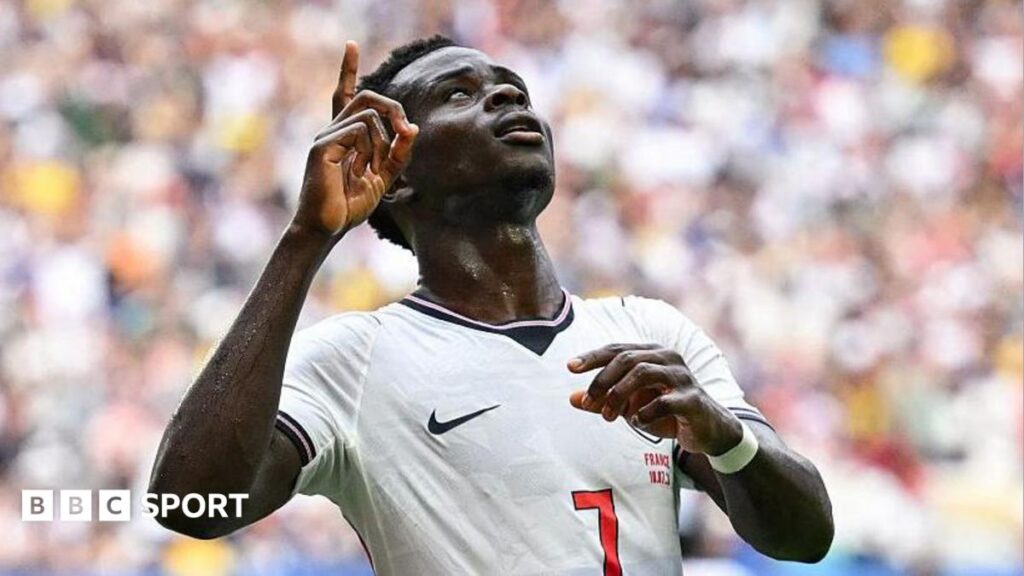
Image source, Getty ImagesImage caption, Saka hat-trick helps England finish third at World CupByMohamed MoallimBBC Sport journalistPublished7 minutes agoThree days can feel like an eternity in tournament football.On Wednesday night in Atlanta, Bukayo Saka watched from the substitutes' bench as England's World Cup dream slipped away. Despite being fit enough to play, the Arsenal winger remained an unused substitute as Thomas Tuchel's side surrendered a 1-0 lead in the closing stages to lose 2-1 to holders Argentina.By Saturday evening in Miami, Saka had delivered his response in the only way…
Saka shows Tuchel why he's too good to leave out
What happened
Image source, Getty ImagesImage caption, Saka hat-trick helps England finish third at World CupByMohamed MoallimBBC Sport journalistPublished7 minutes agoThree days can feel like an eternity in tournament football.On Wednesday night in Atlanta, Bukayo Saka watched from the substitutes' bench as England's World Cup dream slipped away. Despite being fit enough to play, the Arsenal winger remained an unused substitute as Thomas Tuchel's side surrendered a 1-0 lead in the closing stages to lose 2-1 to holders Argentina.By Saturday evening in Miami, Saka had delivered his response in the only way he knows how.A superb hat-trick inspired England to a thrilling 6-4 victory over France in the third-place play-off, earning the Three Lions their best World Cup finish since lifting the trophy in 1966 and reigniting questions over whether one of England's key players should have featured when it mattered most.A statement in MiamiSaka's reply could hardly have been more emphatic. He struck twice as England stormed into a 4-0 half-time lead against France, first reacting quickest after Marcus Rashford's saved effort before collecting Eberechi Eze's through ball and calmly firing into the bottom corner. With France threatening an unlikely turnaround after the break, Saka completed his hat-trick from the penalty spot to restore England's two-goal cushion.It made him only the fourth England player to score a World Cup hat-trick -…
The Role of Squad Depth in Tournament Success
Players who begin a tournament in a supporting role but deliver decisive performances later in the competition are often held up by coaches and analysts as proof of the value of squad depth over a long tournament campaign, particularly in the physically and emotionally draining knockout stages. Managers frequently describe difficult team-selection decisions, including leaving a clearly talented player out of a starting eleven, as one of the hardest aspects of tournament management, requiring a balance between current form, tactical fit and squad harmony.
A standout individual performance following a high-profile benching often becomes a defining storyline in its own right, generating extensive media coverage that examines both the player’s response to being left out and the manager’s decision-making process in the matches that followed. Such moments are frequently cited afterward as evidence of a squad’s strength in depth, a quality widely regarded among football analysts as essential to sustained tournament success at the highest level.
Third-Place Play-Offs as a Stage for Redemption
For players who experience a difficult moment earlier in a tournament, whether through a costly error, a benching, or a below-par individual performance, the third-place play-off often takes on added personal significance as an opportunity to leave a positive final impression before the tournament concludes. Coaches frequently use these matches to reward players who have shown patience and professionalism despite reduced game time earlier in the competition.
Individual redemption stories of this kind, playing out on a smaller stage than the final itself, nonetheless tend to resonate strongly with fans and pundits, often becoming some of the most talked-about individual narratives once a tournament’s broader results have been digested.
Managing Player Morale Through a Tournament
Squad management across a demanding tournament schedule requires coaching staff to maintain morale among players who may not be receiving regular game time, a challenge that becomes particularly acute following a painful result like a semi-final exit. Sports psychologists working with national teams often emphasise the importance of keeping every squad member mentally engaged throughout a tournament, since momentum can shift rapidly and previously unused players are sometimes required to deliver at short notice.
Reactions from players themselves to being left out of a pivotal match, followed by a strong return to form, are often held up by teammates and coaching staff as a model of professionalism, reinforcing squad unity heading into a team’s next assignment or tournament cycle. Such moments are frequently referenced by coaches in subsequent team talks as an example of the standards expected throughout a demanding international season.
The Value of Squad Depth Heading Into Future Tournaments
National federations often cite performances like this when reviewing player development pathways and squad-building strategy ahead of future tournaments, treating a strong response from a previously unused player as validation of broader talent identification and development systems. Such moments also tend to shape media narratives heading into subsequent competitions, with journalists and pundits revisiting a player’s tournament arc as part of the broader story of a national team’s evolution across multiple tournament cycles.
Broadcasters and pundits covering the match afterward frequently highlighted the contrast between the player’s bench role earlier in the tournament and his decisive contribution days later, using the moment as a wider talking point about resilience and professionalism in elite sport.
National team coaching staff often point to moments of this kind when addressing younger squad members specifically, using a senior player’s composed response to being left out as a practical example of the professionalism expected throughout a demanding tournament campaign.
Fitness and conditioning staff also play a quieter but important role in these situations, ensuring a player kept out of the starting eleven remains physically primed to deliver an immediate high-level performance whenever called upon.
Media coverage in the days following such a performance often extends beyond the immediate match report, with feature pieces exploring the player’s mindset during the period on the bench and how that experience shaped his eventual response on the pitch.
Supporters attending the match in person frequently describe such moments as some of the most memorable of an entire tournament, adding to the folklore that builds around a national team’s campaign long after the final whistle.
Originally reported by bbc.co.uk. Adapted for our readers with AI assistance.
Thousands of young protesters in Delhi continue to demand education reforms and the resignation of Education Minister Dharmendra Pradhan after a police crackdown. The…
Facing a looming financial collapse, Thames Water’s main lenders have offered the UK government a ‘golden share’ and increased local authority involvement to avoid…
Facing record-breaking temperatures and severe drought, Thames Water has introduced a hosepipe ban impacting over 10 million customers across parts of southern England to…