
News
RUSSIA versus NATO and BRICS vs. NATO Military SWOT
Recall that Poland’s Minister Sikorski’s core claim is partially supported by the numbers, but the framing “quite quickly” and “without the U.S.” does not…
TAMFIS NIG LTDRC 8067447CAC ACTIVEFinima, Bonny Island, Rivers State

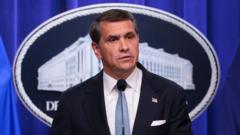
Todd Blanche, who served as President Donald Trump's personal attorney and acting US Attorney General since April, has now been confirmed as the official Attorney General in a closely contested Senate vote. This decision concludes a protracted political impasse that reflected deep divisions within the Senate and broader concerns about the Justice Department's independence and priorities under Blanche's leadership. This article examines the key elements of Blanche's confirmation, the controversies surrounding his nomination, and the implications for the Justice Department and US governance going forward.
Todd Blanche secured confirmation as the United States Attorney General with a razor-thin 50-49 Senate vote. The result hinged on Senator Bill Cassidy’s pivotal support, who broke from some of his Republican colleagues to back Blanche. This vote concluded months of uncertainty following Blanche’s appointment as acting Attorney General in April after the dismissal of Pam Bondi.
All Senate Democrats opposed Blanche’s confirmation, citing concerns about his past actions and the potential politicization of the Justice Department. Meanwhile, two Republican Senators, Susan Collins and Lisa Murkowski, also voted against him, highlighting ongoing unease within the GOP about his suitability for the role.
Cassidy’s endorsement was particularly significant given his fraught history with President Trump, including his vote to convict Trump in the 2021 impeachment trial related to the January 6 Capitol riot. Cassidy’s decision to support Blanche was framed as a pragmatic choice, emphasizing the need for strong leadership within the Justice Department amid ongoing challenges.
Several issues complicated Blanche’s confirmation process. Critics scrutinized his involvement in the handling of documents related to Jeffrey Epstein, raising questions about transparency and accountability within the Justice Department. The release of Epstein-related documents had been a contentious issue, with concerns about whether Blanche’s decisions adequately served justice and public interest.
Additionally, Blanche’s role in establishing a $1.8 billion fund intended to compensate individuals alleging government persecution drew significant criticism. The fund, dubbed the "anti-weaponization" fund, was designed to support those who claimed they were unfairly targeted by government authorities. However, opponents, including Senator Murkowski, feared the fund could inadvertently benefit individuals prosecuted for participating in the January 6 Capitol attack.
This concern fueled arguments that the fund might undermine justice for those involved in the insurrection and could be perceived as politicizing the Justice Department’s resources. Under pressure during his confirmation hearings, Blanche pledged to retract the fund. However, ambiguity remains about whether this commitment is legally binding or if future actions could revive a similar initiative under a different guise. This uncertainty contributed to the reservations expressed by some Republican senators.
The confirmation vote exposed fractures within the Republican caucus. Senators Collins and Murkowski stood firmly against Blanche, citing concerns about his ability to maintain the Justice Department’s independence and resist political pressures. Murkowski explicitly referenced worries about the "politicization" of the department under Blanche’s stewardship, emphasizing the importance of impartial law enforcement.
Collins also voiced apprehension regarding Blanche’s involvement in settling a $10 billion lawsuit between President Trump and the Internal Revenue Service (IRS). This settlement, which had significant financial and legal implications, raised questions about Blanche’s role and judgment in handling sensitive legal matters.
Despite these concerns, Collins ultimately acknowledged Blanche’s potential to provide candid legal advice to the president, highlighting a nuanced position that balanced skepticism with recognition of his capabilities.
Senator Cassidy’s support was framed as a vote for institutional stability rather than an endorsement of President Trump’s broader agenda. Cassidy emphasized that Senate confirmation would empower Blanche with greater authority to influence the Justice Department’s priorities, particularly in combating violent crime, which he identified as a pressing concern.
Blanche’s confirmation raises important questions about the future direction of the Justice Department. His close ties to President Trump and prior role as the president’s personal lawyer have led to concerns about potential conflicts of interest and the department’s ability to operate independently in politically charged cases.
The controversy surrounding the "anti-weaponization" fund and the handling of sensitive legal documents signals ongoing tensions about how the Justice Department balances accountability with political considerations. Blanche’s pledge to withdraw the fund may ease some immediate concerns, but the possibility of its revival remains a point of uncertainty, especially given his close relationship with Trump.
Senator Murkowski’s opposition underscores fears that the department could be used to advance partisan objectives rather than impartial law enforcement. These concerns are heightened in the context of recent political turmoil, including the January 6 Capitol attack and ongoing debates about executive power and the rule of law.
Cassidy’s remarks suggest a pragmatic approach within parts of the Senate to prioritize functional leadership over ideological purity. His acknowledgment that President Trump remains the ultimate decision-maker highlights the limitations of Senate confirmation in shaping the Justice Department’s trajectory, underscoring the complex interplay between executive influence and Senate oversight.
The confirmation of Todd Blanche as US Attorney General marks a significant moment for the Justice Department and the broader political landscape. While his appointment ends a period of uncertainty, it also intensifies debates about the department’s independence and the influence of partisan politics on law enforcement. Blanche’s tenure will be closely watched as the Justice Department navigates complex legal and political challenges in the coming months. The Senate’s divided vote reflects broader national tensions about governance, accountability, and the rule of law in a deeply polarized environment.
Originally reported by bbc.co.uk. Adapted for our readers with AI assistance.
Keep reading
News
Recall that Poland’s Minister Sikorski’s core claim is partially supported by the numbers, but the framing “quite quickly” and “without the U.S.” does not…
Politics
In August 2025, Zespri, the world’s largest marketer of kiwifruit, announced that the European Commission had approved what it described as the first health…
News
By Engr. Tamunofiniarisa BrownReading Time: 6 Minutes The conflict between Russia and Ukraine is often framed in the media as a simple battle between…
TAMFIS NIG LTD
Electrical and instrumentation engineering, bid preparation and consulting, IT and software.