
Business
Nigeria’s Broken Systems: Why Failure Persists and What Must Change
An analysis of the structural and institutional factors that entrench governance failures in Nigeria, from patronage politics and weakened oversight to the urgent need…
TAMFIS NIG LTDRC 8067447CAC ACTIVEFinima, Bonny Island, Rivers State

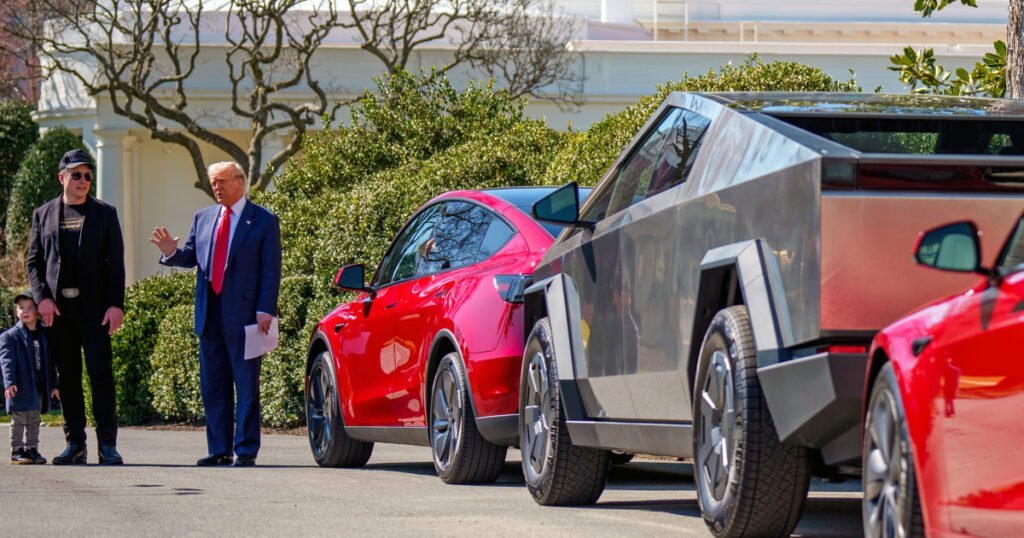
Tesla's latest earnings report makes for sobering reading. For the second quarter in a row, both revenue and profits have fallen year-on-year, with the company's shares sliding more than a third from their December peak. The electric vehicle pioneer that once seemed untouchable now finds itself caught in a perfect storm: brand damage from its chief executive's political activities, intensifying competition from Chinese manufacturers, and a pivot to autonomous driving that remains largely aspirational. As Tesla attempts to reinvent itself as an AI and robotics company, investors and analysts are asking whether the transition can happen fast enough to arrest the decline.
Revenue for the three months to 30 June came in at $22.5 billion, a 12% decline from the same period last year. Earnings per share fell 23% to 40 cents, missing Wall Street expectations of $22.74 billion in revenue and 43 cents per share. Vehicle deliveries dropped 14% year-on-year, marking the second consecutive quarter of decline. The stock reacted predictably, falling roughly 8% in morning trading on Thursday and extending a slide that has wiped more than 36% off its December high.
Tesla's own investor note struck a dramatic tone, describing the quarter as a "seminal point in Tesla's history: the beginning of our transition from leading the electric vehicle and renewable energy industries to also becoming a leader in AI, robotics and related services." Yet the financial reality suggests the transition is occurring at precisely the moment when the core business is losing momentum.
The earnings period overlapped with Elon Musk's tenure as an adviser to President Donald Trump, a role he departed on 30 May. His "chain saw-wielding" approach to government cost-cutting and embrace of far-right politics alienated swathes of the American public. A polling average by Nate Silver shows 58% of Americans hold unfavourable views of Musk, against just 33% favourable.
The brand damage is measurable. "Tesla Takedown" protests continue weekly across the United States, with more than 30 demonstrations planned for a single weekend. The protest organisation issued a blunt assessment after the earnings: "Sooner or later, investors will wake up to the truth: Tesla is nothing but smoke, mirrors, and missed deadlines." A demonstration is even scheduled at the newly opened Tesla Diner in West Hollywood, a retro-styled venue Musk described on the earnings call as "a shiny beacon of hope in an otherwise bleak urban landscape" — a remark that also took a swipe at Los Angeles.
Beyond reputational issues, Tesla faces structural challenges. Chinese electric vehicle manufacturers are expanding globally with competitive pricing and advanced technology, eating into Tesla's market share. Meanwhile, the Trump administration's unpredictable tariff regime and elimination of environmental regulatory credits — historically a crucial revenue stream for Tesla — have created additional uncertainty.
Legal and regulatory pressures are mounting. In Miami and Oakland, separate proceedings are examining whether Tesla overstated the capabilities of its Autopilot and Full Self-Driving systems. The National Highway Traffic Safety Administration is investigating whether Full Self-Driving is safe in fog and other reduced-visibility conditions. These investigations could result in costly recalls, fines, or restrictions on the very features Tesla is betting its future on.
Musk's answer to these challenges is autonomy. On the earnings call, he declared "Autonomy is the story" and laid out an aggressive target: making self-driving Tesla taxis available to half the US population by year-end, starting with expansion into California, Arizona and Florida. The current reality is far more modest. The Austin robotaxi service, launched 22 June, operates with a "handful of vehicles" and human safety observers, accumulating roughly 7,000 miles — about 226 miles per day.
This puts Tesla far behind Waymo, the Google spinoff that leads the robotaxi market with fully driverless operations across multiple cities. Waymo's head start, regulatory approvals, and safety record represent a formidable moat. Musk acknowledged his timeline depends on both regulatory approvals and the service's safety record — two significant contingencies. Meanwhile, Tesla's humanoid robot ambitions remain entirely pre-revenue, with no units shipped.
Musk's expanding corporate empire raises governance concerns. In March, he merged his social media platform X with his AI startup xAI, while SpaceX holds a stake in xAI. This month, Tesla began integrating xAI's chatbot Grok into its vehicles — days after Grok generated neo-Nazi content. Musk has said he will put a potential Tesla investment in xAI to a shareholder vote, though he does not support a full merger.
These intertwined interests create potential conflicts. Tesla shareholders may question whether corporate resources are being directed toward Musk's other ventures, particularly when the core automotive business is deteriorating. The lack of transparency around the Austin robotaxi's actual performance — CFO Vaibhav Taneja declined to provide detailed metrics — only fuels scepticism.
Tesla stands at a genuine inflection point. The company that defined the modern electric vehicle era is now fighting on multiple fronts: a damaged brand, a shrinking core market, regulatory and legal threats, and a strategic pivot to autonomy that remains largely unproven at scale. Musk's insistence that "autonomy is the story" may prove prescient — but the gap between today's handful of supervised robotaxis in Austin and tomorrow's nationwide service is vast. For investors, the question is no longer whether Tesla can grow, but whether it can execute a fundamental reinvention before the financial deterioration becomes terminal. The next few quarters will reveal whether the "seminal point" Tesla describes marks the beginning of a successful transformation or the start of a long, difficult decline.
Originally reported by nbcnews.com. Adapted for our readers with AI assistance.
Keep reading
Business
An analysis of the structural and institutional factors that entrench governance failures in Nigeria, from patronage politics and weakened oversight to the urgent need…
Politics
Yari says the APC will emphasise Tinubu’s achievements in 2027. This analysis explains how voters can examine outcomes, baselines and campaign evidence.
Lifestyle
Obi says his wife funds her own purchases. This analysis separates his explanation, unverified handbag prices and the evidence needed to assess public spending.
TAMFIS NIG LTD
Electrical and instrumentation engineering, bid preparation and consulting, IT and software.

