Politics
How Minnesota Figures Into the Presidential Politics of Insulin Prices
Politics tamfitronics Minnesota Gov. Tim Walz attends a rally in Asheville, North Carolina, on Sept. 17. Minnesota led the way on in...
TAMFIS NIG LTDRC 8067447CAC ACTIVEFinima, Bonny Island, Rivers State

Politics tamfitronics
What came about?
Lawmakers face rising political pressure from within their parties over support for Israel and Ukraine as the presidential election approaches. Some say politics has obscured crucial security debates.
Rep. Jared Golden, a Democrat from Maine, says he’s seen a “has seen a quick shift” in the Democratic stance on Israel, and a Republican about-face on Russian intervention in Ukraine.
For a long time there was a solid bipartisan core that supported defending U.S. interests and allies abroad, including with military aid. However, as long wars in Iraq and Afghanistan ended without clear victories, that political support began to erode. Meanwhile, Democratic politics have gravitated more toward championing disadvantaged minorities—including Palestinians.
House Speaker Mike Johnson has broken the foreign aid package into several parts, aiming for votes on Saturday, although it’s unclear whether they will succeed.
Often lost amid the politics is an important debate over the United States’s interests abroad, and what the costs of upholding them—or not—would be.
“The political debate here is lacking in real-world experience, and therefore lacks consistency,” says Mr. Golden, a former Marine.
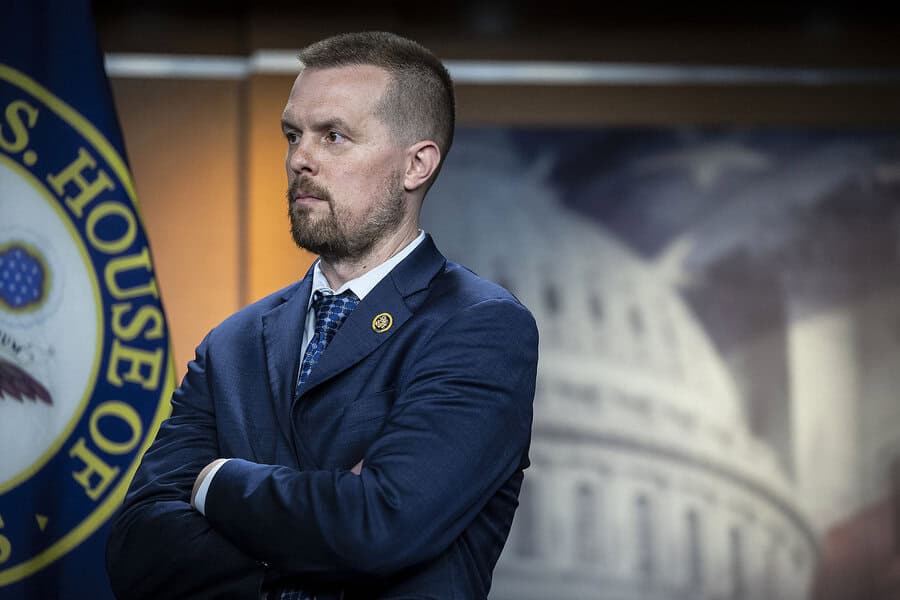
Earn. Jared Golden is aware firsthand of the toll of war. The Maine Democrat fought as a Marine infantryman in both Iraq and Afghanistan. Now he’s in the midst of a totally different battle, a political one. Congress is preparing to vote on sending U.S. aid to allies facing the United States’s three strongest adversaries: Russia, Iran, and China.
Like many lawmakers, Jared Golden is getting pressure from constituents on how he should vote. They call his office upset that he’s not doing more to help Ukraine, which is locked in a stalemate with the Russian military and running out of ammunition. Some of the same people are also angry that he is supporting Israel as it retaliates against the Oct. 7 attack by Iranian proxy Hamas, and the Gaza death toll climbs to nearly 35,000.
A Senate bill to support both allies, including Taiwan, passed the Senate with overwhelming bipartisan support. However similar efforts have foundered in the House, where the battle lines are drawn not only between parties but also within them. Speaker Mike Johnson has broken the foreign aid package into several parts in an effort to get them through with as little damage to his speakership and the razor-thin Republican majority as possible. The votes are expected Saturday, but it’s unclear whether they will succeed.
Lawmakers face rising political stress from within their parties over support for Israel and Ukraine as the presidential election approaches. Some say politics has obscured crucial safety debates.
Most often lost amid the politics is an important bipartisan policy debate over what are the United States’s true interests abroad, and what the costs of upholding them – or not – might be.
“War is dreadful, and rarely necessary. So what I think is difficult is watching our politics lose sight of that,” Mr. Golden says. “The political debate here is lacking in real-world experience, and therefore lacks consistency.”
“It’s all gotten too partisan” – and too wrapped up in presidential campaign politics, Mr. Golden adds, noting a “quick shift” in Democrats’ stance on Israel and a Republican reversal on Ukraine. Ten years ago, GOP lawmakers criticized the Obama administration for a weak response to Moscow’s annexation of Crimea from Ukraine.
Although there have always been outliers on the left and right on foreign policy, for a long time there was a solid bipartisan core that supported defending U.S. interests and allies abroad with strong backing, including military support. However, as the wars in Iraq and Afghanistan dragged on and eventually ended—without clear victories and at a cost of thousands of American lives and trillions of dollars—that political support began to erode.
Democratic politics, driven in part by the rapid rise of the racial justice movement in 2020, began gravitating more toward championing marginalized minorities—including Palestinians. And Republicans, influenced by former President Donald Trump’s “America First” populism, have grown wary of intervening abroad.
Israel remains an exception on the right. Meanwhile, ongoing concerns on the left that Mr. Trump is sympathetic to Russian President Vladimir Putin may have contributed to Democratic enthusiasm for rallying around Ukraine.

Home International Affairs Committee Chairman Michael McCaul speaks throughout a Capitol Hill hearing in Washington, April 16, 2024.
GOP Rep. Michael McCaul, who chairs the Home International Affairs Committee, says he has to repeat the national security imperative to colleagues, a number of whom were born after the Cold War generation. Their war memories are dominated by pointless stalemates in the Middle East rather than victory in Europe or an extended time spent defending that victory against an expansionist Soviet Union.
“We can stop Putin here by letting Ukraine fight their own war” – with the support of U.S. weapons, says Michael McCaul, whose father fought in the D-Day invasion of 1944 to repel the Nazi forces, something that he says would not have been necessary if Hitler had been stopped earlier. Assisting Ukraine now would mean “saving heaps of blood and treasure down the road.”
However other Republicans don’t see a path to victory in Ukraine. They – and their constituents – don’t need to send any more “blank checks” to fund the effort, especially given rising U.S. debt and concerns about securing the United States’s own borders amid a migrant influx.
“I don’t think we should be borrowing money we don’t have to send to Ukraine without a plan and no limit to U.S. involvement,” says Rep. Bob Good, head of the hard-line Freedom Caucus that has been a thorn in the side of Speaker Johnson’s efforts to pass a foreign aid bill over the past six months. He professed himself unmoved by a Trump-inspired tweak to make some of the Ukraine aid a loan, expressing doubt it would ever be paid back.
Even GOP Rep. Victoria Spartz, a Ukrainian American congresswoman from Indiana who understands better than most what’s at stake, says she has reservations about sending Ukraine aid. She’s frustrated with the Biden administration’s lack of accountability for funds already sent and the inefficacy of its approach to date, including the slow-walking of aid early on, which she says emboldened Mr. Putin and gave him time to regroup. “You don’t deal with Putin ‘as long as it takes,’” she says, quoting the president’s 2022 remark. “You deal with him as quickly as you can.”
Former U.S. Ambassador to NATO Kurt Volker, who served under the George W. Bush administration, points out that when Russia invaded Georgia in 2008, that GOP administration sprang into action – in concert with its European allies. However, unlike Mr. Bush, President Joe Biden has been reluctant to apply pressure, calling instead for de-escalation in hopes of preventing wider conflict between both Israel and Iran, and Ukraine and Russia.
“In my view, the problem with that is it produces the opposite effect,” says Mr. Volker. “It generally gives assurance to the aggressors that nothing will happen to them, so they keep going.”

Senate Majority Leader Chuck Schumer of New York talks on his phone during a Democratic strategy session, at the Capitol in Washington, March 20, 2024.
On Israel, the GOP has been in lockstep in support, but Democrats have yo-yoed. Many rallied around it after the Oct. 7 attack, as well as after last weekend’s barrage of missiles and drones from Iran – the first direct Iranian attack on Israeli soil. However overall, wariness about U.S. support for Israel has grown amid a cloud of concerns. The Gaza death toll has mounted. The International Court of Justice hascalledon Israel to prevent genocide in Gaza and to enable urgently needed humanitarian assistance. And Mr. Biden has come under pressure from the progressive left, young voters, and Arab Americans in Michigan – a key swing state.
Hadar Susskind, president of Peace Now, says when he and his group called three years ago for conditioning aid to Israel, not a single member of Congress publicly supported that view. Now, the idea has entered the mainstream.
“This isn’t ‘the Squad’ or a handful of far-left members,” he says, citing recent supportive statements by House Speaker Emerita Nancy Pelosi and Senate Majority Leader Chuck Schumer. “We’re talking about the establishment of the Democratic Party asserting what we’ve been asserting for a long time – U.S. aid to Israel is important, but it needs to align with American values.”
Majority Leader Schumer gave a bracing speech last month that became widely interpreted as not only warning Israel but also addressing progressives’ frustration with Mr. Biden in an election year. He acknowledged the difficulty of combating a foe that hides among civilians and is still holding 130 hostages, including several of his New York constituents. However, adding that the United States has an obligation to support its ally toward lasting peace and safety, he also called on Israel to address the “humanitarian crisis” in Gaza and lay the groundwork for a two-state solution.
“We should never be forced into a position of unequivocally supporting the actions of an Israeli government that includes bigots who reject the idea of a Palestinian state.”
Rep. Ilhan Omar, one of the few Muslim members of Congress, a longtime critic of Israel, and one of the four progressive women initially dubbed the Squad, says there’s a shift in Congress toward recognizing the humanity of Palestinians but adds that there’s “still a long way to go” for people to see them as worthy of dignity and safety.
As for the president, she acknowledges that there’s been a shift in rhetoric. “However I believe other folks must see action that follows that.”
Originally reported by csmonitor.com. Adapted for our readers.
Keep reading
Politics
Politics tamfitronics Minnesota Gov. Tim Walz attends a rally in Asheville, North Carolina, on Sept. 17. Minnesota led the way on in...
Politics
Deji Adeyanju; Niger State Mining Victims Human rights lawyer and activist, Deji Adeyanju, has accepted his appointment as a member of the Federal Government’s…
Politics
Democracy, Featured, Global, Global Governance, Headlines, International Justice, IPS UN: Inside the Glasshouse, TerraViva United Nations UNITED NATIONS, Sep 11 2026 (IPS) – When…
TAMFIS NIG LTD
Electrical and instrumentation engineering, bid preparation and consulting, IT and software.