Politics
How Minnesota Figures Into the Presidential Politics of Insulin Prices
Politics tamfitronics Minnesota Gov. Tim Walz attends a rally in Asheville, North Carolina, on Sept. 17. Minnesota led the way on in...
TAMFIS NIG LTDRC 8067447CAC ACTIVEFinima, Bonny Island, Rivers State

Politics tamfitronics
This became as soon as a skinny premise for a movie—exiguous extra than an excuse for Emmerich to device what he did exclusively, which became as soon as conjuring world-accepted landmarks onscreen and then, with campy extravagance, blowing them up. (In “Independence Day,” he destroyed the White Home with an alien death ray; in “2012,” he would rupture it all all over again, this time with a mega-tsunami.) Within the movie, the cosmic conspiracy theorists are proved proper: the year 2012 ends no longer with a whimper but with a bang, or after all a sequence of cataclysmic bangs all the device thru the globe. We private been in Jackson Gap because one in all the V.F.X. money photos in “2012” is the eruption of a supervolcano lurking below the surface of Yellowstone Park. There after all is a Yellowstone supervolcano. Indulge in the diversified spectacular plagues in “2012,” including unheard of photograph voltaic flares and continent-splitting earthquakesan eruption that buries vital of the Mountain West is something that could well happen in proper existence. On an extended sufficient time line, it totally could well. But of the day and hour knoweth no man, least of all Roland Emmerich. Despite the entirety, at the Four Seasons, Emmerich did exiguous to screen the reality that what had drawn him to the sphere became as soon as no longer Mayan prophecy but what has come to be acknowledged as “pre-consciousness.” “2012 is this date, you perceive, which there’s a lot of solutions about,” he mentioned. “And we selected the abominable one.” It became as soon as, in diversified words, the favored freakout of the 2d, repurposed as a collection of buzzy I.P.
Press junkets aren’t what they became as soon as as soon as. Final week, I seen “Civil Conflict,” the novel movie by the British creator and director Alex Garland, in a particular ground-floor screening room on Sixth Avenue. (No elk chili this time. Now no longer even popcorn. And no experts providing ancient context.) “Civil Conflict” is no longer a campy effort movie. It’s taut, carefully paced, colourful but no longer overstuffed. As a battle movie, it’s closer to “The Anxiety Locker” than “Glory”; as an aspect toll road movie, it’s extra “Badlands” than “The Road.” Aesthetically talking, the movie is finely crafted, fat of stunning and harrowing photos (the wildflowers subsequent to a sniper’s trench; the chassis of a crashed helicopter in an abandoned JCPenney car automobile parking space). As prophecy, on the opposite hand, it’s no longer so illuminating. Indulge in an erupting supervolcano or a catastrophic photograph voltaic flare, a 2d American Civil Conflict is something that after all could well happen—an no longer going prospect but, gentle, grisly sufficient to be charge tense about. But wars are no longer random acts of nature. As an quite quite a lot of of exquisite hoping for the exclusively, we are in a position to strive to prevent the worst, if we’re exciting to face some laborious questions.
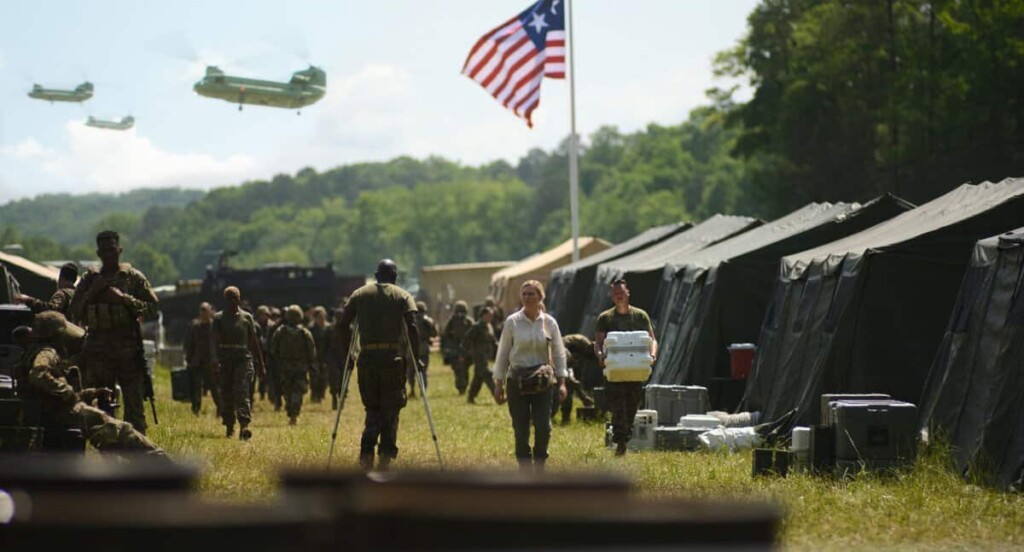
The movie takes place in what appears to be an extraordinarily bleak future, if not an alternate present. (The phones, which don’t work, and the weapons, which look very much like today’s models, appear as they do now.) The dramatic setup is that of every Pixar movie: unlikely companions embark on a high-stakes quest. Here, our heroes are four American journalists, led by a war photographer named Lee (an exhausted-looking Kirsten Dunst), who has earned accolades and endured traumas in a foreign country and is now covering a brutal war at home. According to a plan outlined by the movie’s U.S. distributor, when the action of “Civil War” begins, nineteen states have seceded. A tyrannical president in his third term (played by Nick Offerman, who doesn’t go out of his way to behave like Donald Trump, but also doesn’t go out of his way not to) is clinging to power, and Lee and her companions—two other weathered veterans and a wide-eyed amateur—are seeking to interview him. To reach him, they decide to travel from New York to Washington, D.C., which requires not a 3-hour Acela ride but a death-defying odyssey in a battered Ford Tour.
We follow them as they head south: building-to-building combat by day, ropes of orange rocket fire at night. Sooner or later, they fall in with guerrillas in civilian clothes; the next, they’re following troops in fatigues. It’s usually unclear who the good guys are, or whether we’re supposed to care. “West Coast forces, fucking Portland Maoists—it’s all the same,” one of the journalists says. Later, when the amateur expresses concern about whether two prisoners of war will survive to tell the tale, Lee rebukes her: “Once you start asking yourself these questions, you can’t stop. So we don’t ask. We report so others don’t have to.” At first, I wondered whether this was meant to be Lee’s PTSD speaking. Is the audience supposed to admire her detached composure, or suspect that her moral compass has spun out of control? Then I listened to some interviews with Garland, in which he made it clear that his protagonist’s views have usually been his own. “The movie is trying to behave like the journalists it admires,” he told WNYC (a member station of NPR, which, depending on your perspective in our current culture war, either is a source of reliable news or contains publicly subsidized advocacy journalism). Garland had imagined the mechanics of an American Civil War 2.0 in great detail, but he had left its causes intentionally vague, he said, because “at a certain point, the specifics stop mattering… It stops being, in a way, issue-driven, and it simply becomes madness.”
But madness doesn’t emerge out of nowhere, in drama or in ancient history. In the real world, journalists are supposed to be aware of the root causes of Americans’ suffering: racism, runaway inequality, insufficient health care, job insecurity, and so much else. In the world of “Civil War,” we find no explanation of what has driven the country past the verge of collapse, or what makes conditions in the secessionist states different from those in the loyalist states. At the movie’s premiere, during South by Southwest, an interviewer asked Garland about the ubiquity of firearms in the U.S.; Garland, apparently deeming the question too narrow, demurred, saying that some civil wars have been fought with machetes instead of guns.
Garland has said that his aim was to make an “emphatically antiwar” film. But “Civil War” remains resolutely incurious about what could motivate a modern civil war in the United States—and thus how it could be prevented. (To oppose a hypothetical war without confronting the conditions that could ignite it is rather like claiming to oppose mass incarceration while deliberately avoiding questions about crime, policing, poverty, psychology, judges, and laws.) One of the battles we hear about in the film is “the Antifa Bloodbath.” Antifa stands for antifascism, and fascism seems like the kind of issue on which many of us—even jaded journalists—might eventually feel obliged to take a side. But Lee tries to distance herself from it, and, by extension, so does the film. “I think civil war is just an extension of politics,” Garland recently told the Times. “That politics is polarization.” He seems to be trying to have it both ways, using our dire politics as topical IP while sidestepping frank conversations that could get him in trouble with parts of his potential audience. It’s hard to rise above the fray while also banking on the fray for relevance. Garland’s paeans to objectivity sound noble in theory, but the photojournalist’s lens has never been fully objective. Moreover, it’s hard to imagine anything meaningful about a country on the verge of collapse without addressing what brought it there.
That that you would possibly maybe well’t discover a movie known as “Civil Conflict” with out being scared by about a ghosts, but Garland’s movie looks determined to private some distance flung from having a leer at them. In a 2d of sweaty exposition, we are instructed that Lee’s name is an allusion to Lee Millerthe accepted battle photographer for Vogue. (Miller arrived in France a month after D Day, which one could well moreover call an Antifa Bloodbath.) Then all all over again it’s most no longer going to listen to the principle persona’s name with out moreover pondering of Robert E. Lee, especially because the journalists come the front line, in Charlottesville, Virginia. It completely finds something about the narrow scope of Garland’s mission that he could private named his protagonist Grant or Lincoln, with out changing any diversified shrimp print, and it most definitely wouldn’t private made vital distinction. There is extra exposition throughout the movie, vital of it amounting to “Conflict is Hell.” It’s laborious to argue with that, on the opposite hand it’s moreover laborious to speculate too vital emotional vitality in any text that’s laborious to argue with.
The secessionist forces consist of, most notably, California and Texas; the loyalist states consist of New York, South Carolina, Kansas, and Arizona. As many viewers have pointed out, this is not plausible. It’s entirely a brazen fantasy, so eager to avoid provocation that it risks becoming a distraction; it shifts the film into a particular register, if not a distinct genre, as if Garland had built a fictional world that resembled the real world in every respect except that, for some unexplained reason, there was no gravity. (Emmerich was being indulgent when he blew a hole through Wyoming in “2012,” but at least he kept the fault lines in the correct state.) In 2022, Barbara F. Walter, a political scientist at the University of California, San Diego, published a best-selling book titled “How Civil Wars Start.” Walter warned that “the U.S. has the risk factors we know are likely to lead to civil war,” but she was also careful not to engage in “fearmongering.” In the London Review of Books, James Meek criticized Walter in part, for being too cautious. “Her text struggles to grasp the tension between the view that civil war is an absolute evil, and the possibility that in some civil wars one side is right and the other is wrong,” Meek wrote. (One of his examples was the African National Congress’s struggle against South African apartheid, a struggle that is sometimes quickly misremembered as having been entirely nonviolent.) “It is as if cherished liberal causes—democracy, equal rights, tolerance—must never be associated with the messiness of intercommunal violence; as if the fact that the partial victory of these causes in certain countries had to be fought for, in the literal sense of the word, is a shameful secret.”
Originally reported by newyorker.com. Adapted for our readers.
Keep reading
Politics
Politics tamfitronics Minnesota Gov. Tim Walz attends a rally in Asheville, North Carolina, on Sept. 17. Minnesota led the way on in...
Politics
Deji Adeyanju; Niger State Mining Victims Human rights lawyer and activist, Deji Adeyanju, has accepted his appointment as a member of the Federal Government’s…
Politics
Democracy, Featured, Global, Global Governance, Headlines, International Justice, IPS UN: Inside the Glasshouse, TerraViva United Nations UNITED NATIONS, Sep 11 2026 (IPS) – When…
TAMFIS NIG LTD
Electrical and instrumentation engineering, bid preparation and consulting, IT and software.