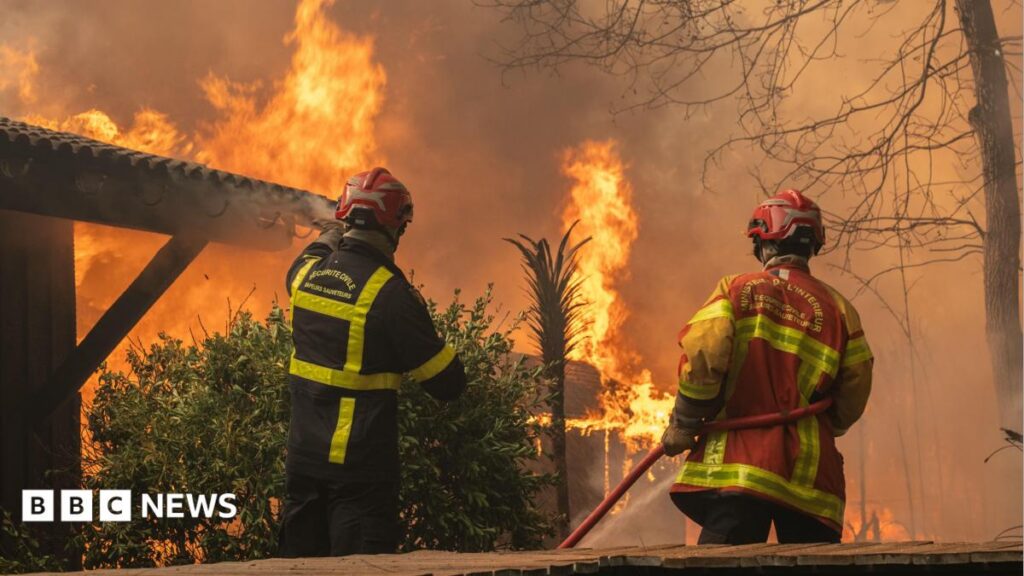
More than 250,000 flee wildfires in France and Spain
More than 250,000 flee wildfires in France and Spain
Editor’s note: The following is AI-generated commentary and context on this topic, not original reporting.
When a story like “More than 250,000 flee wildfires in France and Spain” breaks, the initial facts are often only part of what makes it significant — the surrounding context matters just as much.
According to what has been reported: Image source, EPAImage caption, Firefighters battle flames in Lège-Cap-Ferret, south-western FranceByDearbail Jordan and Sofia Ferreira SantosPublished25 July 2026, 17:43 BSTUpdated 46 minutes agoFirefighters are struggling to contain wildfires in south-west France as strong winds push flames towards the city of Bordeaux, with one official saying they “are far from having the fire under control.”More than 250,000 people in France and Spain have fled fires which have been raging for days, as winds and high temperatures hamper efforts to contain them. Overnight, seven towns west of Bordeaux were told to evacuate… More than 250,000 flee wildfires in France and Spain What happened Image source, EPAImage caption, Firefighters battle flames in Lège-Cap-Ferret, south-western FranceByDearbail Jordan and Sofia Ferreira SantosPublished25 July 2026, 17:43 BSTUpdated 46 minutes agoFirefighters are struggling to contain wildfires in south-west France as strong winds push flames towards the city of Bordeaux, with one official saying they “are far from having the fire under control.”More than 250,000 people in France and Spain have fled fires which have been raging for days, as winds and high temperatures hamper efforts to contain them.
The reporting also notes: Overnight, seven towns west of Bordeaux were told to evacuate residents. In Spain, where a state of emergency has been declared, a change in weather conditions has helped firefighters outside Madrid.Spanish PM Pedro Sánchez admitted there are “complex times ahead”.
Further detail from the same source material: Meanwhile, authorities in València confirmed the death of a man in a fire.The man, believed to be in his 70s, was found dead in his car by firefighters as they extinguished a fire in the Salt de l’Aigua ravine in Manises, according to local media reports.In France, around 200,000 people have been evacuated in south-western regions of Gironde and Landes regions.France has mobilised its military to help with the response and extra reinforcements from the army have been sent to help firefighters by clearing brush and creating fire breaks.As of Saturday morning, the wildfire was around 40km to 50km (25… Source: More than 250,000 flee wildfires in France and Spain via www.bbc.co.uk. This article was curated with AI assistance.
On Tamfitronics, coverage of stories such as “More than 250,000 flee wildfires in France and Spain” aims to give readers useful context alongside the headline, rather than simply repeating a single short news alert.
Understanding the Wider Context
Regional context matters enormously in stories like this — the same event can be read very differently depending on the recent history between the parties involved.
Multilateral bodies and allied governments often find themselves walking a careful line in response to incidents of this kind, balancing principle against the practicalities of ongoing diplomatic relationships.
Why It Matters
International institutions tasked with mediating disputes of this kind often move more slowly than public opinion would like, constrained by procedure, consensus-building and the competing interests of member states.
As with most fast-moving international stories, early reporting can be incomplete, and a clearer picture usually only emerges once official statements, investigations or follow-up reporting catch up with events on the ground.
Different Perspectives
Diplomatic incidents and international disputes are rarely resolved quickly; they tend to unfold over weeks or months through a mixture of formal statements, back-channel negotiation and public posturing.
Coverage of international affairs often has to balance the urgency of breaking developments with the reality that verified, on-the-ground detail can take time to confirm through independent sources.
Practical Implications
Domestic audiences in each country involved often receive quite different framing of the same international story, shaped by local media, political context and historical relationships.
International stories of this nature typically involve a web of competing national interests, diplomatic history and domestic political pressures on all sides, which makes definitive judgements difficult to reach from the outside.
What Happens Next
Economic ties, security arrangements and long-standing alliances all factor into how governments respond publicly to events like this, even when the immediate story appears to be a single, contained incident.
Key considerations
Regional context matters enormously in stories like this — the same event can be read very differently depending on the recent history between the parties involved.
Multilateral bodies and allied governments often find themselves walking a careful line in response to incidents of this kind, balancing principle against the practicalities of ongoing diplomatic relationships.
International institutions tasked with mediating disputes of this kind often move more slowly than public opinion would like, constrained by procedure, consensus-building and the competing interests of member states.
As with most fast-moving international stories, early reporting can be incomplete, and a clearer picture usually only emerges once official statements, investigations or follow-up reporting catch up with events on the ground.
Frequently Asked Questions
How reliable is early reporting on stories like this?
Details often firm up over following days as official statements and independent verification catch up with initial accounts.
What typically happens after an incident like this?
A period of formal statements, diplomatic exchanges and, in some cases, official inquiries usually follows before the matter is considered resolved.
What role do international bodies play?
Multilateral organisations often become involved in mediating or commenting on disputes of this kind, though their influence varies by situation.
A Note on How This Story Is Being Covered
As with most news stories, the details that seem most significant in the first hours are not always the ones that end up mattering most once the full picture is understood.
Context from previous, related stories often helps explain why a particular development is considered significant enough to be reported in the first place.
The distinction between confirmed fact, official claim and informed speculation is one that responsible coverage tries to maintain clearly, even when the underlying story is moving quickly.
Readers are generally well served by treating breaking news with a degree of patience, since early details are sometimes revised, corrected or expanded as a story develops.
Understanding the broader institutional or industry context behind a story often does more to illuminate its significance than any single additional fact about the event itself.
It’s worth remembering that most news stories are part of an ongoing process rather than a single, final word on a subject — updates and follow-ups are the norm rather than the exception.
The role of official spokespeople and press offices is to provide an authoritative account of events, though their statements are usually just one part of a fuller picture that includes independent verification.
Editorial standards around sourcing, attribution and verification vary between outlets, which is part of why comparing several accounts of the same story can be worthwhile.
Stories that touch on public institutions or well-known figures often attract additional scrutiny, both from professional journalists and from members of the public scrutinising the coverage itself.
Public reaction to news stories, particularly on social media, can sometimes move faster than the verified facts themselves, which is part of why measured analysis is valuable.
This piece is intended to provide background and context; readers seeking the latest confirmed facts should consult ongoing coverage from established outlets.
Originally reported by bbc.co.uk. Adapted for our readers with AI assistance.
Thousands of young protesters in Delhi continue to demand education reforms and the resignation of Education Minister Dharmendra Pradhan after a police crackdown. The…
Facing a looming financial collapse, Thames Water’s main lenders have offered the UK government a ‘golden share’ and increased local authority involvement to avoid…
Facing record-breaking temperatures and severe drought, Thames Water has introduced a hosepipe ban impacting over 10 million customers across parts of southern England to…