Business
Nigeria’s Economic Performance: Domestic Debt Rise and Agriculture Trade Shift in Q2 2026
Nigeria's economic landscape in the second quarter of 2026 presents a mixed picture of fiscal press...
TAMFIS NIG LTDRC 8067447CAC ACTIVEFinima, Bonny Island, Rivers State

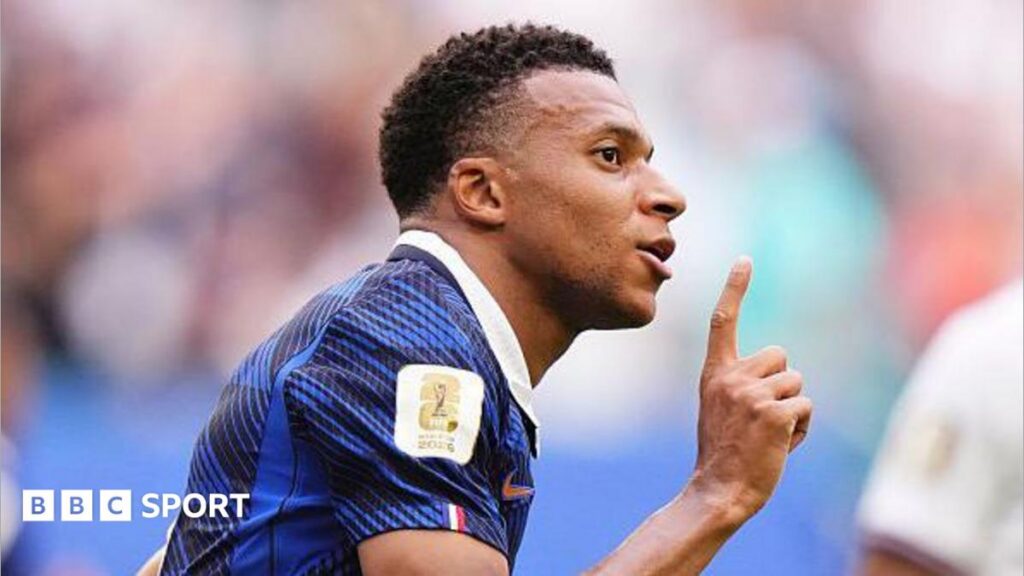
The 2026 FIFA World Cup has delivered a Golden Boot race for the ages. With the tournament's final match between Argentina and Spain still to be played, Kylian Mbappé sits atop the scoring charts with 10 goals, two clear of Lionel Messi. Yet the 39-year-old Argentine retains a mathematical path to the award through the tiebreaker system, which rewards assists when goal tallies are level. Beyond the individual accolade, the duel has pushed both players to the summit of the all-time World Cup scoring list, where Mbappé currently holds a one-goal advantage with 22 to Messi's 21. As the sport's two generational icons prepare for their final acts on the world stage, the narrative tension extends far beyond the golden boot itself.
Mbappé's brace in France's 6-4 third-place play-off defeat by England moved him to double figures for the tournament, the first player to reach 10 goals at a single World Cup since Gerd Müller in 1970. The tally represents the highest single-tournament return this century, surpassing the eight-goal benchmarks set by Ronaldo in 2002 and James Rodríguez in 2014. Messi, who has netted eight times in Qatar, must score twice in the final to draw level on goals; he would then claim the Golden Boot by virtue of a superior assists record, a scenario that underscores the award's modern emphasis on all-round attacking contribution.
The two-goal gap is significant but not insurmountable. Messi has scored multiple goals in a knockout match at this tournament already, netting a brace in the quarter-final against the Netherlands. Argentina's tactical setup under Lionel Scaloni continues to funnel creative play through the captain, and Spain's high defensive line could offer the space he requires. Conversely, Mbappé's tournament is complete; he can only watch and wait. The psychological dynamic is unusual: the leader is a spectator, the chaser controls his destiny.
Only eight players in World Cup history have scored eight or more goals in a single edition. The list reads like a roll call of the game's greatest finishers: Just Fontaine (13 in 1958), Sándor Kocsis (11 in 1954), Gerd Müller (10 in 1970), Ronaldo (8 in 2002), and now Mbappé. The 56-year gap between Müller and Mbappé reflects football's tactical evolution; modern defences are more organised, pressing is more intense, and squads are deeper, diluting individual goal shares. That Mbappé has reached double figures despite these headwinds reinforces his status as the pre-eminent number nine of his generation.
His all-time World Cup tally of 22 goals, accumulated across just three tournaments (2018, 2022, 2026), places him alone at the top of the all-time charts. Messi's 21 goals have come across five tournaments (2006, 2010, 2014, 2018, 2022, 2026), a testament to remarkable longevity. The next active challenger, Cristiano Ronaldo, sits on eight. Barring injury or early retirement, Mbappé could extend the record to a figure that may stand for decades.
While the headlines belong to the two superstars, the 2026 tournament has produced a compelling supporting cast. Jude Bellingham's seven goals represent the highest single-tournament return by an English player, surpassing Gary Lineker's six in 1986. The 23-year-old's evolution from box-to-box midfielder to prolific attacking threat has been the story of England's campaign, and his third-place finish in the Golden Boot standings—ahead of Erling Haaland and Harry Kane on six each—signals a shifting of the guard in European football.
Haaland's six goals, scored in fewer minutes than any other leading contender, underline his ruthless efficiency, while Kane's return, supplemented by a tournament-high assist count, highlights his hybrid striker-playmaker profile. The depth of quality across the top six scorers—Mbappé, Messi, Bellingham, Haaland, Kane, and Spain's Dani Olmo on five—has made this the most competitive Golden Boot race since the 1990 edition, when four players finished on four goals.
The Argentina vs Spain final carries layered significance. For Argentina, it is a chance to add a fourth star above the badge and provide Messi the storybook ending his career deserves. For Spain, it represents a first World Cup triumph since 2010 and validation of Luis de la Fuente's possession-based rebuild. The Golden Boot subplot adds commercial and narrative weight: broadcasters and sponsors have built marketing campaigns around the head-to-head, and the final's global audience will swell accordingly.
Should Mbappé retain the award, he becomes the first player to win the Golden Boot twice (2022, 2026), a distinction that would sit alongside his two World Cup winner's medals (2018, 2022) and the 2022 Golden Ball. If Messi overturns the deficit, he claims his first Golden Boot at the age of 39, an unprecedented achievement that would crown a career already defined by the impossible. Either outcome writes a fresh chapter in the sport's history books.
The Golden Boot, known as the Golden Shoe until 2010, has been awarded at every World Cup since 1982. Tiebreaker rules have evolved: assists now serve as the primary differentiator, followed by fewest minutes played, a system designed to reward efficiency and creative contribution. The award's prestige derives from its simplicity—goals win matches—yet its winners' list reflects the game's tactical shifts. Strikers dominated the early decades; the 2010s saw the rise of the false nine and the inverted winger, with Thomas Müller (2010), James Rodríguez (2014), and Harry Kane (2018) each embodying a different attacking archetype.
Media coverage of the Golden Boot race typically intensifies at the quarter-final stage, when the field narrows and statistical models become predictive. Sponsors leverage the narrative for activation campaigns; broadcasters build studio segments around shot maps, expected goals (xG) comparisons, and penalty versus open-play breakdowns. The 2026 race, pitting a 27-year-old at his physical peak against a 39-year-old defying time, has generated unprecedented engagement across digital platforms, with FIFA's official Golden Boot tracker recording a 40% year-on-year increase in interactions.
The 2026 World Cup will be remembered for many things—expanded format, technological innovations, geopolitical storylines—but the Mbappé-Messi Golden Boot duel sits at its emotional core. Two players who have defined an era, separated by a generation yet bound by excellence, have pushed each other to historic heights. Whether the award rests in the cabinet of a 27-year-old phenom or a 39-year-old maestro, the race has reminded a global audience why the World Cup remains sport's greatest theatre: it produces moments where individual brilliance and collective destiny collide, and where the numbers on a scoresheet become the raw material of legend. As the final whistle approaches in Buenos Aires, the only certainty is that football history will be written one more time.
Originally reported by bbc.co.uk. Adapted for our readers with AI assistance.
Keep reading
Business
Nigeria's economic landscape in the second quarter of 2026 presents a mixed picture of fiscal press...
Business
Liverpool manager Andoni Iraola is confronting a significant selection headache as two key forwards, Cod...
News
Health News tamfitronics [Editor’snote:[Editor’snote: This transcript was generated using both transcription ...
TAMFIS NIG LTD
Electrical and instrumentation engineering, bid preparation and consulting, IT and software.