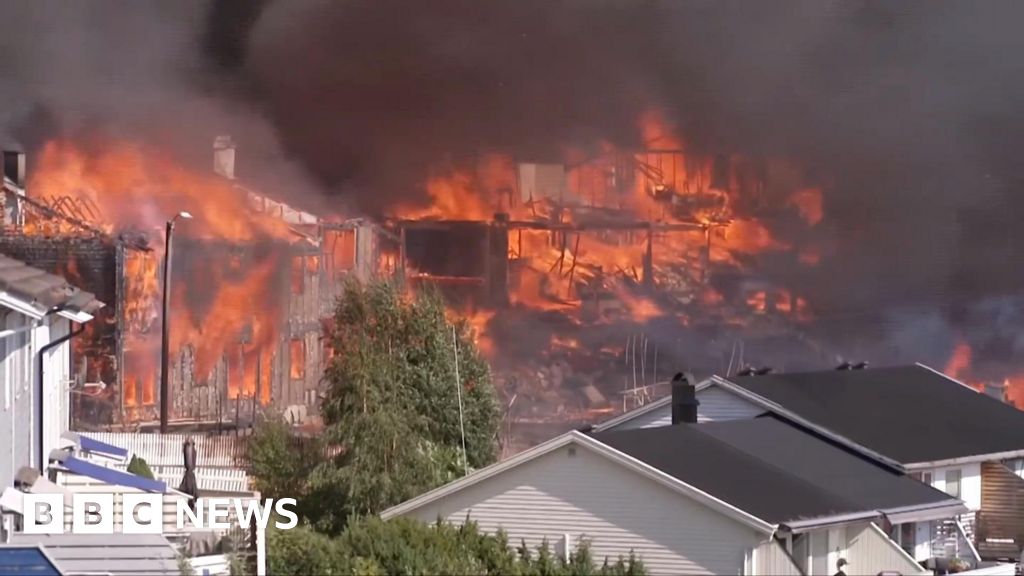
Massive Wildfire Devastates Homes in Drammen, Norway: Helicopters and Firefighters Battle Blaze
A significant wildfire has erupted in Drammen, a city located approximately 30 miles west of Oslo in southern Norway. The fire has rapidly consumed more than 100 homes and prompted the evacuation of hundreds of residents. Emergency services, including dozens of firefighters and water-dropping helicopters, are actively combating the blaze, which has also spread to nearby forested areas. Authorities have yet to determine the fire’s origin, but the dry and hot weather conditions in the region have been identified as a key factor in the fire’s swift expansion.
Massive Wildfire Devastates Homes in Drammen, Norway: Helicopters and Firefighters Battle Blaze
Scope and Impact of the Fire
The wildfire in Drammen has caused extensive damage, with over 100 homes destroyed. This level of destruction marks one of the most severe fire incidents in the area in recent years. The fire’s rapid spread has forced hundreds of people to evacuate their homes, although, notably, there have been no reports of casualties or missing persons thus far.
The affected area is a residential zone situated roughly 30 miles from Norway’s capital, Oslo. The proximity to a major urban center has raised concerns about potential further spread and the challenges of managing such a large-scale emergency in a populated region.
Emergency Response and Firefighting Efforts
Local authorities have mobilized a significant firefighting response to contain the blaze. Dozens of firefighters are on the ground working tirelessly to extinguish the flames. In addition to ground efforts, helicopters equipped to drop water have been deployed to tackle the fire from above, targeting hotspots and areas difficult to access by land.
Despite these efforts, police have reported that the fire remains uncontrolled. The combination of ground and aerial firefighting tactics reflects the complexity and scale of the incident, as well as the urgency to prevent further destruction and protect remaining homes and natural areas.
Weather Conditions and Fire Behavior
The rapid spread of the fire has been attributed largely to recent weather conditions in southern Norway. Thomas Evjen, a worker with the Drammen Red Cross, highlighted the impact of prolonged heat and dryness, stating that the dry weather created ideal conditions for the fire to quickly escalate once ignited.
This situation underscores how climatic factors such as heatwaves and drought can exacerbate wildfire risks, even in regions like Norway where such events have historically been less common. The current fire serves as a stark reminder of the increasing vulnerability of various landscapes to wildfires amid changing weather patterns.
Uncertainty Around the Fire’s Origin
At this stage, officials have not confirmed the cause or origin of the fire. Investigations are likely underway to determine whether the fire started naturally, for example from lightning, or was caused by human activity.
Understanding the source of the fire is critical for both addressing immediate safety concerns and developing strategies to prevent similar incidents in the future. However, the priority remains focused on controlling the blaze and ensuring the safety of residents and emergency personnel.
Broader Context: Wildfires in Europe and Norway
While wildfires are more commonly associated with southern European countries, northern regions like Norway are increasingly experiencing such events due to shifting climate conditions. This fire in Drammen is part of a broader pattern of unusual wildfire activity in Europe, linked to hotter and drier summers.
The incident highlights the need for enhanced preparedness and adaptation measures across Europe, including improved firefighting resources, early warning systems, and community evacuation plans. It also raises awareness about the importance of addressing climate change to mitigate the growing frequency and intensity of wildfires.
Editor’s note: The following is AI-generated commentary and context on this topic, not original reporting.
Nordic Wildfires and a Changing Climate
Wildfires of this scale are historically less common in Nordic countries compared to Mediterranean Europe, and their increasing frequency has prompted growing concern among climate researchers studying shifting precipitation and temperature patterns across northern Europe. Firefighting resources in the region are generally calibrated for a lower historical baseline of fire activity, meaning that unusually large or fast-moving blazes can place significant strain on local emergency services, sometimes requiring mutual aid from neighbouring municipalities or countries.
Residents in affected areas typically face a difficult combination of evacuation logistics and uncertainty about property damage, with insurance and recovery processes often taking considerably longer than the emergency response itself. Local authorities generally use events of this kind to review emergency preparedness plans, including evacuation routes and public alert systems, in anticipation of similar events becoming more frequent in the future.
Insurance providers operating in wildfire-prone areas of Scandinavia have in recent years begun reassessing risk models that historically assumed a lower baseline of fire activity than has been observed in recent seasons. Cross-border cooperation among Nordic emergency services has also expanded, with shared equipment and personnel agreements increasingly treated as standard practice when a single country’s resources are stretched by a fast-moving blaze.
What this means
The wildfire in Drammen is a stark illustration of how changing weather patterns are increasing wildfire risks even in regions traditionally less affected by such disasters. The extensive damage and ongoing firefighting efforts highlight the challenges faced by emergency services in managing large-scale fires near populated areas. As investigations continue into the fire’s cause, the event underscores the urgent need for enhanced wildfire preparedness and climate adaptation strategies in Norway and across Europe. Protecting communities and natural landscapes will require coordinated efforts to address both immediate threats and long-term environmental changes.
Originally reported by bbc.co.uk. Adapted for our readers with AI assistance.
Thousands of young protesters in Delhi continue to demand education reforms and the resignation of Education Minister Dharmendra Pradhan after a police crackdown. The…
Facing a looming financial collapse, Thames Water’s main lenders have offered the UK government a ‘golden share’ and increased local authority involvement to avoid…
Facing record-breaking temperatures and severe drought, Thames Water has introduced a hosepipe ban impacting over 10 million customers across parts of southern England to…