
News
RUSSIA versus NATO and BRICS vs. NATO Military SWOT
Recall that Poland’s Minister Sikorski’s core claim is partially supported by the numbers, but the framing “quite quickly” and “without the U.S.” does not…
TAMFIS NIG LTDRC 8067447CAC ACTIVEFinima, Bonny Island, Rivers State

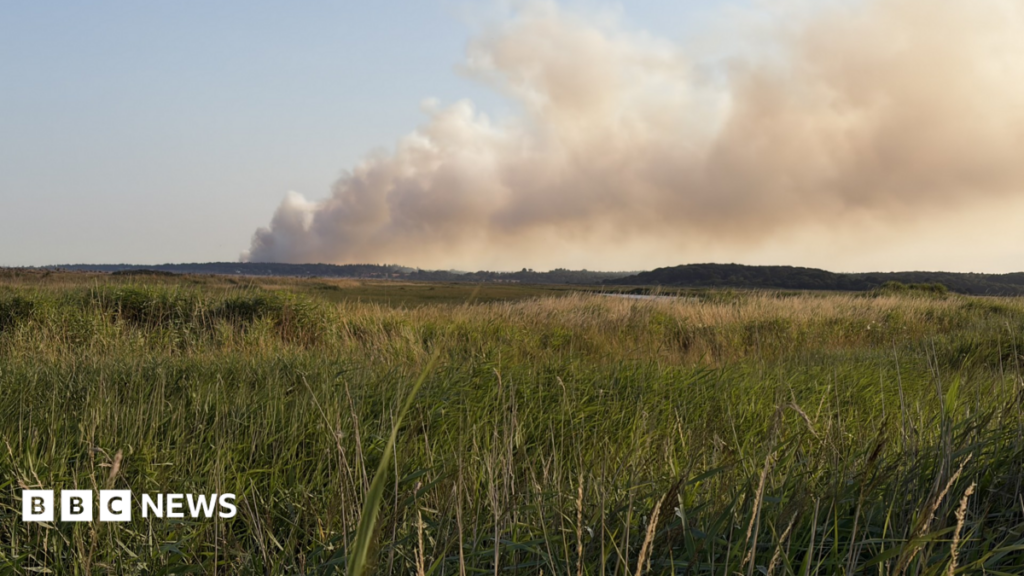
On Wednesday afternoon, a significant wildfire erupted on the heathland along the Suffolk coast, near Dunwich Heath and Leiston. The fire, described as large-scale and wind-driven, has rapidly spread across the area, prompting Suffolk Fire and Rescue Service to declare a major incident. With approximately 90 firefighters actively combating the blaze under challenging conditions, authorities have issued safety warnings and urged the public to avoid the affected areas. This article offers an authoritative overview of the incident, the response underway, and important safety information for those in the vicinity.
The wildfire ignited on Wednesday afternoon and quickly escalated due to strong winds driving the flames across the heathland. The affected area includes Dunwich Heath, a nature reserve managed by the National Trust, and is in close proximity to the RSPB Minsmere nature reserve, both of which are ecologically sensitive zones.
Suffolk Fire and Rescue Service characterized the fire as 'large-scale' and 'wind-driven,' highlighting the complexity and rapid progression of the blaze. The fire is advancing southwest towards St James's Church, located off Westleton Road, raising concerns about potential damage to both natural habitats and local infrastructure.
The declaration of a major incident underscores the seriousness of the situation, reflecting both the size of the fire and the challenges involved in controlling it.
Approximately 90 firefighters are currently engaged in efforts to bring the wildfire under control. These crews are operating under arduous conditions, contending with the heat, wind, and difficult terrain characteristic of heathland environments.
To enhance operational effectiveness, the fire service is utilizing a variety of specialized equipment, including off-road vehicles, drones for aerial surveillance, and quad bikes to navigate the rugged landscape. This combination of technology and manpower is critical for monitoring fire spread, coordinating response efforts, and accessing remote areas.
The National Trust is actively assisting firefighting efforts, leveraging its local knowledge and resources to support containment strategies. Coordination between emergency services and conservation organizations is vital to protect the natural reserves and minimize ecological damage.
Authorities have issued clear guidance for the public to avoid the affected areas to ensure safety and facilitate emergency operations. Specific locations to steer clear of include Westleton Heath, Mount Pleasant, Westleton Walks, and the main bridleway from the entrance road towards Dunwich.
Residents and visitors are advised to keep windows and doors closed to prevent smoke ingress and reduce health risks associated with wildfire smoke exposure.
Road users are urged to keep routes clear for emergency vehicles, as accessibility is crucial for rapid response and evacuation if necessary. The fire service emphasizes the importance of public cooperation to avoid hindering firefighting efforts.
Given the proximity to popular nature reserves, these advisories also aim to protect vulnerable wildlife and habitats from disturbance during this critical period.
The wildfire occurs amid an amber heat-health alert issued by the UK Health Security Agency for the East Midlands, East, South East, and London regions. Elevated temperatures and dry conditions contribute to increased wildfire risk and exacerbate the challenges faced by emergency responders.
Heathlands are particularly susceptible to fires during hot, dry spells due to the accumulation of dry vegetation and the open landscape, which facilitates rapid fire spread. The ecological impact of such fires can be significant, affecting rare plant species, insects, and bird populations that depend on these habitats.
The proximity of the fire to the RSPB Minsmere reserve is of particular concern, as this area supports diverse birdlife and other wildlife. Efforts to contain the fire are therefore not only about protecting human safety but also preserving important natural heritage.
Local communities near the fire, including those around Westleton and Leiston, are experiencing disruptions due to road closures and smoke. Emergency services are maintaining a presence to monitor the situation and provide updates as conditions evolve.
The use of drones and other surveillance technologies enables real-time assessment of fire behavior, allowing for dynamic response adjustments and early identification of new fire fronts.
Authorities continue to monitor weather conditions closely, as shifts in wind direction or speed could influence the fire's trajectory and intensity. Public communication channels remain open to disseminate timely information and safety instructions.
Residents are encouraged to stay informed through official sources and to report any signs of fire or smoke to emergency services promptly.
The wildfire on Suffolk's coastal heathland represents a significant emergency with implications for public safety, environmental conservation, and local communities. The coordinated response by Suffolk Fire and Rescue Service, supported by conservation organizations, reflects the complexity of managing such incidents in ecologically sensitive areas. As firefighting efforts continue, adherence to public safety guidance remains critical to ensuring effective containment and minimizing harm. This event also serves as a reminder of the growing challenges posed by climate conditions that increase wildfire risks across the UK. Staying informed and prepared is essential for residents and visitors alike as the situation develops.
Editor’s note: The following is AI-generated commentary and context on this topic, not original reporting.
Beyond the immediate danger to life and property, incidents of this scale tend to carry lasting economic effects — insurance losses, tourism disruption, and damage to forestry and agriculture that can take years to fully recover from.
Volunteer fire brigades often play an outsized role in rural areas during events like this, supplementing professional crews who are frequently stretched across multiple active fronts simultaneously.
Insurance industry data from recent fire seasons across southern Europe suggests that claims tied to wildfire damage have risen sharply, a trend that is prompting insurers to reassess risk pricing in fire-prone regions.
Local authorities dealing with situations comparable to this one generally rely on a mix of early-warning systems, controlled burns, and public education campaigns to reduce the risk of similar outbreaks in future fire seasons.
Firefighters on the ground in cases like this often describe exhaustion as one of the biggest operational risks, with extended deployments across multiple fire fronts stretching personnel and equipment thin.
Climate researchers have repeatedly linked the lengthening fire season in parts of Europe to drier soils, hotter summers, and vegetation that has become increasingly primed to burn, a trend that context like this helps illustrate in concrete terms.
Community resilience and coordinated regional firefighting resources are frequently cited by officials as the biggest factors in how quickly an area bounces back once the immediate crisis described here has passed.
Emergency planners responding to situations like this one typically juggle several competing priorities at once — active suppression, evacuation logistics, road closures, and public health advisories tied to smoke inhalation — often with limited visibility into how conditions will change hour to hour.
Air quality monitoring stations downwind of major fires typically record spikes in particulate pollution that can persist for days, prompting health advisories even in towns and cities far from the flames themselves.
Originally reported by bbc.co.uk. Adapted for our readers with AI assistance.
Keep reading
News
Recall that Poland’s Minister Sikorski’s core claim is partially supported by the numbers, but the framing “quite quickly” and “without the U.S.” does not…
News
Thousands of young protesters in Delhi continue to demand education reforms and the resignation of Education Minister Dharmendra Pradhan after a police crackdown. The…
News
Facing a looming financial collapse, Thames Water’s main lenders have offered the UK government a ‘golden share’ and increased local authority involvement to avoid…
TAMFIS NIG LTD
Electrical and instrumentation engineering, bid preparation and consulting, IT and software.