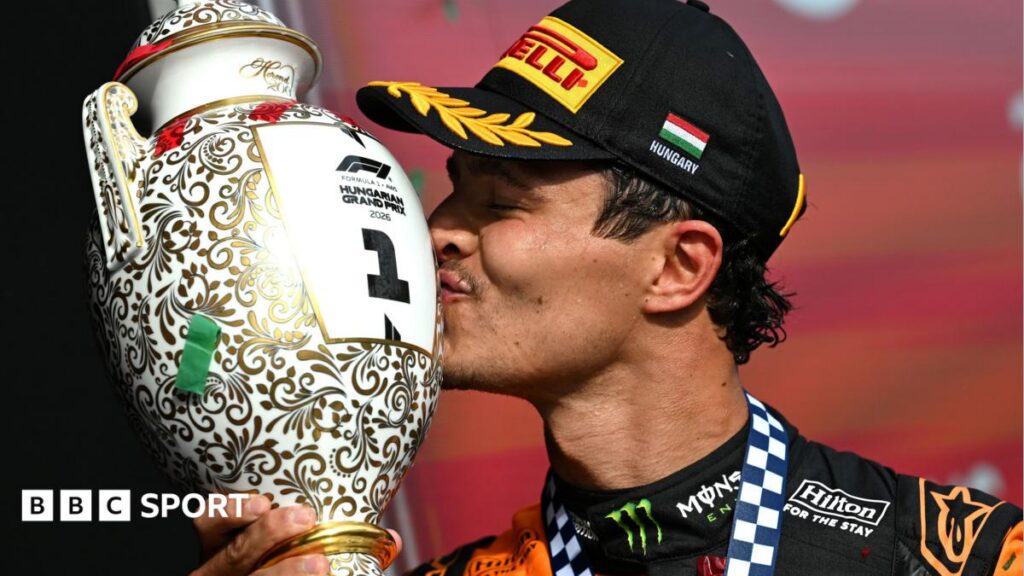
Lando Norris Secures First Win of 2026 Season at Hungarian Grand Prix Amid Strategic Drama
The 2026 Hungarian Grand Prix at the Hungaroring saw Lando Norris return to the top step of the podium, marking his first victory since November last year in Sao Paulo. The race unfolded with a mix of strategic gambles, mechanical setbacks, and on-track battles that shaped the final standings. Norris’ triumph not only ended McLaren’s win drought this season but also revived memories of the team’s dominant form from 2025. Meanwhile, Red Bull’s Max Verstappen and Mercedes’ Kimi Antonelli engaged in a gripping fight for second and third places, while Ferrari faced a challenging race compounded by penalties.
Lando Norris Secures First Win of 2026 Season at Hungarian Grand Prix Amid Strategic Drama
Norris and McLaren Reclaim Glory with Strategic Mastery
Lando Norris’ victory was the highlight of a race that combined speed, strategy, and resilience. Starting from pole, Norris initially lost the lead to his McLaren teammate Oscar Piastri, who made a stronger start. However, an error by Norris at Turn Two allowed Piastri to seize the lead, setting up a tense intra-team battle.
McLaren faced a strategic dilemma with their cars running first and second but the slower car in front. Although Norris requested to pit first to challenge Piastri, the team initially declined, opting instead to cover threats from Ferrari’s Lewis Hamilton. Eventually, Norris was allowed to extend his stint, pitting later and using fresher tyres to close the gap.
Piastri’s race was compromised by a collision with Williams’ Carlos Sainz while lapping the Spaniard, which delayed his pit stop and caused visible frustration. Despite this, Piastri maintained that his anger was directed at the incident rather than the team’s strategy.
Tragically for McLaren, Piastri’s gearbox failed on lap 56, forcing him to retire and handing Norris a clear path to victory. Norris described his pace as among the best he’s ever had, praising the car’s performance and his confidence behind the wheel.
This win marked McLaren’s first of the year, signaling a resurgence reminiscent of their strong 2025 campaign, especially with the upgraded car that debuted in Hungary.
Verstappen’s Strategic Gamble Secures Second Place
Max Verstappen’s race was marked by mixed fortunes and strategic ingenuity. Despite expressing dissatisfaction with his car’s handling throughout the Grand Prix, the Red Bull driver capitalized on a bold tyre strategy during his second pit stop, switching to soft tyres to mount a late-race challenge.
This gamble was designed to counter Ferrari’s Lewis Hamilton, who had pitted early. Verstappen’s fresh soft tyres allowed him to overtake Hamilton after the first round of pit stops, gaining clear air to consolidate his position.
The race’s late virtual safety car, triggered by Piastri’s retirement, prompted a final series of pit stops. Ferrari’s decision to pit both drivers then placed Hamilton behind Verstappen on track. Although Hamilton briefly passed Mercedes’ Kimi Antonelli, he was forced to relinquish the place due to track limits.
Despite pressure from Antonelli and Hamilton in the closing laps, Verstappen maintained a comfortable margin, crossing the line 3.6 seconds ahead of the Mercedes driver. His second-place finish was a testament to Red Bull’s strategic acumen, even as Verstappen voiced ongoing concerns about the car’s balance.
Mercedes and Ferrari Face Mixed Fortunes Amid Penalties and Challenges
Mercedes’ Kimi Antonelli secured third place, extending his championship lead to 50 points over Lewis Hamilton and 59 over teammate George Russell. Antonelli’s podium finish was hard-fought, particularly in the closing stages where he defended against Hamilton and Verstappen.
George Russell experienced a difficult race after his anti-stall system activated at the start, dropping him to 21st place. Despite a strong recovery drive that saw him finish seventh, the early setback limited his ability to challenge for higher points.
Ferrari endured a disappointing race given their car’s competitive pace. Lewis Hamilton finished fourth on track but was demoted to fifth after a five-second penalty for speeding in the pit lane. This penalty added to a series of infractions for Hamilton in recent races, including a qualifying penalty for blocking Piastri and previous penalties in Belgium and Britain.
Charles Leclerc managed to finish ahead of Hamilton in fourth place, benefiting from the latter’s penalty. However, Ferrari’s overall weekend was marred by strategic and disciplinary issues that undermined their potential to capitalize on their car’s speed.
Aston Martin’s Promising Upgrade and Strategic Boldness
Aston Martin’s weekend was notable for the introduction of a significant car upgrade that, while not yielding immediate points, demonstrated clear performance improvements. The upgrade, which retained the front suspension, engine, and gearbox but revamped other components, reduced lap times by approximately two seconds.
Fernando Alonso showcased the car’s enhanced capabilities by running a long first stint on soft tyres before switching to medium tyres, a strategy that allowed him to compete more effectively with rivals. Lance Stroll finished 13th, ahead of Alonso, with their results influenced by the timing of the virtual safety car and differing strategic calls.
Looking ahead, Aston Martin anticipates further gains with a Honda engine upgrade scheduled for the Dutch Grand Prix in late August. This development could elevate the team’s competitiveness and open the door to occasional points finishes.
Championship Implications and Upcoming Races
Kimi Antonelli’s podium finish in Hungary extended his lead in the drivers’ championship, creating a significant points buffer over his closest rivals Lewis Hamilton and George Russell. This advantage places Mercedes in a strong position as the season progresses.
McLaren’s victory injects fresh momentum into their campaign, signaling potential for further successes if their upgraded car continues to perform well and reliability issues, like Piastri’s gearbox failure, are resolved.
Red Bull’s strategic prowess remains a critical factor, with Verstappen’s ability to maximize race outcomes despite car issues keeping the team in contention.
Formula 1 now enters a four-week summer break before resuming at the Dutch Grand Prix at Zandvoort, a sprint event and the final race at the circuit under its current contract. Teams will use this period to prepare upgrades and refine strategies for the season’s second half.
What this means
The 2026 Hungarian Grand Prix was a pivotal race that highlighted the interplay of driver skill, team strategy, and mechanical reliability. Lando Norris’ triumph not only ended McLaren’s winless streak but also underscored the team’s potential resurgence with their upgraded car. Meanwhile, Red Bull and Mercedes demonstrated their strategic depth and championship ambitions, while Ferrari’s challenges emphasized the fine margins that define success in Formula 1. As the sport pauses for its summer break, teams will reflect on the lessons from Hungary and prepare for the critical races ahead, with the Dutch Grand Prix promising another exciting chapter in this tightly contested season.
Originally reported by bbc.co.uk. Adapted for our readers with AI assistance.
Thousands of young protesters in Delhi continue to demand education reforms and the resignation of Education Minister Dharmendra Pradhan after a police crackdown. The…
Facing a looming financial collapse, Thames Water’s main lenders have offered the UK government a ‘golden share’ and increased local authority involvement to avoid…
Facing record-breaking temperatures and severe drought, Thames Water has introduced a hosepipe ban impacting over 10 million customers across parts of southern England to…