
News
RUSSIA versus NATO and BRICS vs. NATO Military SWOT
Recall that Poland’s Minister Sikorski’s core claim is partially supported by the numbers, but the framing “quite quickly” and “without the U.S.” does not…
TAMFIS NIG LTDRC 8067447CAC ACTIVEFinima, Bonny Island, Rivers State

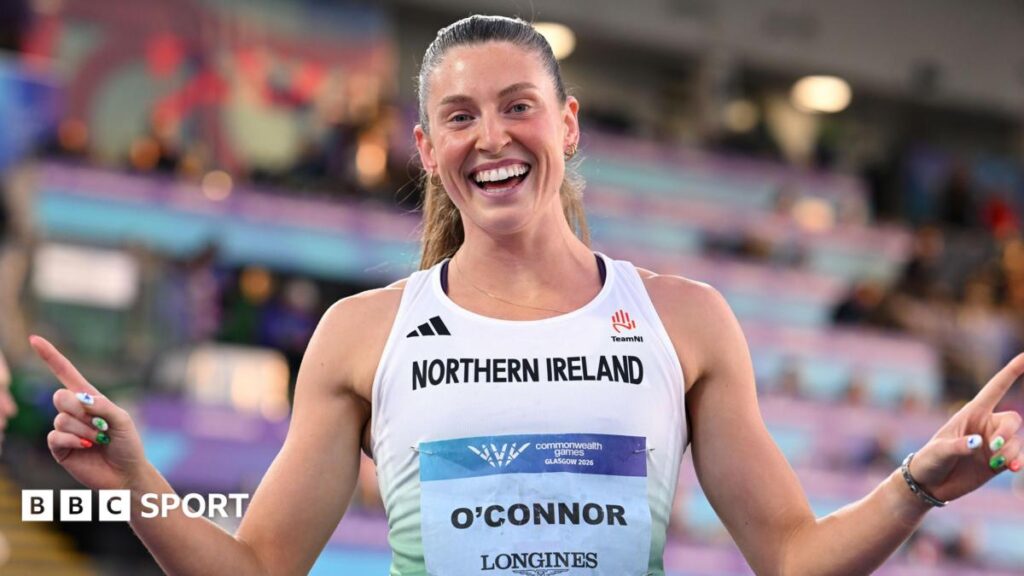
The 2026 Commonwealth Games in Glasgow witnessed a landmark achievement for Northern Ireland as Kate O'Connor emerged victorious in the heptathlon, securing the country's first gold medal of the Games. O'Connor, a seasoned athlete with previous silver medals at world indoor and outdoor championships, demonstrated resilience and consistency across seven events to claim the top podium spot. This victory not only highlights her personal progression but also revives Northern Ireland's prominence in athletics on the Commonwealth stage.
Kate O'Connor's gold medal in the heptathlon represents Northern Ireland's first gold at the 2026 Commonwealth Games and the first athletics gold since 1986. This achievement underscores a significant breakthrough for the nation in a competition that gathers elite athletes from across the Commonwealth.
At 25 years old, O'Connor has steadily climbed the ranks in multi-event athletics. Her victory in Glasgow marks her first senior outdoor gold and comes after competing in two previous Commonwealth Games, where she finished eighth in 2018 and earned silver in 2022. This progression reflects her dedication and growing prowess in the heptathlon.
The heptathlon comprises seven events spread over two days, testing an athlete's speed, strength, and endurance. O'Connor started strong on the first day at Scotstoun Stadium, leading after the initial two events. She clocked 13.54 seconds in the 100m hurdles and achieved a season-best 1.82m in the high jump, setting a solid foundation.
Despite challenging weather conditions during the shot put, O'Connor managed a throw of 12.85 meters, though she expressed disappointment with this performance. Nevertheless, she rebounded impressively in the 200m, posting a season-best 24.14 seconds, narrowly missing her personal best by 0.07 seconds and comfortably winning her heat.
After the first day, O'Connor accumulated 3,731 points, leading the competition with a 49-point margin over England's Jade O'Dowda.
On the second day, O'Connor extended her lead by clearing 1.82m in the long jump and achieving a season-best javelin throw of 52.85 meters. These performances increased her advantage to 258 points, positioning her firmly ahead of her rivals.
The final event, the 800m, saw O'Connor finishing first with a time of 2:10.45, sealing her overall victory. This win also marks Northern Ireland's first multi-class gold since Dame Mary Peters' pentathlon triumph in 1974.
O'Connor entered the competition as the favorite following the late withdrawal of England's Katarina Johnson-Thompson, the defending champion from 2022. Johnson-Thompson's absence opened the field, but O'Connor's consistent performances across all events justified her top billing.
England's Jade O'Dowda secured the silver medal, while Australia's Tori West claimed bronze, highlighting the competitive nature of the event.
Northern Ireland's team also saw Anna McCauley finish eighth overall, with a notable second-fastest time in the 800m, underscoring the depth of talent within the squad.
O'Connor's gold medal is a milestone for Northern Ireland athletics, ending a four-decade wait for a multi-event gold at the Commonwealth Games. Her success may inspire a new generation of athletes from the region and increase support for athletics programs locally.
Her progression from eighth place in 2018 to gold in 2026 illustrates the value of perseverance and continuous improvement in elite sports.
The victory also adds to Northern Ireland's medal tally in Glasgow, making O'Connor the 12th medal winner for the country at these Games, reflecting a strong overall team performance.
Kate O'Connor's triumph in the heptathlon at the 2026 Commonwealth Games is a testament to her skill, determination, and resilience. Her victory not only brings pride to Northern Ireland but also revitalizes the nation's presence in athletics on the international stage. As she prepares to receive her gold medal, O'Connor's success story serves as an inspiring example of athletic progression and the impact of perseverance. Looking ahead, her achievement may catalyze greater investment and interest in athletics within Northern Ireland, fostering future champions.
Editor’s note: The following is AI-generated commentary and context on this topic, not original reporting.
Sports scientists and analysts increasingly point to marginal gains — in recovery, nutrition, and data-driven tactical preparation — as a growing factor behind performances and decisions of the sort covered here.
Fans and pundits alike tend to view outcomes of this kind through the lens of what they signal for the rest of the season, weighing short-term form against longer-term structural questions facing the team or athlete involved.
Broadcast and sponsorship revenue tied to major competitions increasingly shapes decisions once made purely on sporting grounds, a tension that regularly surfaces in discussions like this one.
Results and moments like the one described in “Kate O’Connor Secures Northern Ireland’s First Gold at 2026 Commonwealth Games with Hep…” are often the product of years of behind-the-scenes work — coaching changes, training regimens, and squad-depth decisions that only become visible to the public in moments of high drama.
Grassroots participation numbers often see a temporary boost following high-profile moments of this kind, as young fans are inspired to take up the sport themselves.
The broader competitive landscape — including transfer activity, coaching appointments, and shifting team form — will likely continue to shape how a story like this one is remembered in the context of the wider season.
For younger athletes and up-and-coming talent, high-profile moments comparable to this can serve as both inspiration and a benchmark for what is achievable with the right support structures in place.
Governing bodies in sport are frequently balancing commercial pressures against the traditions and expectations of supporters, a tension that plays out publicly whenever a decision or result like this one draws scrutiny.
Injury prevention and squad rotation have become central talking points across professional sport, as data on player workload increasingly informs decisions that once relied mostly on instinct.
Public interest in stories of this kind tends to spike sharply in the first 48 hours before gradually settling into a steadier stream of analysis and follow-up coverage over the following weeks.
Official inquiries or reviews, where they follow a story of this kind, typically take considerably longer to conclude than the news cycle that first brought the story to public attention, which can create a gap between public perception and the eventual documented record.
Originally reported by bbc.co.uk. Adapted for our readers with AI assistance.
Keep reading
News
Recall that Poland’s Minister Sikorski’s core claim is partially supported by the numbers, but the framing “quite quickly” and “without the U.S.” does not…
News
Thousands of young protesters in Delhi continue to demand education reforms and the resignation of Education Minister Dharmendra Pradhan after a police crackdown. The…
News
Facing a looming financial collapse, Thames Water’s main lenders have offered the UK government a ‘golden share’ and increased local authority involvement to avoid…
TAMFIS NIG LTD
Electrical and instrumentation engineering, bid preparation and consulting, IT and software.