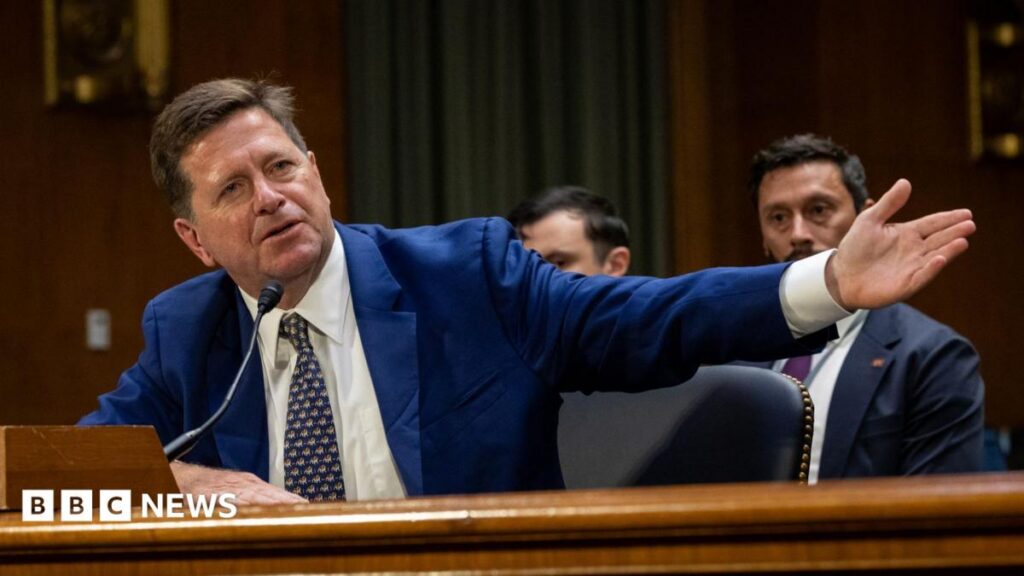
Jay Clayton Confirmed as US Director of National Intelligence Amid Political Controversy
The US Senate has confirmed Jay Clayton as the new Director of National Intelligence (DNI), marking a significant leadership change within the nation’s intelligence community. Clayton’s confirmation comes after President Donald Trump’s initial nominee, Bill Pulte, faced bipartisan criticism over his lack of intelligence experience and controversial actions. Clayton, a former federal prosecutor and securities regulator, steps into the role amid ongoing debates over surveillance laws and political tensions surrounding the intelligence apparatus.
Jay Clayton Confirmed as US Director of National Intelligence Amid Political Controversy
Background: From Acting DNI to Confirmed Director
Bill Pulte, initially appointed as acting Director of National Intelligence in early June, sparked concern across party lines due to his background primarily in housing regulation rather than intelligence. His tenure was marked by staffing reductions and politically charged referrals of President Trump’s opponents for potential prosecution, raising alarm about the politicization of the intelligence community.
In response to these concerns, President Trump nominated Jay Clayton to replace Pulte. Clayton, who had been serving as the US attorney for the Southern District of New York, brought a more conventional profile to the role, with experience prosecuting high-profile cases including drug trafficking charges against former Venezuelan president Nicolás Maduro.
The Senate confirmed Clayton by a narrow vote of 51 to 47, signaling a desire for steadier leadership in the intelligence sector after a period of uncertainty.
Jay Clayton’s Professional Profile and Senate Confirmation
Jay Clayton’s career spans roles as a federal prosecutor and securities regulator, positioning him as a figure with legal expertise and government experience. His tenure as US attorney for the Southern District of New York involved oversight of significant criminal cases, lending credibility to his new role overseeing national intelligence.
During his confirmation process, Clayton faced rigorous questioning from senators, particularly about his stance on the 2020 presidential election results. He affirmed that Joe Biden had been officially certified as the winner and rejected election denial narratives, stating, “I’m not an election denier.”
Despite this, some lawmakers expressed reservations about Clayton’s willingness to resist political pressure. Senate Intelligence Committee Vice-Chair Mark Warner voiced concerns about whether Clayton would provide the consistent, nonpartisan leadership the intelligence community requires, though he expressed hope that Clayton would prove those doubts unfounded.
Political Context and Implications for Intelligence Oversight
Clayton’s confirmation occurs against a backdrop of political tension surrounding the intelligence community’s role and the renewal of key surveillance legislation. The Foreign Intelligence Surveillance Act (FISA), particularly Section 702, which permits warrantless collection of foreign communications, has been a contentious issue in Congress.
President Trump has advocated for the long-term renewal of Section 702, and Clayton’s appointment is seen by some lawmakers as a potential catalyst to advance stalled negotiations. Senate Majority Leader John Thune expressed optimism that Clayton’s leadership could encourage bipartisan cooperation to reauthorize FISA provisions.
The intelligence community has faced challenges in recent months, including staffing cuts and concerns about politicization. Clayton inherits the task of restoring stability and credibility while navigating complex legislative and political landscapes.
Reactions and Future Outlook
President Trump praised Clayton’s confirmation on his social media platform, calling him “outstanding in every way” and predicting a “spectacular job” as DNI. This endorsement underscores the administration’s confidence in Clayton’s ability to lead the intelligence community.
Democratic lawmakers initially welcomed Clayton as a more traditional and qualified nominee compared to Pulte, though skepticism emerged during the confirmation hearings. The narrow Senate vote reflects a divided political environment and the contentious nature of intelligence oversight.
Moving forward, Clayton’s leadership will be closely watched as he addresses the intelligence community’s operational challenges, manages political pressures, and engages with Congress on surveillance laws and national security priorities.
What this means
Jay Clayton’s confirmation as Director of National Intelligence represents a pivotal moment for the US intelligence community amid a politically charged atmosphere. His legal and prosecutorial background offers a more conventional leadership profile compared to his predecessor, Bill Pulte, whose tenure raised significant concerns. While Clayton’s confirmation vote was narrowly divided, his appointment may help stabilize the intelligence apparatus and advance critical legislative discussions, particularly regarding surveillance laws. However, his ability to maintain nonpartisan leadership and navigate political pressures will be essential in restoring confidence and ensuring effective intelligence oversight in the months ahead.
Editor’s note: The following is AI-generated commentary and context on this topic, not original reporting.
Broader Context and Outlook
Stories like “Jay Clayton Confirmed as US Director of National Intelligence Amid Political Controversy” tend to draw attention because they touch on themes that resonate well beyond the immediate specifics reported at the time.
As more details emerge in cases like this, the fuller picture often looks somewhat different from the first wave of coverage, which is a common pattern with fast-moving news events.
Context matters considerably in situations comparable to this one, and readers are generally well served by following how the story develops over the coming days and weeks.
It remains to be seen how a story like this will be viewed with the benefit of hindsight, once the immediate news cycle has moved on.
Follow-up reporting in the days after a story like this often fills in details that were unavailable or unclear in the initial coverage.
Public reaction to developments like this is often shaped as much by prior expectations as by the specific facts of the case itself.
Expert commentary in the aftermath of stories like this tends to focus on placing the specific event within a longer historical or structural pattern.
Readers are generally well served by treating first-day coverage of fast-moving stories as a starting point rather than a complete picture.
Readers who want to stay informed on a topic like this are generally well served by following multiple credible outlets, since initial reports can sometimes vary in emphasis or detail.
Institutional responses to situations like this — statements, reviews, or policy adjustments — are frequently shaped as much by public pressure and reputational concerns as by the underlying facts themselves.
News organisations covering developments connected to “Jay Clayton Confirmed as US Director of National Intelligence Amid Political Controversy” typically rely on a combination of official sources, eyewitness accounts, and expert commentary, each of which carries a different level of certainty and should be weighed accordingly.
Originally reported by bbc.co.uk. Adapted for our readers with AI assistance.
Thousands of young protesters in Delhi continue to demand education reforms and the resignation of Education Minister Dharmendra Pradhan after a police crackdown. The…
Facing a looming financial collapse, Thames Water’s main lenders have offered the UK government a ‘golden share’ and increased local authority involvement to avoid…
Facing record-breaking temperatures and severe drought, Thames Water has introduced a hosepipe ban impacting over 10 million customers across parts of southern England to…