India's 'cockroach' protest called off after education minister quits
India's 'cockroach' protest called off after education minister quits
Editor’s note: The following is AI-generated commentary and context on this topic, not original reporting.
“India's 'cockroach' protest called off after education minister quits” has drawn attention for what it reveals about the wider context surrounding it, beyond the immediate facts of the story itself.
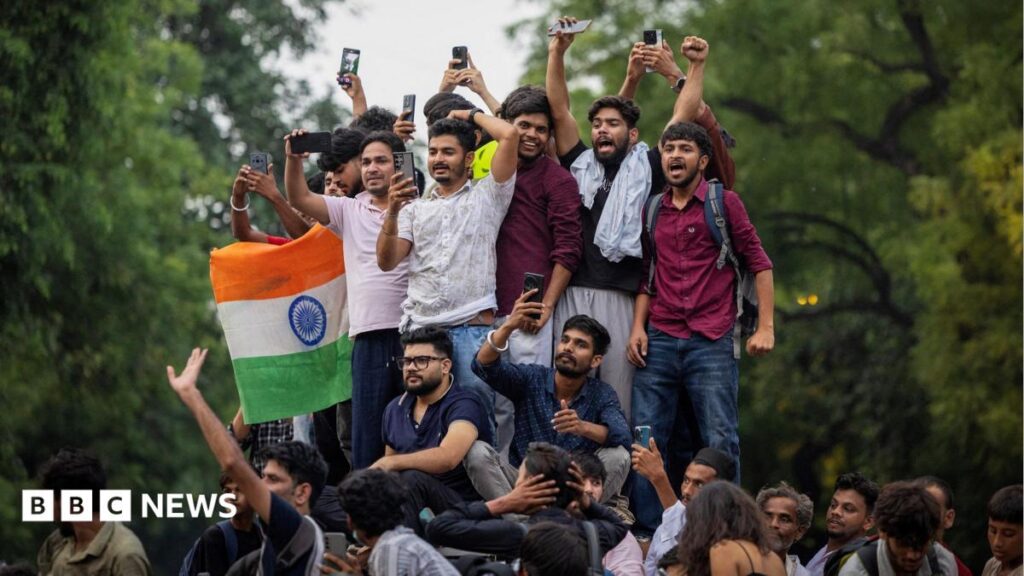
According to what has been reported: To play this video you need to enable JavaScript in your browser.This video can not be playedFigure caption, Watch: Protesters celebrate India’s education minister resignationByGeeta Pandey, Yogita Limaye, International correspondent and Vikas Pandey, India digital editor, Reporting fromDelhiPublished25 July 2026, 18:25 BSTUpdated 15 minutes agoIndia’s Cockroach Janta Party (CJP) has called off its five-week-long protest, hours after Education Minister Dharmendra Pradhan resigned.The CJP has called it a win for democracy and thousands of jubilant supporters continue to celebrate at Jantar Mantar, the main protest venue in Delhi.An online satirical campaign… India’s ‘cockroach’ protest called off after education minister quits What happened To play this video you need to enable JavaScript in your browser.This video can not be playedFigure caption, Watch: Protesters celebrate India’s education minister resignationByGeeta Pandey, Yogita Limaye, International correspondent and Vikas Pandey, India digital editor, Reporting fromDelhiPublished25 July 2026, 18:25 BSTUpdated 15 minutes agoIndia’s Cockroach Janta Party (CJP) has called off its five-week-long protest, hours after Education Minister Dharmendra Pradhan resigned.The CJP has called it a win for democracy and thousands of jubilant supporters continue to celebrate at Jantar Mantar, the main protest venue in Delhi.An online satirical campaign with an AI-generated cockroach as its mascot, the CJP is not a real party but has evolved into a powerful platform for young people’s anxieties and dissent.The protest has been the most visible expression of public anger against PM Narendra Modi’s government in recent years and gained momentum after Monday’s police crackdown on people marching to parliament left dozens injured.
The reporting also notes: Image source, ReutersImage caption, CJP founder Abhijeet Dipke has called Pradhan’s resignation a win for democracyPradhan announced his resignation on X in a post in Hindi saying he “respected the aspirations, dreams, and expectations of the youth” and was “pained by the events” of the past few days.”Considering the situation at Jantar Mantar and across the country – with the aim of preventing anti-national forces from exploiting it, preserving national… Source: India’s ‘cockroach’ protest called off after education minister quits via www.bbc.co.uk. This article was curated with AI assistance.
On Tamfitronics, coverage of stories such as “India's 'cockroach' protest called off after education minister quits” aims to give readers useful context alongside the headline, rather than simply repeating a single short news alert.
Understanding the Wider Context
Public opinion polling and focus group research increasingly shape how political announcements are timed and worded, even if the underlying substance has been in development for far longer.
Funding questions tend to sit at the heart of most policy debates, since even well-intentioned proposals can stall or be watered down if the budget behind them does not match the ambition.
Why It Matters
Reactions to political announcements typically split along familiar lines, with opposition parties, interest groups and commentators each framing the same decision through very different lenses depending on their priorities.
The relationship between central government and the electorate is often tested most visibly around moments like this, where promises made in opposition meet the practical constraints of governing.
Different Perspectives
Devolved administrations, local authorities and civil society groups often have their own stake in how national policy is interpreted and delivered on the ground, adding further layers of negotiation.
It’s worth noting that political positioning ahead of votes or elections often shapes both the timing and the framing of announcements, which is something seasoned observers factor into their reading of any story like this.
Practical Implications
Government communications teams typically manage the rollout of announcements carefully, and the language used in official statements can be as revealing as the substance of the policy itself.
The practical implementation of any policy shift is often where the real story lies, since announcements can look very different once they move from statement of intent to funded, delivered reality.
What Happens Next
Public and parliamentary scrutiny of political decisions has intensified in recent years, with select committees, independent watchdogs and a fragmented media landscape all providing additional layers of accountability.
Policy announcements of this kind rarely emerge in isolation — they tend to reflect a wider set of pressures on government, from public finances to shifting voter priorities, and are usually the product of extended internal debate before being made public.
Key considerations
Public opinion polling and focus group research increasingly shape how political announcements are timed and worded, even if the underlying substance has been in development for far longer.
Funding questions tend to sit at the heart of most policy debates, since even well-intentioned proposals can stall or be watered down if the budget behind them does not match the ambition.
Reactions to political announcements typically split along familiar lines, with opposition parties, interest groups and commentators each framing the same decision through very different lenses depending on their priorities.
The relationship between central government and the electorate is often tested most visibly around moments like this, where promises made in opposition meet the practical constraints of governing.
Frequently Asked Questions
What are critics saying?
Opposition politicians and interest groups typically respond quickly, offering competing interpretations of the same proposal.
What happens if the policy stalls?
Proposals can be delayed, amended or dropped entirely as they move through scrutiny, negotiation and, where relevant, a parliamentary vote.
Why now?
The timing of political announcements is rarely accidental, often reflecting parliamentary schedules, upcoming votes or wider economic pressures.
A Note on How This Story Is Being Covered
Stories with a clear human element tend to generate more engagement than purely procedural ones, even when the procedural details are, in the end, more consequential.
Editorial standards around sourcing, attribution and verification vary between outlets, which is part of why comparing several accounts of the same story can be worthwhile.
Understanding who benefits from a particular framing of a story is a useful, if sometimes uncomfortable, exercise for readers trying to evaluate coverage critically.
Editorial judgement about what counts as newsworthy is shaped by a mix of public interest, timeliness and relevance — factors that can shift as a story develops.
Stories that touch on public institutions or well-known figures often attract additional scrutiny, both from professional journalists and from members of the public scrutinising the coverage itself.
The volume and speed of modern news coverage means that stories can rise and fall in prominence quickly, even when the underlying issues they touch on remain relevant for much longer.
Public reaction to news stories, particularly on social media, can sometimes move faster than the verified facts themselves, which is part of why measured analysis is valuable.
Understanding the broader institutional or industry context behind a story often does more to illuminate its significance than any single additional fact about the event itself.
The distinction between confirmed fact, official claim and informed speculation is one that responsible coverage tries to maintain clearly, even when the underlying story is moving quickly.
Context from previous, related stories often helps explain why a particular development is considered significant enough to be reported in the first place.
For the most current and verified information, readers should refer to established news outlets continuing to cover this story.
Originally reported by bbc.co.uk. Adapted for our readers with AI assistance.
Thousands of young protesters in Delhi continue to demand education reforms and the resignation of Education Minister Dharmendra Pradhan after a police crackdown. The…
Facing a looming financial collapse, Thames Water’s main lenders have offered the UK government a ‘golden share’ and increased local authority involvement to avoid…
Facing record-breaking temperatures and severe drought, Thames Water has introduced a hosepipe ban impacting over 10 million customers across parts of southern England to…