
Business
Nigeria’s Economic Performance: Domestic Debt Rise and Agriculture Trade Shift in Q2 2026
Nigeria's economic landscape in the second quarter of 2026 presents a mixed picture of fiscal press...
TAMFIS NIG LTDRC 8067447CAC ACTIVEFinima, Bonny Island, Rivers State

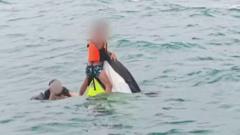
A French family's recreational outing turned into a harrowing overnight ordeal when their rented jet ski capsized off the coast of Koh Samui, Thailand's second-largest island. The 50-year-old father and his two sons — aged 5 and 7 according to multiple reports — were found alive on the morning of August 14, 2026, after drifting for over 16 hours in rough seas. Local official Amorn Chomchoey confirmed the rescue to AFP, stating the trio were exhausted, pale, and had swallowed significant amounts of seawater. The incident has prompted immediate regulatory action and renewed scrutiny of marine tourism safety standards on one of Thailand's most popular resort islands.
The family rented a jet ski from Chaweng Beach on the evening of August 13, 2026, for what was supposed to be a 45-minute ride. When they failed to return by nightfall, the rental operator raised the alarm, triggering a search operation that would span the night and involve multiple agencies.
Search efforts were initially hampered by darkness and rough sea conditions. Police, marine rescue workers, district personnel, and private jet ski operators deployed speedboats to comb the waters around Koh Samui. The search was reportedly called off temporarily during the darkest hours but resumed at first light.
At approximately 7:00 AM on August 14, rescuers located the family several kilometers offshore. The youngest son was found clinging to the overturned jet ski, while the father and older brother were floating nearby, kept afloat by life jackets. All three were conscious but severely exhausted.
Amorn Chomchoey told AFP that rescuers 'found them exhausted after swallowing a lot of seawater,' adding 'they were pale, especially the boys.' The family was immediately transported to a local hospital for evaluation.
Medical staff treated them for dehydration, hypothermia risk, and seawater aspiration. Remarkably, no serious injuries were reported. After several hours of observation and rehydration, all three were discharged the same day. The father later told French media that staying calm and keeping the children focused on breathing had been critical to their survival.
The rescue mobilized a coordinated response unusual for a single missing watercraft. Beyond official marine police and rescue teams, private jet ski operators volunteered their vessels and local knowledge of currents. District administration personnel coordinated logistics from shore.
Koh Samui's geography complicated the search: the island's irregular coastline and surrounding currents can carry drifting objects far from their starting point within hours. Rescuers expanded their search radius progressively through the night, guided by the jet ski's last known position and prevailing wind patterns.
The successful outcome has been attributed to the family's use of life jackets — mandatory for rentals but not always worn properly — and the father's decision to keep the group together with the capsized craft rather than attempting to swim to shore.
Within hours of the rescue, Amorn Chomchoey, in his capacity as a local government official, ordered the Koh Samui Marine Office to implement immediate safety audits of all jet ski rental businesses on the island. The directive includes verification of operating licenses, inspection of safety equipment, and review of rental procedures.
Operators have been instructed to cease rentals near sunset and to restrict customer routes to areas visible from shore or patrol boats. Amorn also floated the possibility of mandatory GPS tracking devices on rental watercraft, a measure already adopted in some other Thai marine tourism zones.
The incident has reignited debate about Thailand's marine tourism regulatory framework. While the country has strengthened safety standards following several high-profile incidents in recent years — including the 2018 Phoenix boat sinking off Phuket that killed 47 Chinese tourists — enforcement remains inconsistent across different islands and operators.
Koh Samui, located in the Gulf of Thailand, attracts over 2.5 million visitors annually. Water sports — particularly jet ski rentals — are a mainstay of the beach economy, with dozens of operators concentrated along Chaweng, Lamai, and Bophut beaches.
The industry operates under a patchwork of national regulations and local ordinances. The Marine Department oversees vessel registration and operator licensing, while district offices manage beach concessions and day-to-day compliance. This divided authority can create enforcement gaps, particularly for small, informal rental outfits.
Tourism operators on the island have generally welcomed the tightened oversight, recognizing that high-profile accidents damage the destination's reputation. Several major rental companies have already voluntarily adopted GPS tracking and enhanced pre-rental safety briefings beyond legal minimums.
The French Embassy in Bangkok confirmed it was providing consular assistance to the family. French media covered the story extensively, with outlets including La Dépêche and Midi Libre detailing the father's account of the ordeal.
The incident follows a pattern of tourist marine accidents in Southeast Asia that periodically draw diplomatic attention. Several European governments maintain travel advisories cautioning citizens about water sport safety standards in the region, though Thailand remains a top destination for French tourists, with over 800,000 arrivals annually pre-pandemic.
The rescue of the French family off Koh Samui stands as a rare positive outcome in a category of marine incidents that too often ends in tragedy. The convergence of preparedness — life jackets worn, a father's calm decision-making, a rental operator who noticed the overdue return, and a community-wide search response — created the conditions for survival. Yet the incident also exposes structural vulnerabilities: a regulatory framework that struggles to enforce consistent safety standards across hundreds of small operators, and a tourism economy that sometimes prioritizes volume over vigilance. The immediate reforms ordered by local authorities are necessary and welcome, but their durability will depend on sustained inspection capacity and political will. For the millions of visitors who enjoy Thailand's waters each year, the lesson is clear: safety equipment is not optional, rental briefings deserve full attention, and the sea — however inviting — demands respect.
Originally reported by bbc.co.uk. Adapted for our readers with AI assistance.
Keep reading
Business
Nigeria's economic landscape in the second quarter of 2026 presents a mixed picture of fiscal press...
Business
Liverpool manager Andoni Iraola is confronting a significant selection headache as two key forwards, Cod...
News
Health News tamfitronics [Editor’snote:[Editor’snote: This transcript was generated using both transcription ...
TAMFIS NIG LTD
Electrical and instrumentation engineering, bid preparation and consulting, IT and software.