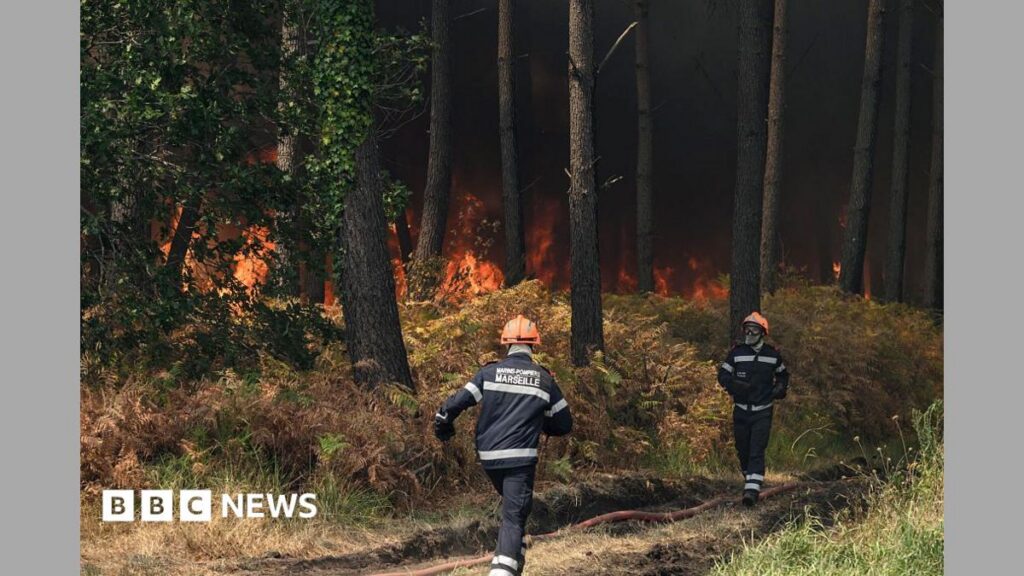
France’s Gironde Wildfires: Battling Blazes Amid Relentless Heat and Community Resolve
In late July 2026, the south-western Gironde region of France has been engulfed by devastating wildfires, fueled by record-breaking heat and dry conditions. Fire crews, supported by volunteers and aerial firefighting units, are locked in a continuous struggle to contain the rapidly spreading flames. This article provides an in-depth look at the firefighting efforts, the environmental factors exacerbating the situation, and the human stories emerging from the heart of the crisis.
France’s Gironde Wildfires: Battling Blazes Amid Relentless Heat and Community Resolve
Aerial Firefighting: The Frontline from Above
The battle against the Gironde wildfires prominently features aerial firefighting units, including three Canadair aircraft and multiple helicopters. These planes, carrying over 1,000 gallons of water each, execute coordinated water drops over the thick plumes of smoke and active flames. The Canadairs arrive in formation, maneuvering sharply to target the most intense fire zones, while helicopters follow with streams of red fire retardant to slow the fire’s advance.
This aerial intervention is vital in managing the wildfires’ rapid spread, especially given the challenging terrain and the sheer scale of the infernos. The water and retardant drops help to cool the flames and create containment lines, enabling ground crews to move in safely to tackle flare-ups on foot.
Ground Efforts: Firefighters and Volunteers in a Relentless Fight
On the ground, thousands of firefighters from across France have converged on Gironde, bringing manpower from regions as far north as Brittany and southern cities like Marseille and Lyon. Their work involves not only direct firefighting but also preventative measures such as watering soil and vegetation to reduce the risk of new fires igniting—a technique known locally as “noyer,” or “drowning.”
Volunteers play a crucial supporting role, often risking their own safety to deliver water or spray fires themselves. Hugo, a 26-year-old volunteer who returned from Bali to protect his family’s home, exemplifies the community’s determination. Despite the overwhelming destruction—over 50,000 hectares already lost—volunteers like Hugo and Maëlys, a nurse balancing hospital shifts with firefighting efforts, demonstrate a profound commitment to their homeland.
Environmental Conditions Fueling the Wildfires
The wildfires have been exacerbated by extreme environmental conditions. Temperatures have peaked around 40°C (104°F), creating tinderbox conditions in the region’s pine forests. The soil is described as powder-like, littered with dry pinecones and leaves, which act as fuel for the flames and contribute to the rapid spread of fires.
These conditions have made containment a game of constant vigilance, with new fires igniting unpredictably. Firefighters characterize the situation as a “cat and mouse” or “Whack-a-Mole” challenge, where controlling one flare-up often coincides with the emergence of another nearby.
Community Impact and Personal Stories
The human toll of the wildfires extends beyond environmental damage. Tens of thousands of residents and tourists have been forced to evacuate, leaving behind homes and livelihoods. Some, like Pierre Alexandre, have chosen to stay despite evacuation orders, driven by a desire to protect their property and a deep connection to the land. Alexandre’s decision to remain, even sitting on his roof amid the smoke, highlights the emotional complexity faced by those living in fire-prone areas.
Others express a mix of sadness and determination. Maëlys, whose face is marked by soot, speaks to the heartbreak of seeing her home and forest threatened. Yet, her dual role as a nurse and volunteer firefighter underscores the resilience and solidarity emerging within the community.
Challenges and Strategies in Containment
Containing the Gironde wildfires involves a combination of aerial and ground tactics, but the scale and intensity of the fires present significant challenges. The unpredictable nature of flare-ups means that firefighters must constantly adapt their strategies, focusing on containment rather than complete extinguishment.
The use of water drops and retardants from aircraft provides critical support, but ground crews must follow swiftly to secure containment lines and prevent new outbreaks. The “noyer” technique, watering vegetation to create firebreaks, is a key preventative measure, although its effectiveness is limited by the ongoing heat and dryness.
Coordination among fire services from across France reflects the national scale of the response, yet the vast area affected and the continuous threat of new fires mean that the situation remains precarious.
What this means
The wildfires ravaging France’s Gironde region represent a formidable environmental and humanitarian crisis, intensified by soaring temperatures and dry conditions. The combined efforts of professional firefighters, volunteers, and aerial support highlight a determined and coordinated response, though the unpredictable nature of the fires demands constant vigilance. As communities grapple with loss and uncertainty, their resilience and commitment offer a hopeful counterpoint to the devastation. The Gironde fires underscore the urgent need for continued investment in wildfire preparedness and climate adaptation strategies to mitigate future risks.
Editor’s note: The following is AI-generated commentary and context on this topic, not original reporting.
Broader Context and Outlook
The events described in “France’s Gironde Wildfires: Battling Blazes Amid Relentless Heat and Community Resolve” fit a pattern seen across much of Europe this decade: wildfires that spread faster and burn hotter than firefighting resources were originally built to handle, forcing agencies to rethink staffing, equipment, and mutual-aid agreements between regions.
Community resilience and coordinated regional firefighting resources are frequently cited by officials as the biggest factors in how quickly an area bounces back once the immediate crisis described here has passed.
Climate researchers have repeatedly linked the lengthening fire season in parts of Europe to drier soils, hotter summers, and vegetation that has become increasingly primed to burn, a trend that context like this helps illustrate in concrete terms.
Local authorities dealing with situations comparable to this one generally rely on a mix of early-warning systems, controlled burns, and public education campaigns to reduce the risk of similar outbreaks in future fire seasons.
Recovery after a fire like the one at the centre of this story usually involves more than rebuilding structures; land often needs to be stabilised and replanted to prevent erosion and flash flooding once rain eventually returns.
Insurance industry data from recent fire seasons across southern Europe suggests that claims tied to wildfire damage have risen sharply, a trend that is prompting insurers to reassess risk pricing in fire-prone regions.
Beyond the immediate danger to life and property, incidents of this scale tend to carry lasting economic effects — insurance losses, tourism disruption, and damage to forestry and agriculture that can take years to fully recover from.
Emergency planners responding to situations like this one typically juggle several competing priorities at once — active suppression, evacuation logistics, road closures, and public health advisories tied to smoke inhalation — often with limited visibility into how conditions will change hour to hour.
Originally reported by bbc.co.uk. Adapted for our readers with AI assistance.
Thousands of young protesters in Delhi continue to demand education reforms and the resignation of Education Minister Dharmendra Pradhan after a police crackdown. The…
Facing a looming financial collapse, Thames Water’s main lenders have offered the UK government a ‘golden share’ and increased local authority involvement to avoid…
Facing record-breaking temperatures and severe drought, Thames Water has introduced a hosepipe ban impacting over 10 million customers across parts of southern England to…