
News
RUSSIA versus NATO and BRICS vs. NATO Military SWOT
Recall that Poland’s Minister Sikorski’s core claim is partially supported by the numbers, but the framing “quite quickly” and “without the U.S.” does not…
TAMFIS NIG LTDRC 8067447CAC ACTIVEFinima, Bonny Island, Rivers State

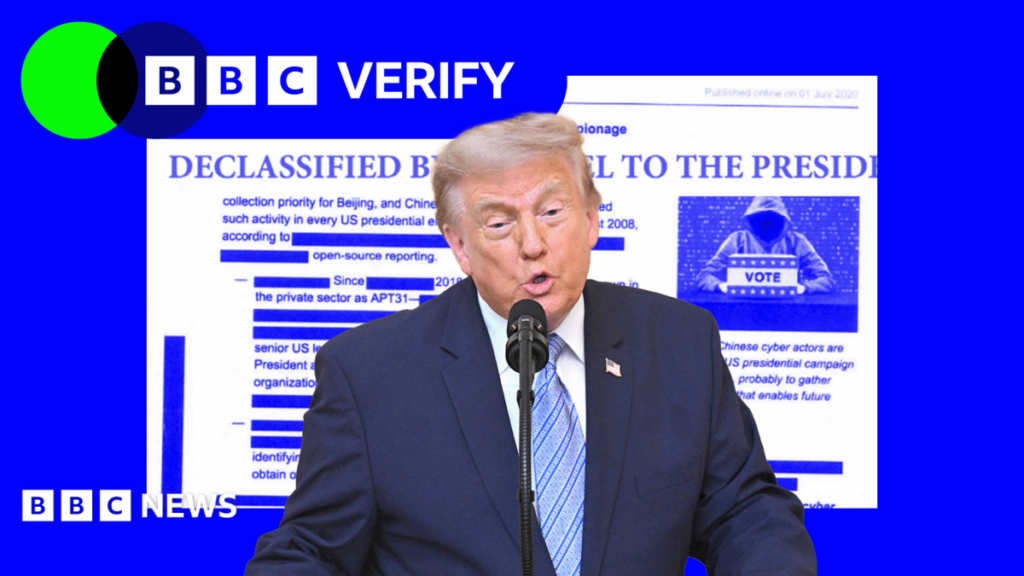
In a recent White House address, former President Donald Trump reignited debates over the integrity of US elections, particularly focusing on alleged vulnerabilities and foreign interference. He referenced hundreds of declassified intelligence documents as evidence of systemic election flaws and fraud, including claims of large-scale data breaches by China and widespread non-citizen voter registrations. This article analyzes the released files and related reports to assess the validity of these claims, offering a balanced perspective on what the evidence shows and what remains unproven.
In a 26-minute speech delivered from the White House East Room, President Trump asserted that the US election system was "catastrophically short" of security. He suggested that declassified intelligence files would reveal "shocking vulnerabilities" and extensive foreign interference, particularly by China. These claims come amid ongoing political tensions and debates over election integrity following the 2020 presidential election, which Trump lost.
The White House released four sets of documents labeled as "election integrity" files. BBC Verify and other analysts have reviewed these files, many of which are heavily redacted. The overall assessment is that while the files confirm some concerns about data security and foreign interest in voter information, they do not provide evidence of election interference or fraud that altered the outcome of recent elections.
China featured prominently in Trump’s narrative as a malign actor engaging in "sinister election meddling." The declassified documents support the claim that China sought to acquire US voter data, including publicly available or commercially purchasable information. One document mentions the compromise of over 200 million voter records, though it does not specify the timeframe or the exact nature of the breach due to heavy redactions.
Despite these data acquisition efforts, the files do not indicate that China engaged in direct election tampering or manipulation on a scale comparable to Russia’s interference in 2016, which Trump barely mentioned. A 2021 report by the US National Intelligence Council (NIC) assessed with high confidence that China did not interfere in the 2020 election.
Trump claimed that tens of millions of voter records in 18 states were "bought, stolen or hacked" by China, but the documents only confirm that voter registration rolls were compromised without detailing the impact or confirming any manipulation of votes.
Concerns about the security of voting machines and election infrastructure have long been bipartisan priorities, especially after the contested 2000 election and Russia’s interference in 2016. Most US votes are recorded on paper ballots, which provide a physical audit trail.
The released documents acknowledge vulnerabilities in ballot preparation and voting machines, particularly those without paper backups. A January 2020 NIC assessment noted that these systems are susceptible to cyber, supply chain, and insider threats. However, it also emphasized that the distribution of voting machine storage and security measures make large-scale coordinated manipulation difficult.
Trump cited these assessments to argue that US adversaries like Russia, China, Iran, and North Korea have the capability to compromise election infrastructure. While technically accurate regarding capability, the documents do not provide evidence that such compromises occurred on a scale that affected election outcomes.
It is also noteworthy that Trump’s administration took steps that reduced funding and oversight for agencies responsible for election security, potentially undermining efforts to safeguard the electoral process.
Michigan, a key battleground state, has been a focal point of Trump’s allegations of election fraud. His recent speech highlighted claims of widespread fraudulent voter registrations, particularly in Muskegon, where officials investigated irregularities in 2020.
The documents reveal that local election officials referred a case involving 8,000 to 10,000 questionable voter registration applications to police. The FBI tested a sample and found many applications did not match database records. Despite this, after nearly five years, the FBI closed the investigation without identifying criminal violations.
Trump has called for renewed investigations, citing these unresolved concerns. However, local news reports at the time described the issue as irregularities rather than confirmed fraud, and no evidence has emerged to suggest that these registration issues impacted the 2020 election results.
One of Trump’s more specific claims involved the registration of approximately 278,000 non-citizens to vote in federal elections. The White House released a one-page Department of Homeland Security (DHS) document stating that over 250,000 non-citizens were registered in just four states based on public data files reviewed.
However, this document lacks supporting evidence, explanations of methodology, or verification details, making it impossible to assess the accuracy of the figure. Historically, documented cases of non-citizen voting in US elections have been extremely rare.
Trump’s assertion that Democrats rely on votes from undocumented migrants remains unsubstantiated by the released files. The claims appear to serve political objectives tied to proposed election-security legislation favored by Republicans.
The recent release of declassified intelligence files provides valuable insights into election security challenges, including foreign interest in voter data and vulnerabilities in voting infrastructure. However, these documents do not support allegations of widespread fraud or interference that altered the results of recent US elections, including the pivotal 2020 contest. As debates over election integrity continue, it is crucial to distinguish between verified facts and politically motivated claims. Strengthening election security remains an important bipartisan goal, but it must be pursued based on evidence and transparency rather than unsubstantiated assertions.
Originally reported by bbc.co.uk. Adapted for our readers with AI assistance.
Keep reading
News
Recall that Poland’s Minister Sikorski’s core claim is partially supported by the numbers, but the framing “quite quickly” and “without the U.S.” does not…
News
Thousands of young protesters in Delhi continue to demand education reforms and the resignation of Education Minister Dharmendra Pradhan after a police crackdown. The…
News
Facing a looming financial collapse, Thames Water’s main lenders have offered the UK government a ‘golden share’ and increased local authority involvement to avoid…
TAMFIS NIG LTD
Electrical and instrumentation engineering, bid preparation and consulting, IT and software.