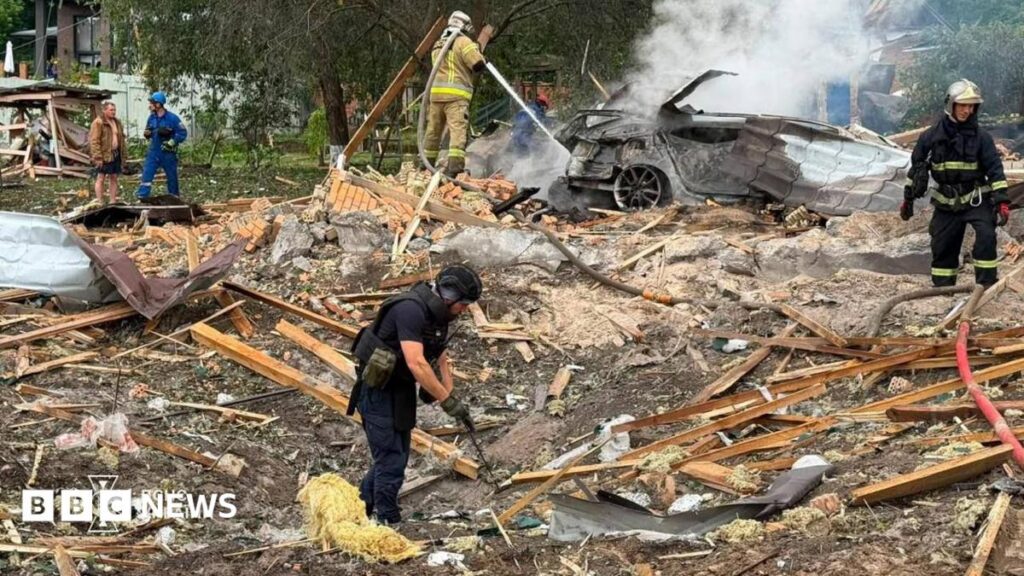
On 24 July 2026, a Russian missile strike near Kyiv targeted a drone exhibition, killing ten people and injuring around 100 others. This attack, alongside other recent strikes on both Ukrainian and Russian territories, reflects the ongoing escalation in the Russia-Ukraine conflict. The incident has raised concerns about the safety of public military-related events and the strategic targeting of logistics hubs, as both sides intensify their military operations. This article examines the details of the attacks, their implications for the conflict, and the broader geopolitical context.
The missile attack near Kyiv struck an exhibition showcasing drone technology, a sector increasingly vital to Ukraine’s defense efforts. At least ten people were killed and approximately 100 injured in the daytime assault. The event was attended by prominent figures from the defense sector, underscoring the significance of the gathering.
Ukrainian President Volodymyr Zelensky confirmed the casualties via social media and noted that the attack involved three ballistic missiles, with only one intercepted by Ukrainian air defenses. Emergency services were seen clearing rubble at the site, highlighting the strike's destructive impact.
Among those initially feared missing were Defence Ministry adviser Serhiy Beskrestnov, known as Flash, and Lyuba Shypovych, a key figure in developing Ukrainian military technology. Both later confirmed their safety, with Beskrestnov revealing he had avoided the event due to security concerns.
Russia’s Defence Ministry acknowledged responsibility for the attack, stating that high-precision long-range weapons targeted a site where drones intended for strikes on Russian civilian locations were being demonstrated. The ministry claimed that drone producers and representatives involved in planning attacks on Russia were present.
This incident marks at least the third time since the 2022 invasion that a drone exhibition has been targeted, raising questions about the prudence of holding such public events amid ongoing hostilities. Ukrainian authorities have launched investigations into the decision to hold the exhibition and the adequacy of safety measures.
Additional Attacks and Counterstrikes
On the same day, Russian glide bomb attacks killed five people in the eastern Ukrainian city of Sloviansk, further illustrating the conflict’s toll on civilian populations. Meanwhile, Ukrainian forces conducted overnight strikes deep inside Russia, killing six people and injuring 26 in the city of Kirov, located over 1,000 kilometers from the front line.
The Ukrainian strikes also targeted warehouses of Wildberries, Russia’s largest online retailer, in the St Petersburg area. These attacks are part of a broader Ukrainian strategy to disrupt Russian military logistics by targeting supply chains and commercial hubs that may facilitate the procurement of military equipment.
President Zelensky described the Kirov strike as hitting a crucial military facility supplying components for aircraft and missile systems used against Ukraine. The attacks on Wildberries have reportedly affected numerous small and medium-sized businesses within Russia, indicating the wider economic impact of the conflict.
These developments come amid warnings from Ukrainian intelligence that Russia is preparing another major missile strike, potentially within 48 hours, signaling the likelihood of continued escalation.
Geopolitical Implications and International Reactions
The ongoing conflict continues to draw international attention, with Ukrainian President Zelensky scheduled to visit the United States next week. He is expected to meet with former President Donald Trump, as Washington seeks to revive peace negotiations between Ukraine and Russia.
In a related development, Romanian President Nicusor Dan reported that a Romanian F-16 fighter jet intercepted a Russian drone breaching Romanian airspace. This incident highlights the conflict’s spillover effects into neighboring countries and the broader regional security concerns.
The targeting of civilian and commercial sites, such as the drone exhibition and Wildberries warehouses, has sparked widespread outrage. Critics argue that holding public events related to military technology in a war zone poses significant risks to civilians and military personnel alike.
Ukrainian authorities are investigating the circumstances surrounding the drone exhibition attack, including the decision-making process and security protocols. This scrutiny reflects the complex balance between showcasing military advancements and safeguarding lives during ongoing hostilities.
What this means
The recent missile strike on the drone exhibition near Kyiv and the concurrent attacks on both Ukrainian and Russian territories underscore the intensifying nature of the Russia-Ukraine conflict. The targeting of military technology showcases and logistics hubs reveals strategic efforts by both sides to undermine each other’s capabilities. However, these actions come with significant human costs and raise critical questions about civilian safety and the conduct of war. As Ukraine prepares for high-level diplomatic engagements and Russia signals potential further strikes, the conflict remains volatile, with regional security implications extending beyond the immediate battlefield.
Editor’s note: The following is AI-generated commentary and context on this topic, not original reporting.
Strikes on Civilian and Dual-Use Infrastructure
Missile strikes on facilities such as exhibitions or logistics hubs illustrate the difficulty of distinguishing purely civilian sites from locations with some connection to a country’s defence industry during an active conflict, a distinction that has become increasingly contested as drone warfare has grown central to the fighting on both sides. International humanitarian law generally requires that attacks distinguish between military and civilian objects, though determining a target’s precise status can be difficult to verify independently in the midst of an active war.
Casualty figures from strikes of this kind are typically confirmed and revised over the hours and days following an attack as emergency services complete search and rescue operations, and international reaction often follows a familiar pattern of condemnation from allied governments alongside calls for renewed diplomatic efforts toward a ceasefire. Each escalation tends to reinforce how difficult a durable resolution to the conflict remains, even as both sides continue to sustain significant military and civilian costs.
Thousands of young protesters in Delhi continue to demand education reforms and the resignation of Education Minister Dharmendra Pradhan after a police crackdown. The…
Facing a looming financial collapse, Thames Water’s main lenders have offered the UK government a ‘golden share’ and increased local authority involvement to avoid…
Facing record-breaking temperatures and severe drought, Thames Water has introduced a hosepipe ban impacting over 10 million customers across parts of southern England to…