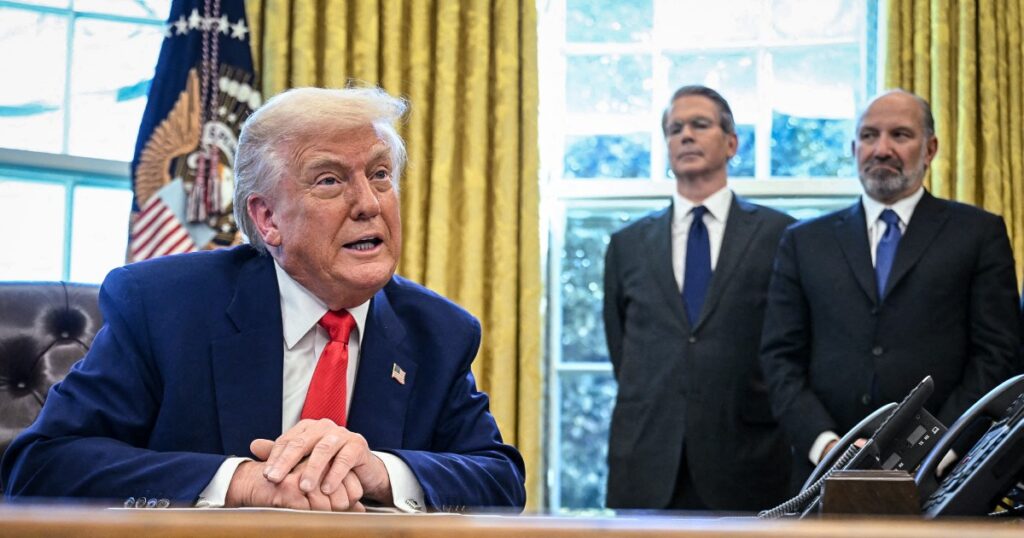
President Donald Trump's recent decision to delay tariff implementation deadlines has created a complex landscape of optimism and apprehension among international trade partners. While major economies like Japan, South Korea and the European Union see renewed hope for negotiated settlements, smaller exporters and businesses worldwide grapple with unprecedented uncertainty. This development follows Trump's initial 'Liberation Day' tariffs announced in early April, which were subsequently dialled back to 10% for most countries to allow time for negotiations. The latest move extends the deadline to August 1, described by Trump as final with no further extensions granted, reflecting his frustration with prolonged trade talks that have not yielded the swift results he anticipated.
Mixed Reactions from Major Trade Partners
Japan, South Korea and the European Union have expressed cautious optimism following Trump's tariff deadline extension, viewing it as an opportunity to reach mutually beneficial agreements. Japanese Prime Minister Shigeru Ishiba emphasised his government's commitment to pressing ahead with negotiations that would benefit both nations while protecting Japan's national interests. Japan, facing a 25% general U.S. tariff, is particularly keen to secure relief for its export-dependent automotive industry from Trump's separate 25% automotive tariffs, while resisting demands for increased purchases of American rice. South Korea's newly inaugurated President Lee Jae Myung has similarly pledged to intensify talks for 'a mutually beneficial result', though analysts warn he will not be easily swayed in negotiations.
The European Union, which did not receive a warning letter or adjustment to its prescribed 20% tariff rate (double the 10% baseline), is reportedly seeking carve-outs for specific sectors in any potential deal. Sources familiar with EU talks indicate discussions could involve exemptions for aircraft and parts, medical equipment and alcoholic spirits, with particular attention to allowing certain automakers to export to the U.S. at rates below the 25% auto tariff. This approach mirrors the framework agreement previously established with the United Kingdom, which included carve-outs for autos, steel and aircraft engines.
India appears to be making progress toward a deal, with prospects looking more favourable compared to smaller nations. However, countries such as South Africa, Thailand and Malaysia face significant challenges, with tariff rates of 30%, 36% and 25% respectively creating substantial pressure on their export economies.
Challenges for Smaller Economies and Businesses
While major trade partners see potential for negotiation, smaller exporters like South Africa are expressing confusion and concern over the tariff rates imposed. South African President Cyril Ramaphosa criticised the 30% U.S. tariff as being out of sync with South Africa's average tariff rate of 7.6%, yet instructed his negotiators to urgently engage with the Trump administration on a framework first submitted by South Africa on May 20. This highlights the difficult position faced by smaller economies attempting to navigate complex trade negotiations with limited leverage.
The impact on businesses is perhaps most acute, with companies across various sectors reporting paralysis in decision-making due to the rapidly shifting tariff landscape. Hubertus Breier, chief technology officer for Germany's Lapp Holdings – a family-owned manufacturer of cables, wires and robotics for factories – described how the uncertainty is already causing financial losses. 'We are already incurring losses simply because of the uncertainty of the daily changing situation,' Breier explained, noting the difficult choices between absorbing additional costs or passing them on to customers, with either option threatening long-term viability.
Small businesses are particularly vulnerable to these fluctuations. DeMejico, a family business in Valencia, California with a plant in Mexico producing traditional Spanish and Mexican-style furniture, is struggling to adapt to 50% tariffs on imported steel. Company president Robert Luna explained their strategy of importing heavy steel components separately to simplify tariff calculations before installation at their Los Angeles-area showroom. Luna expressed concern about further cost increases if Trump imposes reciprocal tariffs on Mexico, admitting his primary focus is simply keeping the company alive amidst the uncertainty.
Trump's Negotiation Strategy and Market Implications
Trade experts suggest Trump's deadline extension reflects his growing frustration with negotiations that have proven more complex than his initial expectation of achieving '90 deals in 90 days'. William Reinsch, a former U.S. Commerce Department official and senior trade adviser at the Center for Strategic and International Studies, observed that Trump has 'put a new number to it and extended the deadline' after finding that trading partners were not conceding to his demands as anticipated.
Stephen Miran, chairman of the White House's Council of Economic Advisers, indicated that more deals remain possible before the end of the week if countries make concessions deemed worthy by Trump. However, Ryan Majerus, another former U.S. Commerce official now at King and Spalding law firm, cautioned that the three-month pause had not produced desired results, suggesting Trump is now seeking to maximise his negotiating leverage by 'pressure-testing things and see how far they can go', particularly with countries showing little movement in talks.
Despite steadier markets and strong economic data providing some room for maneuver, experts warn that the increasing granularity of negotiations makes resolution more difficult. The situation creates significant challenges for businesses attempting to plan supply chains and cost structures, with the unpredictability of daily policy changes hindering long-term strategic planning and investment decisions across global markets.
What this means
The extension of Trump's tariff deadlines has created a dichotomy of hope and uncertainty across the global trade landscape. While major economic powers see opportunities for negotiated settlements that could mitigate economic disruption, smaller economies and businesses of all sizes continue to navigate treacherous waters of unpredictability. For companies attempting to plan for the future, the daily-changing tariff environment presents formidable challenges to supply chain management, pricing strategies and long-term viability. As the August 1 deadline approaches, the focus will shift to whether trading partners can secure concessions deemed sufficient by the Trump administration, or whether businesses will continue to absorb the costs of uncertainty in an increasingly volatile international trade environment.
Originally reported by nbcnews.com. Adapted for our readers with AI assistance.
Governor Babagana Zulum's administration transformed Borno's devastated health infrastructure into a regional centre of excellence, committing over 15 percent of the state budget to…