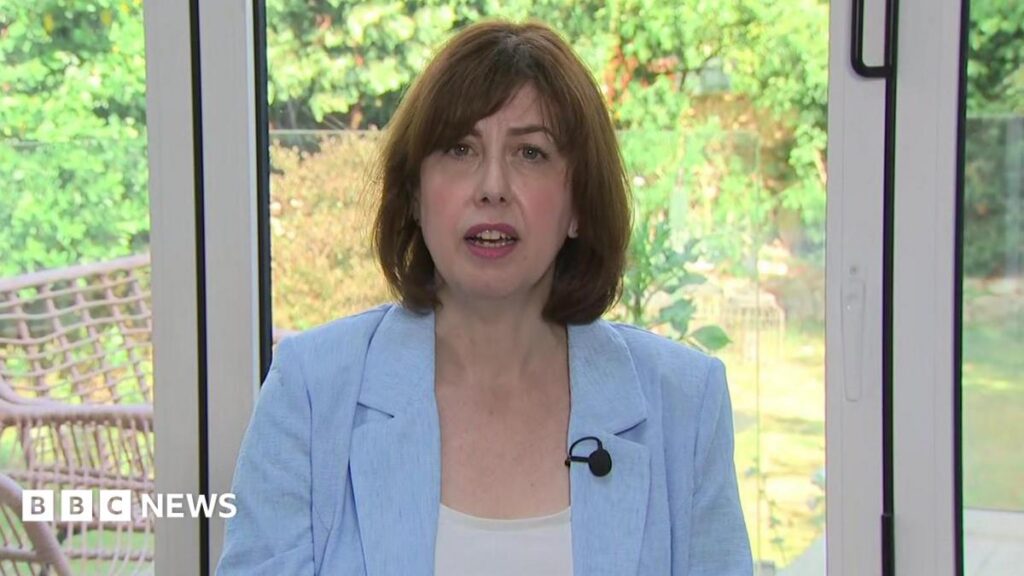
Burnham will be bolder but stick to Labour manifesto, deputy leader says
ByKate WhannelPolitical reporterPublished27 minutes agoAndy Burnham will stand by promises made in Labour's 2024 election manifesto but will be bolder and more ambitious, Labour's deputy leader Lucy Powell has said. Speaking to the BBC's Sunday with Laura Kuenssberg, Powell said Burnham's leadership would be a moment for "clearing the decks of all the other things that might distract" from the cost of living and the economy.Burnham will replace Sir Keir Starmer as prime minister on Monday, following a meeting with King Charles III.Conservative leader Kemi Badenoch has said the incoming…
Burnham will be bolder but stick to Labour manifesto, deputy leader says
What happened
ByKate WhannelPolitical reporterPublished27 minutes agoAndy Burnham will stand by promises made in Labour's 2024 election manifesto but will be bolder and more ambitious, Labour's deputy leader Lucy Powell has said. Speaking to the BBC's Sunday with Laura Kuenssberg, Powell said Burnham's leadership would be a moment for "clearing the decks of all the other things that might distract" from the cost of living and the economy.Burnham will replace Sir Keir Starmer as prime minister on Monday, following a meeting with King Charles III.Conservative leader Kemi Badenoch has said the incoming prime minister was a "people pleaser" at a time when the country needed someone who could "take tough decisions, who can face down Labour MPs"."The job is not a popularity contest. It is making the lives of all of the people outside this building better. And he has not said what he's going to do. It's all airy-fairy stuff," she said.What we know about Andy Burnham's policiesPublished2 days agoFive headaches Andy Burnham will have to deal with as PMPublished2 days agoRuthless plotter? Flip-flopper? Dad dancer? Insiders reveal the real Andy BurnhamPublished20 hours agoBurnham was officially declared as the new Labour Party leader on Friday following a short contest in which he was the only candidate, having secured the backing of 379 MPs. Some opposition parties have urged Burnham to call…
Editor’s note: The following is AI-generated commentary and context on this topic, not original reporting.
What a Change in Party Leadership Typically Signals
Statements from senior party figures in the immediate aftermath of a leadership transition are typically read closely by political commentators for early signals of policy continuity or change, particularly around flagship commitments made in the party’s most recent election manifesto. Deputy leaders and senior cabinet figures often play a key public role during a transition period, providing reassurance to the party’s base while a new leader establishes their own voice and priorities.
References to being “bolder” while still honouring prior manifesto commitments are a common formulation used by incoming leaders and their allies, designed to signal renewed energy and ambition without appearing to abandon the platform on which the party was originally elected to government. Political journalists typically parse such language carefully for clues about which specific policy areas might see the most significant shifts in emphasis under new leadership.
The Formalities of a UK Leadership Transition
The formal transfer of power in the UK follows a well-established constitutional process, with an outgoing prime minister tendering their resignation to the monarch before the incoming prime minister is invited to form a government, a process that typically unfolds within a single day once a governing party has confirmed its new leader. Cabinet reshuffles frequently follow within days of a new prime minister taking office, offering one of the clearest early indicators of the incoming leader’s policy priorities and the internal balance of power within the governing party.
Opposition parties typically use the transition period to sharpen their own critique of the governing party, framing the change in leadership as either an opportunity for meaningful course correction or, alternatively, as evidence of deeper instability within the government.
Balancing Continuity and Change in Government Messaging
Incoming administrations typically face early questions about how closely they intend to follow the policy platform of their predecessor, particularly when the change in leadership occurs mid-term rather than following a general election. Senior party figures speaking publicly during this period often walk a careful line, reassuring both the parliamentary party and the wider electorate that core commitments remain intact while still signalling scope for a fresh approach under new leadership.
Media scrutiny of an incoming prime minister’s first major policy statements tends to be particularly intense, with journalists and opposition figures alike looking for any indication of departure from previously stated positions. How effectively a new leader’s team manages this messaging in the opening weeks is often seen by political analysts as an important early indicator of the government’s overall communications strategy going forward.
Early Signals to Watch in the Coming Weeks
Political analysts typically watch a new prime minister’s first cabinet appointments, first major speech and initial legislative priorities as the clearest early signals of how ambitious or cautious a new government intends to be. Public and party reaction to these early moves generally shapes the narrative of a premiership’s opening chapter well before any substantial policy has had time to take effect or be judged on its results.
Backbench members of the governing party are typically watched closely in the days following a leadership change as well, since their public statements of support or reservation can offer an early indication of how unified the party is likely to be behind the new leader’s agenda.
Think tanks and policy institutes across the political spectrum typically publish rapid-response analysis in the days following a leadership change, offering early assessments of what a new premiership might mean for specific sectors ranging from housing to healthcare.
International observers and allied governments also typically watch a UK leadership transition closely, assessing what continuity or change in domestic priorities might mean for foreign policy and international cooperation going forward.
Public polling conducted in the immediate aftermath of a leadership transition often provides an early, if imperfect, gauge of how the public is responding to a new prime minister’s initial signals, though most pollsters caution against reading too much into numbers gathered before any substantial governing record exists.
Originally reported by bbc.co.uk. Adapted for our readers with AI assistance.
Thousands of young protesters in Delhi continue to demand education reforms and the resignation of Education Minister Dharmendra Pradhan after a police crackdown. The…
Facing a looming financial collapse, Thames Water’s main lenders have offered the UK government a ‘golden share’ and increased local authority involvement to avoid…
Facing record-breaking temperatures and severe drought, Thames Water has introduced a hosepipe ban impacting over 10 million customers across parts of southern England to…