
Educational Resources
The Impact of Digital Twins in Oil & Gas Plant Maintenance
The Impact of Digital Twins in Oil & Gas Plant Maintenance is a topic that deserves thorough explora...
TAMFIS NIG LTDRC 8067447CAC ACTIVEFinima, Bonny Island, Rivers State

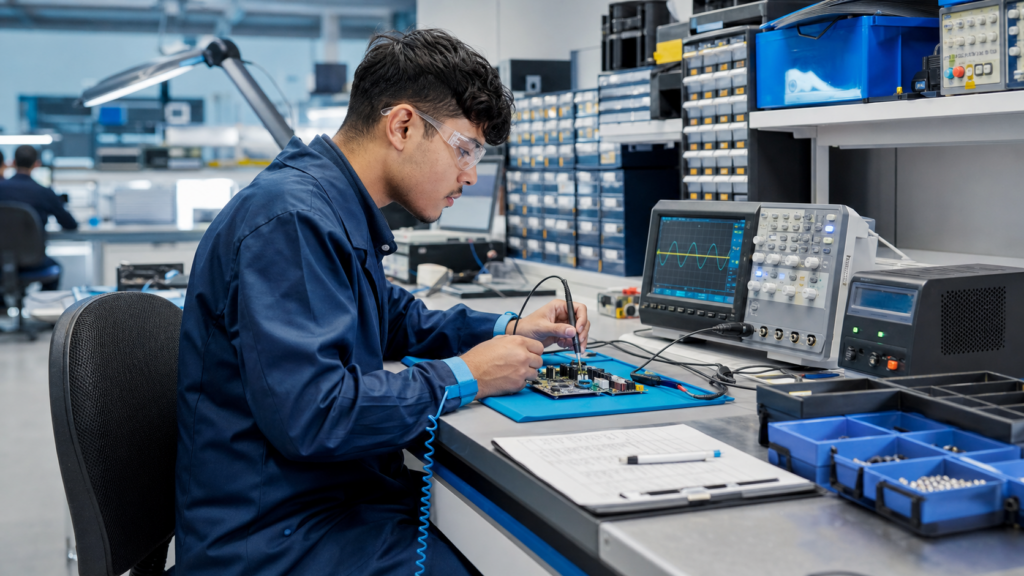
An entry-level electronics engineering technician turns drawings, procedures and engineering intent into reliable physical results. The role may involve assembling prototypes, operating test equipment, recording measurements, diagnosing faults, supporting production or maintaining electronic systems. It is practical work, but it is not merely manual: good technicians understand why a test is performed, recognise an implausible result and communicate evidence clearly.
Job titles vary between countries and sectors. Electronics technician, test technician, engineering technician, calibration technician and production technician can overlap. Read the duties and equipment listed in an advert rather than assuming that the title has one universal meaning.
In a development laboratory, a technician may build an engineer’s prototype, modify wiring, capture oscilloscope traces and report unexpected behaviour. In manufacturing, the focus may be repeatable assembly, automated testing, defect analysis and process improvement. Service roles involve inspection, safe disassembly, component replacement and verification that a repaired product meets its specification. Calibration laboratories compare instruments with traceable references and control environmental conditions.
The Engineering Council describes registered Engineering Technicians as people who apply proven techniques and procedures to practical engineering problems. Its current EngTech guidance highlights contribution to design, manufacture, commissioning, operation or maintenance, together with technical responsibility, communication and professional values. Registration rules are UK-specific, but the description captures the breadth of competent technician work.
Do not memorise component names without learning expected behaviour. Before measuring a circuit, estimate the likely voltage or waveform. If the instrument displays something impossible, pause and check the range, reference point, probe connection and circuit state. This habit protects equipment and shortens fault-finding.
Random component replacement is expensive and teaches little. Begin by confirming the reported symptom and gathering context: when did it occur, under what load and after which change? Inspect for obvious damage, then divide the system into functional blocks. Verify power, clocks, resets, inputs and outputs in a logical order. Change one variable at a time and record the result.
A strong fault report states the requirement, observed behaviour, test conditions, instruments used, evidence and conclusion. “Board faulty” is weak. “Output remained at 0.3 V with a 1 kΩ load while the input and supply met specification; replacing the output module restored 4.9 V” is useful and reproducible.
Electrostatic discharge can damage sensitive parts without producing a visible spark. Follow the employer’s ESD-controlled-area procedure, use verified grounding equipment and handle assemblies by suitable edges. Keep food, loose metal and unnecessary materials away from the bench. Return components to approved protective packaging.
Electrical safety takes priority over completing a task. Know the limits of your authorisation and equipment. Do not work on exposed hazardous voltages simply because a test is urgent. The UK Health and Safety Executive’s electrical safety guidance stresses competence, secure isolation and proving equipment dead. Workplace procedures and local law determine the exact method.
Possible routes include a technical college qualification, apprenticeship, vocational diploma, associate-level programme, military training or structured workplace development. Requirements vary. Prioritise programmes with supervised laboratories, assessed practical tasks, mathematics and employer involvement. Ask whether equipment is current and whether students must diagnose faults rather than only follow assembly instructions.
Qualifications can establish underpinning knowledge, but competence develops through repeated responsible practice. The Engineering Council’s UK-SPEC groups professional competence into knowledge, problem-solving, responsibility, communication and professional commitment. Even outside the UK, these categories provide a useful checklist for development.
Document three pieces of work that show different abilities. One might be a neatly assembled low-voltage circuit with inspection photographs. Another could be a fault-finding exercise with before-and-after measurements. A third might automate data collection from a sensor and present the results. Explain requirements, safety limits, tools, method, problems and verification.
Never publish an employer’s proprietary drawing, customer data or security detail. A portfolio can use personal projects, training boards and sanitised descriptions. Accuracy matters more than visual drama. State which work was yours and which parts were supplied by a tutor or team.
Adapt the CV to the actual vacancy. Name instruments and processes only when you can discuss how you used them. Replace vague claims with evidence: number of assemblies tested, type of fault isolated, documentation produced or improvement measured. Include relevant safety, quality and ESD training with dates.
Interviewers may present an unfamiliar circuit or faulty product. They are often assessing method rather than instant recall. Clarify the requirement, identify hazards, describe initial checks, propose measurements and explain how each result would guide the next step. Admit when specialist authorisation is required.
A dependable entry-level technician is careful, curious and consistent. Employers can teach a particular product more easily than they can correct unsafe habits or unreliable records. Build strong fundamentals, practise structured troubleshooting and demonstrate that your measurements can be trusted.
Keep reading
Educational Resources
The Impact of Digital Twins in Oil & Gas Plant Maintenance is a topic that deserves thorough explora...
Educational Resources
Smart homes have transitioned from futuristic concepts to tangible realities that enhance everyday livin...
Educational Resources
As a small or medium-sized business owner in Nigeria, you are a master of spinning plates. You are the CEO, the head of sales,…
TAMFIS NIG LTD
Electrical and instrumentation engineering, bid preparation and consulting, IT and software.