
Educational Resources
The Impact of Digital Twins in Oil & Gas Plant Maintenance
The Impact of Digital Twins in Oil & Gas Plant Maintenance is a topic that deserves thorough explora...
TAMFIS NIG LTDRC 8067447CAC ACTIVEFinima, Bonny Island, Rivers State

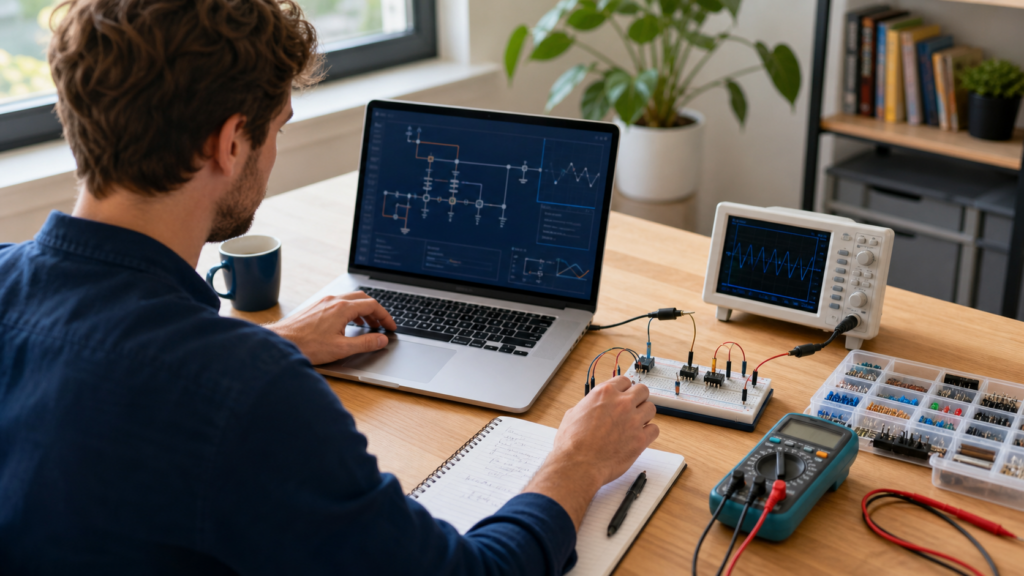
An online electronics engineering course can provide an excellent route into circuit theory, embedded systems or professional development, but a polished course page does not guarantee useful learning. Electronics is both analytical and practical. A worthwhile programme must therefore do more than present videos: it should help you calculate, build, measure, troubleshoot and explain real circuits safely.
The right choice depends on your starting point and intended outcome. A curious beginner needs a structured foundation and low-voltage experiments. A working technician may need a focused module on instrumentation or digital control. Someone seeking an academic qualification must check formal entry requirements, assessment and recognition rather than assuming that any completion certificate carries professional or university credit.
Write a specific learning goal. “Understand electronics” is too broad; “analyse basic analogue circuits and verify them with a multimeter and oscilloscope” is actionable. Decide whether you want personal enrichment, preparation for further study, evidence for an employer or a regulated qualification. Then identify the time, equipment and mathematical preparation you can realistically provide.
A credible syllabus shows a sequence, prerequisites and assessable outcomes. It should state what learners will be able to calculate or produce, not merely what topics the tutor will mention. Look for worked problems followed by independent tasks, opportunities to interpret measurements and a final activity that combines several skills.
Established open providers can help you judge depth. MIT OpenCourseWare’s electrical engineering materials expose syllabuses, notes and assignments from university subjects. India’s official NPTEL course catalogue also offers engineering courses from participating institutions. These resources may not provide the support or credential you need, but they are useful reference points when assessing topic coverage.
Electronics becomes frustrating when a course hides the mathematics until it is suddenly required. Beginners should be comfortable rearranging equations, using scientific notation and reading graphs. Alternating-current and signal courses may require complex numbers, logarithms and introductory calculus. Control, communications and signal processing demand more.
This is not a reason to delay indefinitely. Choose a programme that introduces the necessary mathematics in context and supplies practice. If an equation appears, you should learn what its variables mean, when its assumptions hold and how a measured result could differ from the ideal calculation.
Simulation is valuable, but it cannot reproduce every loose connection, tolerance, loading effect or probing mistake. A good beginner course uses safe, current-limited, extra-low-voltage experiments. A breadboard, modest component set, reliable multimeter and protected bench supply can support substantial learning. An entry-level oscilloscope becomes useful once you understand grounding and probe limits.
Avoid any course that encourages an unqualified learner to experiment directly on mains equipment. The UK Health and Safety Executive notes that electricity can cause shock, burns, fire and explosion, and stresses competence and proper precautions in its electrical safety overview. Country-specific rules differ, but online access never makes hazardous work suitable for unsupervised practice.
Short videos can explain a concept, yet learning is demonstrated by solving a new problem. Check whether the course includes automatically marked questions, design exercises, laboratory reports, tutor review or peer discussion. Feedback should identify the reasoning behind an error. A platform that reveals the answer without explaining the misconception encourages guessing.
Sample a lesson before paying. Is the diagram legible on your device? Does the tutor define symbols and units? Are captions and transcripts available? Can you download data sheets and assignments? Does the course show component tolerances and measurement uncertainty, or only perfect simulations? Clear production helps, but technical care matters more than animation.
A platform certificate usually proves participation or completion under that platform’s rules. It is not automatically an accredited degree, professional registration or permission to undertake regulated work. If recognition matters, confirm the awarding institution, assessment method, credit value and status directly with the relevant university, regulator, professional body or employer before enrolling.
In the UK, the Engineering Council’s education and skills guidance explains how approved and accredited programmes contribute towards professional registration. Other countries use different frameworks. Marketing phrases such as “industry recognised” should be supported by a named standard and a verifiable relationship.
Keep a laboratory notebook containing requirements, calculations, schematics, component choices, photographs, measurements and changes. Complete two or three small projects instead of rushing through many courses. A sensor interface, audio amplifier or battery-powered data logger can demonstrate design, construction, programming and testing when documented honestly.
For every project, record what failed and how you isolated the cause. Employers and tutors value a clear troubleshooting process because real engineering rarely works perfectly on the first attempt. Remove confidential information and publish a concise portfolio where appropriate.
The best online electronics course is not necessarily the longest or most expensive. It is the one that fits your preparation, makes you think independently, connects theory to safe measurement and leaves you able to design and explain something you could not produce before.
Keep reading
Educational Resources
The Impact of Digital Twins in Oil & Gas Plant Maintenance is a topic that deserves thorough explora...
Educational Resources
Smart homes have transitioned from futuristic concepts to tangible realities that enhance everyday livin...
Educational Resources
As a small or medium-sized business owner in Nigeria, you are a master of spinning plates. You are the CEO, the head of sales,…
TAMFIS NIG LTD
Electrical and instrumentation engineering, bid preparation and consulting, IT and software.