
AI Trends & News
Surface Laptop Ultra Pre-orders Open: Price, Release Date and AI Features
Microsoft opens Surface Laptop Ultra pre-orders from US$2,599.99. Explore its launch date, NVIDIA RTX Spark features and implications for Nigerian businesses.
TAMFIS NIG LTDRC 8067447CAC ACTIVEFinima, Bonny Island, Rivers State

When NASA's Double Asteroid Redirection Test spacecraft slammed into the asteroid moonlet Dimorphos on 26 September 2023, the primary objective was planetary defence: to test whether a kinetic impact could nudge a hazardous space rock off a collision course with Earth. The mission succeeded spectacularly, shortening Dimorphos's orbit around its larger companion Didymos by 33 minutes. Yet the scientific harvest from DART extends far beyond deflection metrics. In the months before impact, DART's cameras — supplemented by the Italian LICIACube probe — captured unprecedented close-up imagery of both bodies. Three independent research teams have now mined that data to reconstruct the geological history, surface properties, and relative ages of the Didymos–Dimorphos system, publishing their findings in Nature on 30 July. The results confirm a long-hypothesised formation mechanism for binary asteroids, reveal startlingly rapid surface evolution on Dimorphos, and provide a crucial baseline for the European Space Agency's Hera mission, which arrives at the pair in September 2026.
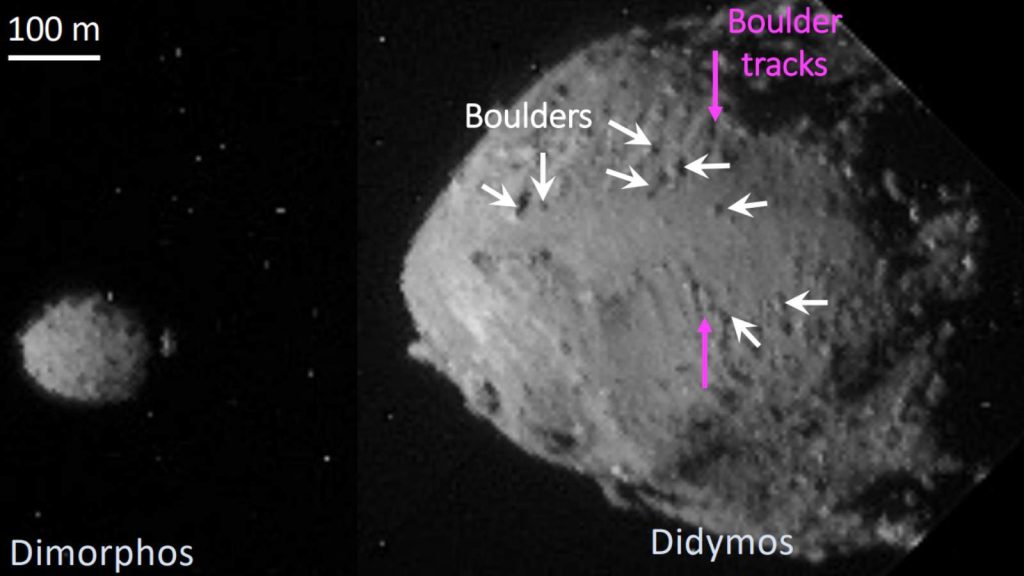
Olivier Barnouin's team at the Johns Hopkins University Applied Physics Laboratory mapped the terrain of Didymos, the 780-metre primary. At high elevations the surface is rugged, strewn with boulders ranging from 10 to 160 metres across and pocked by numerous impact craters. Descending toward the equatorial ridge, the landscape smooths out: fewer large rocks, fewer craters, and a distinctive bulge that girdles the asteroid's midriff. Dimorphos, the 151-metre moonlet, presents a different face. Its surface hosts rocks across a broader size spectrum yet is almost devoid of craters. Instead, it is cross-cut by fractures and faults, hinting at internal stresses rather than external bombardment.
Planetary scientists routinely estimate surface ages by counting craters: older surfaces accumulate more impacts. Applying this method, Barnouin's group found that Didymos bears the scars of 12.5 million years of cosmic battering. Dimorphos, by contrast, is a geological infant at roughly 300,000 years — between 40 and 130 times younger than its parent. The age gap is a smoking gun. It strongly supports the 'rotational fission' model: Didymos spun up over millions of years, perhaps accelerated by the subtle YORP effect of sunlight, until centrifugal force flung material from its equator into orbit. That debris coalesced under gravity to form Dimorphos, explaining both the moonlet's youth and the tell-tale ridge on Didymos.
Maurizio Pajola's team at the INAF Astronomical Observatory of Padova examined the size distribution of boulders on Dimorphos. If the moonlet had formed in a single catastrophic disruption, the fragments would share a common age. Instead, the boulders show a range of formation times, implying they were shed from Didymos in multiple episodes. This incremental shedding paints a picture of a parent body that has been losing mass sporadically, each ejection event contributing building blocks to the growing moonlet. The mechanism also accounts for Didymos's equatorial ridge: as material slides toward the equator before launch, it piles up into a raised rim.
Naomi Murdoch's group at the Université de Toulouse analysed boulder tracks on Didymos to gauge the mechanical strength of its regolith. The surface material is extraordinarily loose — weaker than dry sand on Earth or even lunar soil. A boulder perched on Didymos would sink under a fraction of the weight it could bear on the Moon. Meanwhile, Alice Lucchetti and colleagues discovered that boulders on Dimorphos fracture on a timescale of roughly 100,000 years due to thermal fatigue: the relentless cycle of heating and cooling drives micro-cracks through silicate and nickel-iron rocks. In geological terms, 100,000 years is a blink. This is the first observation of such rapid thermal fatigue on a rocky, silicate-rich asteroid, suggesting that Dimorphos's surface renews itself far faster than previously thought.
Colas Robin's team compared 34 boulders on Dimorphos, ranging from 1.67 to 6.7 metres, with rocks imaged on the near-Earth asteroids Itokawa, Ryugu, and Bennu — all visited by sample-return missions. Despite differences in size and orbit, the boulders share strikingly similar morphologies: angular shapes, pitted textures, and fracture patterns. The convergence points to a universal formation and evolution pathway for rubble-pile asteroids, whether they reside in the main belt or drift through near-Earth space. Dimorphos, it seems, is not an oddity but a representative member of a widespread population.
The DART impact fundamentally altered Dimorphos, excavating a crater, ejecting thousands of tonnes of debris, and reshaping the moonlet's orbit. The pre-impact portrait assembled by the three Nature papers now serves as a 'before' snapshot. ESA's Hera mission, scheduled to launch in October 2024 and rendezvous with the binary system in September 2026, will deliver the 'after' view. Hera's higher-resolution instruments — including a thermal infrared camera, a hyperspectral imager, and two CubeSats — will map the impact crater, measure the mass and internal structure of Dimorphos, and quantify the momentum transfer efficiency of the DART collision. Together, the two missions will turn a single deflection test into a comprehensive case study of binary asteroid geophysics, formation, and planetary defence.
The DART mission was conceived as a planetary defence technology demonstration, but its scientific legacy is proving equally profound. By turning a kinetic impactor into a geological surveyor, NASA has gifted researchers a high-resolution window into the birth and life of a binary asteroid system. The confirmation that Dimorphos assembled from Didymos's equatorial ejecta — and that this process leaves detectable fingerprints in crater counts, boulder populations, and surface structures — validates decades of theoretical work on rotational fission. The discovery of exceptionally rapid thermal fatigue on a silicate-rich body rewrites assumptions about surface ageing on small asteroids. And the morphological kinship with Itokawa, Ryugu, and Bennu hints that the lessons learned at Didymos may generalise across the near-Earth population. When Hera arrives in 2026, it will not merely inspect a crater; it will close the loop on humanity's first full-scale asteroid deflection experiment, delivering data that could one day inform a real planetary defence operation. For now, the Didymos–Dimorphos system stands as the most intimately studied binary asteroid in the solar system — a natural laboratory where geology, orbital dynamics, and impact physics converge.
Originally reported by space.com. Adapted for our readers with AI assistance.
Keep reading
AI Trends & News
Microsoft opens Surface Laptop Ultra pre-orders from US$2,599.99. Explore its launch date, NVIDIA RTX Spark features and implications for Nigerian businesses.
Science & Technology
DJI’s IBC recognition puts pocket gimbal and panoramic capture in the spotlight. Here is how creators can assess framing, editing effort and recording workflows.
Business News
App store steering is about more than permission to add a link. Explore fees, renewal terms, customer experience and the UK consultation.
TAMFIS NIG LTD
Electrical and instrumentation engineering, bid preparation and consulting, IT and software.

