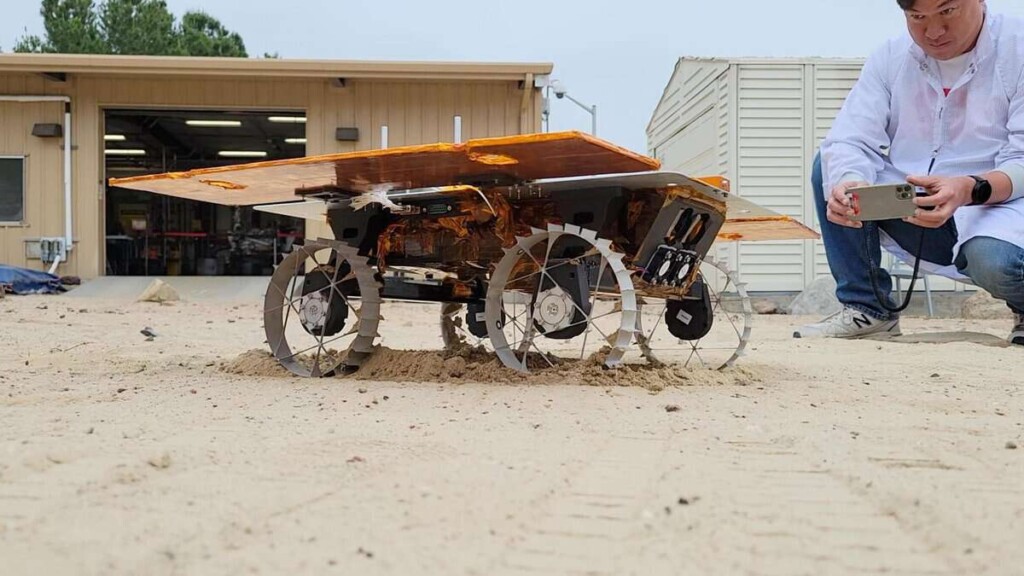
NASA’s mini moon rovers crawl for a take a look at drive before 2025 personal lunar start (photos)
NASA is advancing lunar exploration with a fleet of miniature autonomous rovers designed to operate collaboratively on the Moon's surface. These mini moon rovers, developed under the Cooperative Autonomous Distributed Robotic Exploration (CADRE) program, have recently undergone extensive testing at NASA's Jet Propulsion Laboratory (JPL) to prepare for their anticipated lunar deployment in 2025. Equipped with solar panels, cameras, sensors, and ground-penetrating radar, these rovers aim to provide unprecedented 3D mapping of the lunar terrain. This article delves into the comprehensive testing phases, technological innovations, and mission objectives of NASA's mini moon rovers as they prepare for their historic journey.
Overview of NASA's CADRE Mini Moon Rovers
The Cooperative Autonomous Distributed Robotic Exploration (CADRE) program represents a significant leap forward in robotic lunar exploration. The program focuses on deploying a network of small, suitcase-sized rovers capable of operating independently yet collaboratively to survey and map the Moon's surface in detail. Unlike traditional single-lander missions, CADRE's distributed robotic approach enables the rovers to coordinate their movements and share data autonomously, reducing the need for direct human intervention.
Each rover is outfitted with advanced instrumentation, including cameras, sensors, and ground-penetrating radar, enabling them to capture high-resolution images and subsurface data. Powered by solar panels, these rovers are designed to withstand the harsh lunar environment, enduring temperature extremes and navigating rugged terrain. The miniaturized design allows multiple rovers to be deployed simultaneously, increasing the mission's overall scientific return.
By leveraging autonomous navigation and cooperative behavior, the CADRE rovers demonstrate the potential for scalable robotic exploration on the Moon and other planetary bodies. Their ability to adapt to obstacles and optimize routes collectively is a critical step toward future missions involving swarms of robotic explorers.
Mars Yard Test Drives: Simulating Lunar Terrain
In August 2023, NASA engineers conducted a series of test drives at the Mars Yard facility within the Jet Propulsion Laboratory. Although originally designed to simulate Martian landscapes, the Mars Yard provides a challenging terrain that closely mimics the rugged and uneven surfaces expected on the lunar surface. This environment allowed engineers to validate the rovers' mobility, obstacle avoidance, and cooperative navigation capabilities.
During these tests, two full-scale CADRE rover models were deployed simultaneously. The rovers demonstrated the ability to drive in unison, dynamically adjusting their coordinated routes to circumvent obstacles such as rocks and slopes. This autonomous collaboration is vital for maximizing the efficiency and safety of the mission, enabling the rovers to explore areas that would be hazardous or inaccessible individually.
Notably, only one rover was equipped with a solar panel simulator during the initial tests, but both rovers successfully communicated battery levels and coordinated recharging activities. This energy management strategy ensures sustained operations during the lunar daytime, which lasts approximately 14 Earth days.
Advanced Testing: Night Drives and Environmental Simulations
Beyond daytime navigation, the CADRE rovers were tested under simulated lunar night conditions using powerful flood lamps at the Mars Yard. The Moon's surface experiences sharp contrasts between light and shadow, and these tests assessed the rovers' ability to operate effectively under such lighting conditions. Engineers ensured that the rovers' sensors and cameras could adapt to the low-light environment and maintain navigation accuracy.
Following surface mobility tests, the rovers underwent rigorous vibration and thermal testing in November 2023. The vibration tests involved mounting the rovers on a specialized shaker table that replicated the intense mechanical stresses experienced during launch and landing. Successfully passing this test confirmed the rovers' structural integrity and resilience.
Thermal tests were conducted in a vacuum chamber that simulated the Moon's airless environment and extreme temperature fluctuations, ranging from blistering heat during the lunar day to freezing cold at night. These tests verified that the rovers' hardware and electronics could survive and operate reliably under such harsh conditions.
Electromagnetic Compatibility and Interference Testing
In addition to physical endurance, the CADRE rovers were subjected to electromagnetic interference and compatibility tests in a specialized chamber designed to absorb radio waves. These tests are critical to ensure that the rovers' electronic subsystems function without disrupting each other or the lander's communication systems.
The testing confirmed that the rovers could withstand expected electromagnetic disturbances encountered during the mission, maintaining operational integrity. Reliable electronic performance is essential for autonomous navigation, data collection, and communication with the lander and mission control.
Ensuring electromagnetic compatibility also reduces the risk of data loss or mission failure due to interference, a common challenge in complex space missions with multiple electronic systems operating concurrently.
Integration with Intuitive Machines’ Nova-C Lander
With testing complete, NASA announced in early March 2024 that all three CADRE rovers are ready for integration with Intuitive Machines’ Nova-C lander. This lander is scheduled to deliver the rovers to the lunar surface as part of the company's third lunar lander mission, IM-3, planned for late 2024 or early 2025.
The Nova-C lander will deploy the rovers onto the Moon's surface at the Reiner Gamma formation, a lunar swirl known for its magnetic anomalies and unusual surface features. This site offers a unique opportunity to study the Moon's geology and magnetic environment in unprecedented detail.
The integration marks a critical phase in the mission timeline, combining the rovers' autonomous capabilities with the lander's precise delivery system to enable successful surface exploration and data acquisition.
Scientific Objectives and Lunar Surface Exploration
The primary scientific objective of the CADRE rovers is to create detailed 3D maps of the lunar surface using onboard cameras and ground-penetrating radar. By operating collaboratively, the rovers can cover more ground, cross-verify data, and identify features of geological and scientific interest with higher accuracy.
The mission will focus on the Reiner Gamma region, where the rovers will study surface textures, subsurface structures, and magnetic anomalies. Understanding these features could provide insights into the Moon's formation, geological history, and potential resources for future lunar missions.
Additionally, the rovers' autonomous operation during a full lunar day—approximately 14 Earth days—will test their endurance and energy management strategies, informing the design of future robotic explorers and supporting NASA's long-term Artemis lunar exploration goals.
Technological Innovations and Future Implications
The CADRE program showcases several technological breakthroughs, including autonomous multi-agent coordination, advanced energy management, and resilient hardware design. These innovations pave the way for more complex robotic missions involving swarms of explorers that can perform scientific tasks with minimal human oversight.
The success of these mini rovers could also influence exploration strategies on other planetary bodies, such as Mars, asteroids, or icy moons, where deploying multiple small, cooperative robots can yield richer data while reducing mission risks and costs.
Moreover, the lessons learned from the CADRE mission will contribute to NASA’s broader goals of sustainable lunar presence and eventual human missions beyond the Moon, highlighting the importance of robotic precursors in paving the way for human exploration.
Conclusion
NASA’s mini moon rovers represent a transformative step in lunar exploration, combining cutting-edge autonomous technology with robust engineering to tackle the challenges of the Moon’s harsh environment. Through meticulous testing and integration with the Nova-C lander, these rovers are poised to embark on a groundbreaking mission to the lunar surface in 2025. Their ability to operate cooperatively and autonomously not only enhances scientific discovery but also lays the groundwork for future robotic and human missions. As NASA continues to push the boundaries of space exploration, the success of the CADRE program will be instrumental in unlocking new knowledge about the Moon and beyond.
Originally reported by space.com. Adapted for our readers.
Recent advances in machine perfusion technology are not only preserving donated livers but also making them biologically younger at a molecular level. This breakthrough…
What happens when human imagination, artificial intelligence, art and technology come together? From September 1 to 6, Samsung Electronics presented a special exhibition themed…