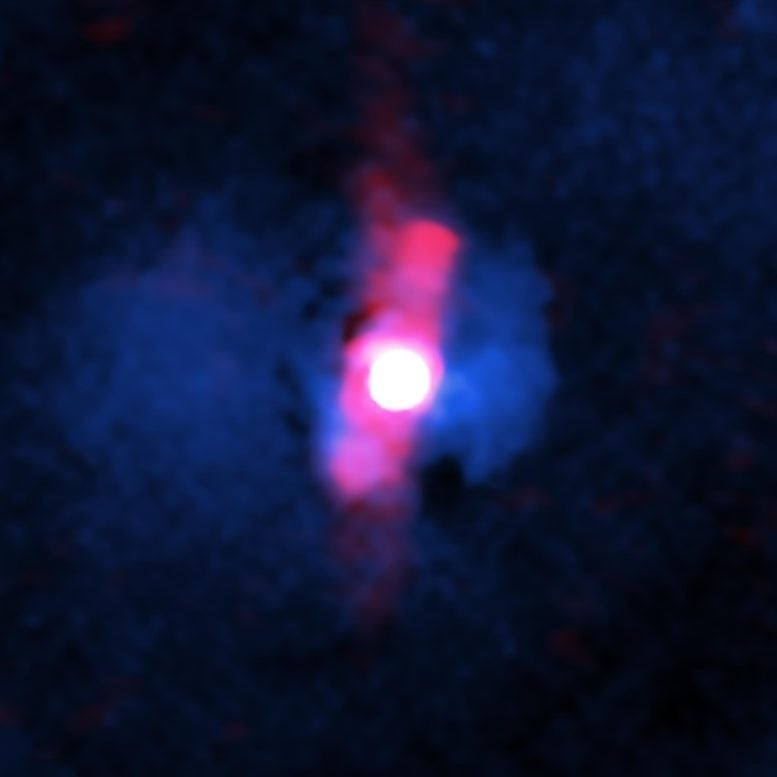
Defying Expectations: NASA’s Chandra Uncovers a Quasar’s Honest Galactic Affect
Quasars are among the universe’s most energetic and luminous phenomena, powered by supermassive black holes voraciously consuming surrounding matter. Traditionally, these cosmic powerhouses are thought to shape their host galaxies and clusters dramatically through intense radiation and energetic jets. However, recent observations by NASA’s Chandra X-ray Observatory of the quasar H1821+643 have defied these expectations. Situated approximately 3.4 billion light-years away, H1821+643 is the closest quasar embedded within a galaxy cluster, offering a unique laboratory to study quasar feedback effects. Contrary to prevailing theories, researchers found that this quasar’s impact on its environment is surprisingly subdued, prompting a reexamination of how quasars influence galactic evolution and intergalactic gas dynamics.
Understanding Quasars: Cosmic Beacons of Energy
Quasars, or quasi-stellar objects, are extraordinarily luminous centers of distant galaxies powered by supermassive black holes actively accreting matter. As matter spirals into these black holes, it heats up and emits intense radiation across the electromagnetic spectrum, making quasars some of the brightest objects in the universe.
Typically, quasars are associated with powerful jets of charged particles that extend far beyond their host galaxies. These jets and radiation can influence star formation rates and the thermal state of surrounding gas, playing a pivotal role in regulating galaxy evolution.
The energetic output from quasars is often considered a form of feedback that prevents runaway cooling of hot gas in galaxy clusters, thereby controlling the growth of galaxies and their central black holes. This feedback mechanism is a cornerstone of many astrophysical models explaining galaxy formation.
Introducing H1821+643: A Unique Quasar in a Galaxy Cluster
H1821+643 stands out as the nearest quasar residing within a galaxy cluster, located about 3.4 billion light-years from Earth. This proximity allows astronomers to study its interactions with the cluster environment in greater detail than typical distant quasars.
Galaxy clusters are massive structures containing hundreds to thousands of galaxies bound by gravity, embedded in hot, X-ray-emitting gas. The presence of a quasar like H1821+643 in such an environment provides a rare opportunity to observe feedback processes in action.
Previous expectations suggested that H1821+643, given its intense radiation and radio jets detected by the Very Large Array (VLA), would exert a significant influence on the intracluster medium, heating the gas and regulating star formation within the cluster.
NASA’s Chandra X-ray Observatory: Peering into the X-ray Universe
NASA’s Chandra X-ray Observatory is a flagship mission designed to observe high-energy X-rays from hot gas and energetic phenomena in the universe. Its high spatial resolution and sensitivity make it ideal for studying the environments around supermassive black holes.
In the case of H1821+643, Chandra’s observations focused on detecting X-ray emissions from the hot gas within the host galaxy cluster. This hot gas, reaching temperatures of millions of degrees, emits primarily in the X-ray band, revealing the physical conditions and dynamics of the cluster environment.
However, one key challenge was separating the bright X-ray emission from the quasar itself, which can obscure the fainter signals from the surrounding hot gas. Advanced image processing techniques were employed to remove the quasar’s glare and isolate the cluster’s X-ray signature.
Surprising Discoveries: A Quasar with Minimal Galactic Impact
Contrary to expectations, the analysis revealed that H1821+643’s energetic output exerts only a limited influence on the surrounding hot gas. The gas near the quasar showed higher density and significantly cooler temperatures compared to regions farther away, indicating minimal heating or disruption.
These findings suggest that the quasar’s feedback is not effectively preventing the hot gas from cooling, a process that typically leads to star formation and further accretion onto the central black hole. This is unusual because quasar feedback is generally thought to inhibit such cooling flows.
The lack of strong feedback effects in H1821+643 challenges the conventional view that quasars invariably regulate their environments through powerful outbursts. Instead, it points to a more complex and varied role of quasars in galaxy cluster evolution.
Implications for Galaxy Evolution and Feedback Models
The subdued impact of H1821+643 on its host galaxy cluster implies that quasar feedback may not be as universally dominant as previously believed. This necessitates revisions to theoretical models that rely heavily on quasar-driven heating to explain galaxy and cluster properties.
If quasars can sometimes coexist with cooling gas without significant disruption, the pathways for star formation and black hole growth could be more diverse, allowing for simultaneous accretion and cooling in certain environments.
This discovery encourages astronomers to investigate other quasars in galaxy clusters to determine whether H1821+643 is an outlier or representative of a broader population exhibiting weak feedback effects.
Technological Advances Enabling These Insights
The success of this study hinged on the combination of high-resolution X-ray imaging by Chandra and radio observations from the Karl G. Jansky Very Large Array (VLA). Together, these instruments provided complementary views of the quasar’s energetic processes and their environmental impact.
Innovative data processing techniques to subtract the quasar’s bright X-ray emission allowed researchers to detect subtle features in the surrounding gas, highlighting the importance of advanced analysis methods in modern astrophysics.
Continued technological improvements in X-ray and radio astronomy will enable deeper exploration of quasar feedback mechanisms, potentially uncovering new facets of black hole-galaxy coevolution.
Future Directions: Expanding Our Understanding of Quasar Feedback
Building on the findings from H1821+643, astronomers plan to conduct surveys of other quasars embedded in galaxy clusters to assess the variability of feedback effects across different environments and evolutionary stages.
Upcoming observatories, such as the James Webb Space Telescope and next-generation X-ray missions, will provide enhanced sensitivity and spectral capabilities to probe the interplay between quasars and their surroundings with unprecedented detail.
These efforts aim to refine models of galaxy formation and evolution by incorporating a more nuanced understanding of how quasars influence—or sometimes fail to influence—their cosmic neighborhoods.
Conclusion
NASA’s Chandra X-ray Observatory has unveiled an unexpected characteristic of the quasar H1821+643: despite its powerful radiation and jets, its influence on its host galaxy cluster is surprisingly modest. This discovery challenges long-held assumptions about quasar feedback and its role in regulating the thermal state of intergalactic gas and star formation. As astronomers continue to explore quasars in diverse environments with cutting-edge technology, our understanding of how these cosmic giants shape galactic evolution will become increasingly refined. H1821+643 serves as a compelling reminder that the universe often defies expectations, inviting ongoing investigation into the complex interplay between black holes and their cosmic surroundings.
Originally reported by scitechdaily.com. Adapted for our readers.
Recent advances in machine perfusion technology are not only preserving donated livers but also making them biologically younger at a molecular level. This breakthrough…
What happens when human imagination, artificial intelligence, art and technology come together? From September 1 to 6, Samsung Electronics presented a special exhibition themed…