
AI Trends & News
Surface Laptop Ultra Pre-orders Open: Price, Release Date and AI Features
Microsoft opens Surface Laptop Ultra pre-orders from US$2,599.99. Explore its launch date, NVIDIA RTX Spark features and implications for Nigerian businesses.
TAMFIS NIG LTDRC 8067447CAC ACTIVEFinima, Bonny Island, Rivers State

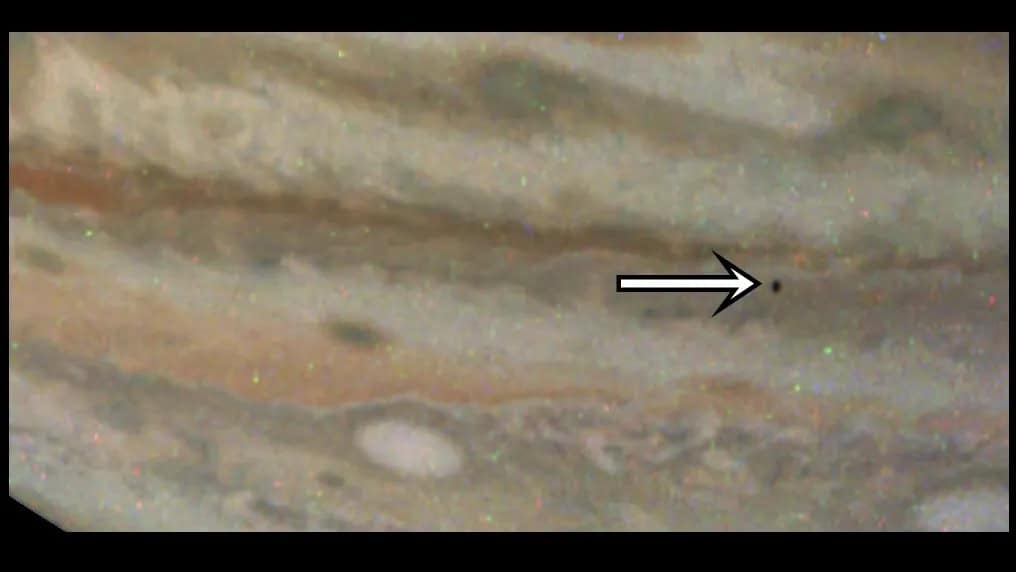
Jupiter, the largest planet in our solar system, is famous not only for its massive size and swirling storms but also for its diverse collection of moons. Among these natural satellites, the four Galilean moons—Io, Europa, Ganymede, and Callisto—are well-studied and widely recognized. However, beyond these giants lies Amalthea, Jupiter’s fifth moon by discovery and size, yet one of the more elusive and enigmatic. On March 7, 2024, NASA’s Juno spacecraft captured stunning new images showing Amalthea crossing the Great Red Spot, Jupiter’s colossal and centuries-old storm. These images mark the first time Juno has observed Amalthea in this way, offering astronomers a rare glimpse of this irregularly shaped, reddish moon against the backdrop of one of the solar system’s most iconic features.
Amalthea was discovered in 1892 by the American astronomer Edward Emerson Barnard, a pioneering observer known for his keen eye and numerous celestial discoveries. As Jupiter’s fifth moon to be identified, Amalthea holds a unique place in the planet’s extensive satellite system, which now counts 95 known moons. Unlike the four massive Galilean moons, Amalthea is relatively small and irregularly shaped, making it more challenging to study.
Despite its modest size, Amalthea is the fifth-largest moon of Jupiter and provides valuable data on the formation and evolution of natural satellites around gas giants. Its discovery expanded our understanding of the diversity of moons in the Jovian system, showcasing that not all moons are large and spherical; some, like Amalthea, have complex shapes and surface compositions.
Barnard’s successful identification of Amalthea was remarkable given the moon’s faintness and proximity to Jupiter’s bright glare. His discovery set the stage for future observations by spacecraft such as Voyager, Galileo, and now Juno, each contributing to a more detailed understanding of this intriguing moon.
Amalthea’s shape is irregular, often compared to a potato, with its longest axis measuring approximately 155 miles (250 kilometers) and its narrowest dimension about 79 miles (128 kilometers). This irregularity suggests a body that has not undergone significant geological reshaping or differentiation, unlike larger moons that are more spherical due to gravitational forces.
NASA’s Galileo spacecraft provided critical gravity measurements in the early 2000s, revealing that Amalthea is likely a loosely held-together rubble pile rather than a solid rock. This low-density structure implies that the moon may be a collection of debris bound by weak gravity, offering clues about its formation and the environment around Jupiter during the early solar system.
One of the most fascinating features of Amalthea is its surface coloration. It is the reddest object in the solar system, exhibiting a striking crimson hue. The origin of this coloration remains a subject of scientific debate, with one leading hypothesis suggesting the reddish coating results from sulfur particles emitted by Io’s volcanic activity, which then settle on Amalthea’s surface.
On March 7, 2024, during its 59th flyby of Jupiter, NASA’s Juno spacecraft captured unprecedented images of Amalthea as it transited across the Great Red Spot. This massive anticyclonic storm, spanning approximately 7,767 miles (12,500 kilometers) in diameter, is one of the largest and longest-lasting storms in the solar system.
Amalthea appeared as a tiny dark speck moving in front of the vibrant, swirling clouds of the Great Red Spot, a remarkable contrast that highlighted the moon’s diminutive size compared to Jupiter’s colossal storm. The moon was approximately 112,500 miles (181,000 kilometers) above Jupiter’s cloud tops during this transit, emphasizing the vast scale differences within the Jovian system.
This observation is significant because it provides a rare opportunity to study Amalthea’s orbit and physical properties in relation to Jupiter’s atmospheric phenomena. The images also showcase Juno’s advanced imaging capabilities and its ongoing mission to unravel Jupiter’s mysteries despite challenges such as the spacecraft’s orbit adjustments caused by a misfiring engine.
Amalthea has the third-shortest orbital period among Jupiter’s moons, completing a full orbit around the gas giant in just about 0.5 Earth days. This rapid orbit places Amalthea closer to Jupiter than many of its other moons, contributing to its unique environmental conditions and interactions with the planet’s magnetosphere.
Its close proximity to Jupiter means Amalthea is subjected to intense gravitational forces and radiation belts, which may influence its surface characteristics and thermal properties. These factors also complicate observational efforts from Earth-based telescopes due to Jupiter’s overwhelming brightness and Amalthea’s faintness.
Barnard’s original visual discovery was a testament to his observational skills, as spotting Amalthea so close to the glare of Jupiter was a formidable challenge. Today, spacecraft like Juno and past missions such as Voyager and Galileo have made tracking Amalthea’s orbit and studying its behavior more feasible, enhancing our understanding of its place within the Jovian system.
Detailed images from NASA’s Voyager 1 and 2 missions, and later from Galileo, have revealed Amalthea’s surface to be marked by colorful spots and craters, illustrating a complex geological history despite its small size. These features suggest that Amalthea has endured impacts and possibly surface reshaping events over time.
The reddish surface coating, combined with cratered terrain, points to interactions with Jupiter’s environment and neighboring moons. The hypothesis that sulfur from Io’s volcanoes colors Amalthea underscores the dynamic and interconnected nature of Jupiter’s moon system.
Intriguingly, Amalthea emits more heat than it receives from the Sun, a phenomenon that puzzles scientists. Various theories propose internal friction, tidal heating from Jupiter’s gravity, or charged particle interactions as potential sources of this additional heat. Understanding this heat emission could shed light on the moon’s internal structure and energy processes.
While Amalthea may not be as famous as the Galilean moons, it plays a critical role in the dynamics of Jupiter’s extensive moon system. Its orbit and interactions contribute to the complex gravitational environment surrounding the planet, influencing dust and particle distribution in Jupiter’s magnetosphere.
Amalthea’s position and characteristics also make it a subject of interest in studying moon formation theories around gas giants. Its irregular shape and composition suggest it might be a captured object or a remnant of early solar system debris that never coalesced into a larger body.
Studying Amalthea alongside other Jovian moons helps astronomers piece together the history and evolution of the planet’s satellite family, offering insights into planetary formation and the processes that govern moon-planet interactions.
The recent images captured by Juno open new avenues for future observation and research on Amalthea. Continued monitoring of its transit events, surface changes, and thermal emissions will be crucial in addressing the many unanswered questions about this moon’s nature.
Upcoming missions and advancements in telescope technology may allow for more detailed studies of Amalthea’s surface composition and internal structure. These observations could help clarify the origin of its reddish surface and the source of its anomalous heat emissions.
Moreover, understanding Amalthea’s role within Jupiter’s magnetosphere and its interactions with neighboring moons could provide broader insights into the complex environments of gas giant systems, with implications for studying exoplanets and their satellites.
The recent observations of Amalthea by NASA’s Juno spacecraft represent a milestone in the study of Jupiter’s lesser-known moons. Capturing this elusive satellite crossing the Great Red Spot not only highlights the moon’s unique characteristics but also underscores the dynamic and interconnected nature of the Jovian system. As scientists continue to analyze these images and plan future missions, Amalthea promises to reveal more secrets about its composition, thermal anomalies, and its intriguing place in the solar system. Through ongoing exploration, Amalthea stands as a compelling subject that enriches our understanding of planetary satellites and the complex environments they inhabit.
Originally reported by livescience.com. Adapted for our readers.
Keep reading
AI Trends & News
Microsoft opens Surface Laptop Ultra pre-orders from US$2,599.99. Explore its launch date, NVIDIA RTX Spark features and implications for Nigerian businesses.
Science & Technology
DJI’s IBC recognition puts pocket gimbal and panoramic capture in the spotlight. Here is how creators can assess framing, editing effort and recording workflows.
Business News
App store steering is about more than permission to add a link. Explore fees, renewal terms, customer experience and the UK consultation.
TAMFIS NIG LTD
Electrical and instrumentation engineering, bid preparation and consulting, IT and software.

