NASA’s Chandra Notices the Galactic Heart is Venting
At the heart of our Milky Way galaxy lies Sagittarius A* (Sgr A*), a supermassive black hole surrounded by complex structures of hot gas and magnetic fields. Recent data from NASA’s Chandra X-ray Observatory, combined with radio observations from the MeerKAT telescope, have provided compelling evidence of a venting mechanism that channels sizzling gas away from the galactic center. This finding enhances our understanding of how energetic phenomena near Sgr A* influence the surrounding environment and contribute to the galaxy’s evolution.
Visualizing the Galactic Center: X-rays and Radio Waves
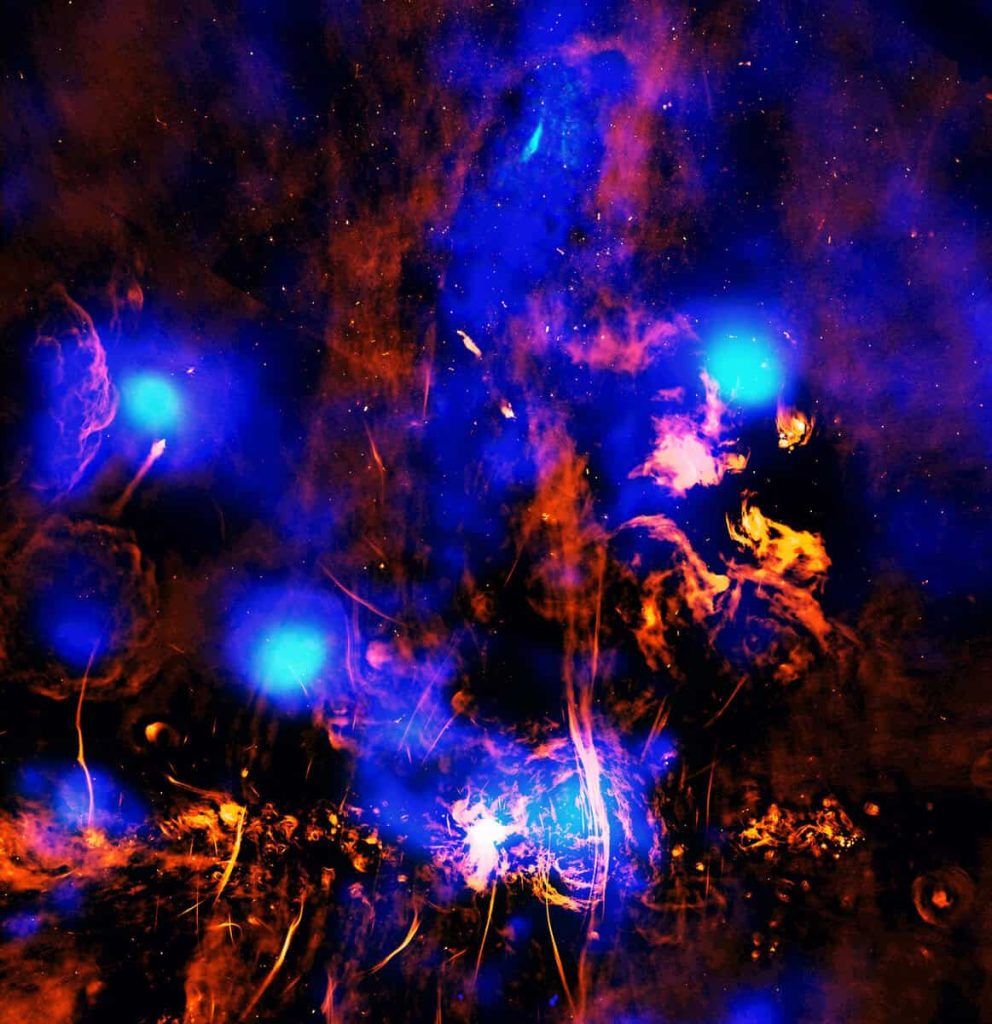
The new images of the Milky Way’s core integrate X-ray data from Chandra with radio signals captured by the MeerKAT telescope. In these composite visuals, Chandra’s X-ray emissions appear as wispy blue clouds, while MeerKAT’s radio emissions are shown in red. This combination allows astronomers to map both the hot gas and the magnetic fields that shape its movement.
At the very center of the image is a bright, tangled knot of material representing Sgr A*, the supermassive black hole anchoring our galaxy. Surrounding it are flame-like red and orange structures, suggestive of energetic processes and star-filled clouds. The interplay of these signals reveals a chimney-shaped column of hot gas rising from the galactic center, a feature previously detected but now seen in greater detail.
The Galactic Chimney and Its Newly Discovered Vent
Astronomers have long observed a ‘chimney’ of hot gas extending from the Milky Way’s core. This structure acts as a conduit, funneling heated material away from the dense environment around Sgr A*. The recent Chandra observations have uncovered a new feature at the chimney’s upper end, about 700 light-years from the galactic center, identified as a vent.
This vent is characterized by several bright X-ray ridges oriented roughly perpendicular to the plane of the galaxy. Researchers interpret these ridges as the walls of a cylindrical tunnel that guides the hot gas upward. The vent’s brightness in X-rays is attributed to shock waves—akin to sonic booms—that occur when the rising hot gas collides with cooler gas in its path. This interaction creates a ‘squawk vent’ effect, where the gas vents explosively into surrounding space.
Mechanisms Driving the Gas Flow from Sgr A*
The origin of the hot gas flowing through the chimney and vent is linked to episodic events near Sgr A*. Scientists propose that bursts of energy, possibly from material falling into the black hole, generate eruptions that propel gas upwards. These eruptions could be triggered by the black hole’s accretion of matter, including the tidal disruption of stars approximately every 20,000 years.
Historical observations have recorded dramatic X-ray flares near Sgr A* occurring every few hundred years. Such flares may contribute significantly to pushing hot gas through the chimney and out the vent. The venting process, therefore, represents a channel by which the black hole’s energetic activity influences the galactic environment on scales of hundreds of light-years.
Magnetic Fields and Their Role in Shaping the Chimney
Radio observations from MeerKAT reveal the presence of magnetic fields enveloping the chimney. These fields appear to confine and guide the hot gas as it moves away from the galactic center. The interaction between magnetic forces and gas dynamics is crucial in maintaining the chimney’s structure and directing the flow through the vent.
Understanding the magnetic environment helps astronomers piece together how energy and matter are transported in the galaxy. It also provides insights into the feedback mechanisms by which the central black hole can regulate star formation and gas distribution in the Milky Way.
Implications for Galactic Evolution and Future Research
The discovery of the vent at the end of the galactic chimney offers a new perspective on how the Milky Way’s central black hole interacts with its surroundings. By channeling hot gas through this venting process, Sgr A* may influence the thermal balance and chemical composition of the galactic halo.
Future observations and simulations will aim to quantify the amount of gas involved and the frequency of these venting events. Such data are essential for refining models of galaxy evolution, particularly in understanding how supermassive black holes impact their host galaxies over cosmic time.
The research team, including scientists from the University of Chicago, UCLA, and the Italian National Institute of Astrophysics, published their findings in The Astrophysical Journal. Their work demonstrates the power of combining X-ray and radio astronomy to uncover hidden processes in our galaxy’s core.
What this means
The unveiling of a venting phenomenon at the Milky Way’s core marks a significant advancement in our understanding of galactic dynamics. By tracing how hot gas escapes from the vicinity of Sagittarius A* through a chimney and vent system, astronomers gain valuable clues about the energetic processes shaping our galaxy. Continued multiwavelength observations will be crucial for unraveling the complex interplay between black holes, magnetic fields, and interstellar gas, deepening our knowledge of the cosmic environment we inhabit.
Recent advances in machine perfusion technology are not only preserving donated livers but also making them biologically younger at a molecular level. This breakthrough…
What happens when human imagination, artificial intelligence, art and technology come together? From September 1 to 6, Samsung Electronics presented a special exhibition themed…