Contemporary NASA Shadowy Gap Visualization Takes Viewers Beyond the Brink
Black holes have long fascinated scientists and the public alike, representing some of the most extreme environments in the universe. Yet, understanding what happens at the very edge of a black hole—the event horizon—has remained elusive due to the complex interplay of gravity, light, and spacetime. Now, leveraging the power of NASA’s supercomputers, astrophysicists have developed an immersive visualization that simulates the journey toward and beyond a supermassive black hole’s event horizon. This pioneering work not only brings to life the mind-bending effects of general relativity but also offers a new tool for education and research.
Simulating the Point of No Return
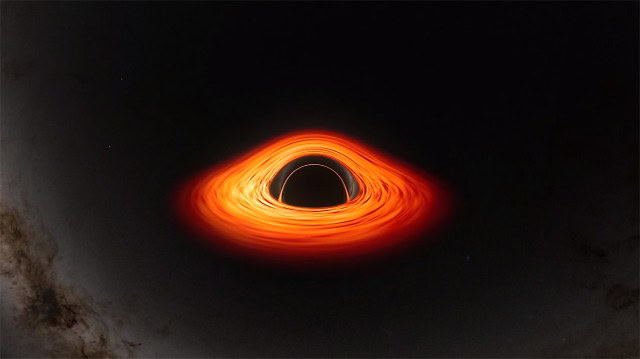
The event horizon of a black hole marks the boundary beyond which nothing, not even light, can escape. To visualize this, NASA astrophysicist Jeremy Schnittman and his colleague Brian Powell used the Peep supercomputer at the NASA Center for Climate Simulation to generate detailed simulations of two scenarios: one where a camera narrowly misses crossing the event horizon and escapes, and another where it crosses the boundary, sealing its fate.
These simulations required immense computational resources, producing about 10 terabytes of data over five days while utilizing only a fraction (0.3%) of Peep’s 129,000 processors. Such a task would take over a decade on a conventional computer, highlighting the importance of advanced supercomputing in modern astrophysics.
Visualizing a Supermassive Black Hole
The black hole modeled in the simulation is supermassive, with a mass 4.3 million times that of our Sun, similar to the one at the center of the Milky Way galaxy. This immense mass results in an event horizon spanning approximately 16 million miles (25 million kilometers), roughly 17% of the distance from Earth to the Sun.
Surrounding the black hole is an accretion disk—a flat, swirling cloud of hot, glowing gas that serves as a visual reference point. Additionally, photon rings, which are glowing structures formed by light orbiting the black hole multiple times, add complexity to the scene. The backdrop features the familiar starry sky as seen from Earth, providing context for the extreme distortions caused by the black hole’s gravity.
Experiencing Extreme Gravitational Effects
As the simulated camera approaches the event horizon, it accelerates to speeds approaching that of light. This causes the light from the accretion disk and background stars to become increasingly amplified and distorted, akin to the rising pitch of a racecar engine. The light appears brighter and whiter when looking toward the direction of travel due to relativistic effects.
The journey begins nearly 400 million miles (640 million kilometers) away from the black hole, with the event horizon initially filling the camera’s field of view. As the camera moves closer, the accretion disk, photon rings, and star field become warped and multiply in appearance, reflecting the intense warping of spacetime near the black hole.
Time Dilation and the Frozen Star Phenomenon
From the perspective of the camera falling inward, the descent to the event horizon takes about three hours, during which it completes nearly two orbits lasting 30 minutes each. However, to an outside observer, the camera appears to slow down and eventually freeze just outside the event horizon. This effect occurs because time itself becomes increasingly distorted near the horizon, a phenomenon that led early astronomers to describe black holes as 'frozen stars.'
Once the camera crosses the event horizon, it enters a region where spacetime flows inward at the speed of light. From this point, the camera and the spacetime it occupies inevitably move toward the black hole’s center, known as the singularity—a point where current physical laws break down.
The Final Moments Inside the Event Horizon
After crossing the event horizon, the simulated camera has only about 12.8 seconds before being destroyed by spaghettification—a process where differential gravitational forces stretch objects into elongated shapes. The remaining distance to the singularity is approximately 79,500 miles (128,000 kilometers), traversed in a fraction of a second.
This rapid end contrasts with the prolonged and visually dramatic approach to the event horizon, underscoring the extreme conditions inside a black hole.
Alternative Scenario: Escaping the Black Hole’s Grasp
In the alternative simulation, the camera orbits close to but never crosses the event horizon, eventually escaping back to safety. This orbit lasts about six hours, during which time dilation causes the camera’s clock to run slower relative to observers far from the black hole. As a result, the astronaut piloting the camera would return approximately 36 minutes younger than colleagues who remained distant from the black hole.
Schnittman notes that if the black hole were non-rotating, similar to the one depicted in the film 'Interstellar,' the time dilation effects would be even more pronounced, potentially resulting in the orbiting astronaut aging many years less than those far away.
Educational and Scientific Implications
These visualizations serve as powerful tools for both education and research. They provide a tangible way to understand the abstract and counterintuitive predictions of Einstein’s general relativity, such as gravitational lensing, time dilation, and spaghettification.
Presented in various formats—including explainer videos, 360-degree immersive movies, and flat all-sky maps—the simulations invite viewers to explore the black hole environment interactively. This accessibility enhances public understanding of complex astrophysical phenomena and supports scientists in visualizing data that would otherwise remain purely theoretical.
What this means
NASA’s cutting-edge visualization project offers an unprecedented window into the enigmatic realm of black holes, transforming complex theoretical physics into vivid, immersive experiences. By simulating both the perilous plunge beyond the event horizon and the delicate dance just outside it, the project deepens our understanding of gravity’s extremes and the fabric of spacetime. As supercomputing power continues to grow, such visualizations will play an increasingly vital role in unraveling the mysteries of the cosmos and inspiring curiosity about the universe’s most fascinating phenomena.
Originally reported by science.nasa.gov. Adapted for our readers with AI assistance.
Recent advances in machine perfusion technology are not only preserving donated livers but also making them biologically younger at a molecular level. This breakthrough…
What happens when human imagination, artificial intelligence, art and technology come together? From September 1 to 6, Samsung Electronics presented a special exhibition themed…