AI Trends & News
Surface Laptop Ultra Pre-orders Open: Price, Release Date and AI Features
Microsoft opens Surface Laptop Ultra pre-orders from US$2,599.99. Explore its launch date, NVIDIA RTX Spark features and implications for Nigerian businesses.
TAMFIS NIG LTDRC 8067447CAC ACTIVEFinima, Bonny Island, Rivers State

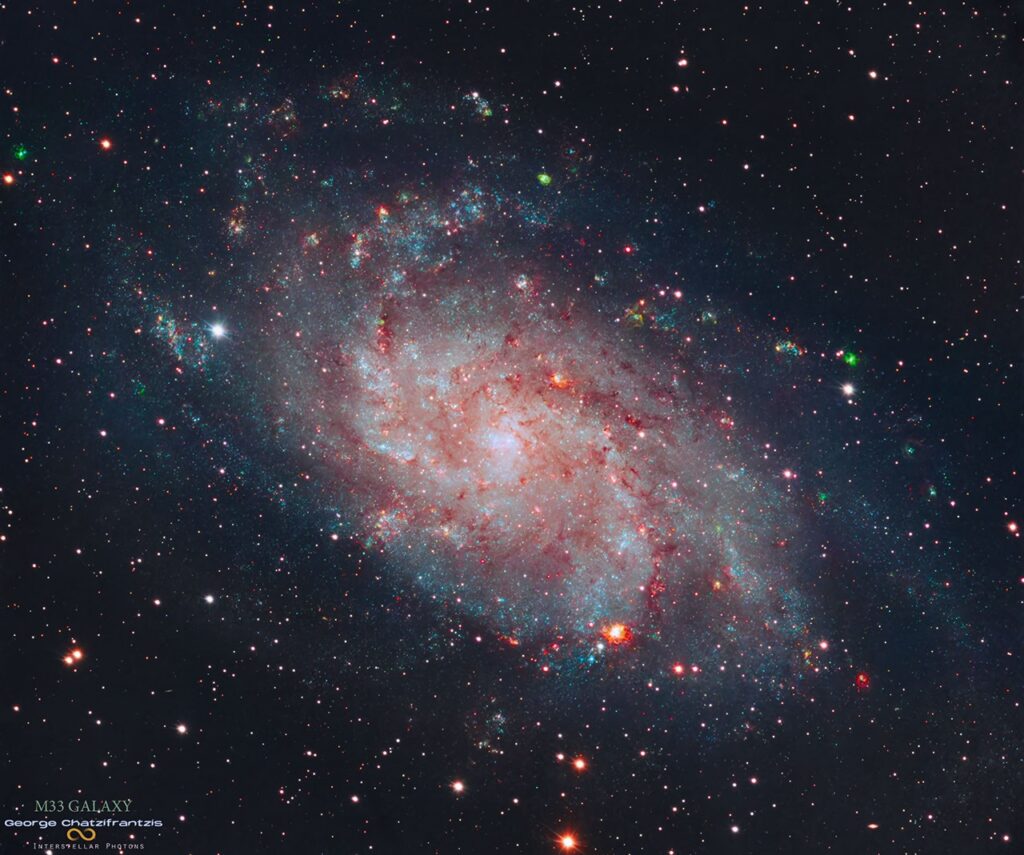
A photograph of Messier 33 can look like a pattern of luminous clouds, but it is also a view into a neighbouring galaxy on an extraordinary scale. Known as the Triangulum Galaxy, M33 is a useful subject for exploring spiral structure, star-forming regions and the way astronomers measure distance. The image featured in NASA’s Astronomy Picture of the Day on 18 September 2026 provides a starting point for that exploration. This article offers an original explanation rather than reproducing the APOD caption.
NASA’s description places M33 roughly three million light-years from the Milky Way and gives its diameter as more than 50,000 light-years. It is among the largest members of the Local Group, alongside the Milky Way and Andromeda. Those figures provide scale, but they are best understood as estimates within an astronomical measurement framework.
A light-year is a distance: the distance light travels in a year. Viewing a galaxy millions of light-years away therefore means receiving light that began its journey millions of years ago. The image is a record of that arriving light, not a live view of every star’s present condition.
The relatively face-on presentation makes the spiral arms easier to follow than they would be in a galaxy seen edge-on. Look for the relationship between the brighter central region and the looser structures extending outward. The arms contain many objects; they should not be read as simple lines drawn across an otherwise empty disc.
A photograph also compresses depth into a flat display. Features that appear close together on the page may occupy different positions along the line of sight. The visible pattern is valuable, but interpreting the physical structure requires additional observations and models.
APOD highlights blue star clusters and pinkish star-forming regions in the image. Those areas point to different components of the galaxy’s stellar and gaseous environment. Colour helps direct attention to structure that might be less obvious in a simple brightness map.
The final appearance of an astronomical image depends on how it was recorded and processed. Filters, exposure choices and the mapping of recorded signals into display colours affect what viewers see. An attractive colour image should therefore be read alongside its explanation and credit, rather than assumed to match the view from an unaided eye.
One prominent star-forming region in M33 is NGC 604, identified in the APOD explanation near the lower-right side of the galaxy’s centre. Finding it gives viewers a concrete landmark rather than leaving the whole image as an undifferentiated spiral. It also illustrates how a galaxy contains smaller structures with their own histories.
A bright region should not be interpreted as a single star merely because it occupies a compact area in the photograph. At the galaxy’s distance, many physical features share a small area on the display. Understanding the image means repeatedly moving between the apparent size of a feature and the scale it represents.
M33 matters beyond its appearance. NASA notes that well-measured variable stars in M33 and Andromeda have helped establish astronomical distances. Observations of nearby systems provide a foundation for methods used to study more distant objects.
The underlying idea is to connect a measurable property with distance using an independently established relationship. That process requires careful calibration and attention to uncertainty. It is not enough to observe that one object looks faint, because apparent brightness also depends on the object’s intrinsic light output and material along the line of sight.
A galaxy photograph invites imaginative comparisons, but appearance alone cannot establish every physical conclusion. A loosely wound arm does not tell the viewer the age of all its stars, and a bright patch does not reveal its entire composition. Astronomers use different measurements to answer different questions.
For a reader, the useful habit is to distinguish what the image shows directly from what its explanation infers using wider research. Identifying visible clusters is different from establishing the history of a galactic interaction. Both can be valuable, provided the basis of each claim is clear.
Begin at the centre and trace one arm outward. Compare smoother light with compact clusters and diffuse coloured regions. Then locate NGC 604 and return to the full image to see how that landmark fits into the wider structure. This turns passive viewing into a simple exercise in observation.
M33 rewards that patient approach because it makes immense scale feel legible. The photograph offers identifiable features, while the scientific description connects them to distance and stellar activity. Together they show how an astronomical image can be both a visual object and a starting point for asking better questions about the universe.
Sources: NASA’s 18 September 2026 APOD listing and the M33 APOD entry. Explanatory comparisons are original editorial writing.
Originally reported by science.nasa.gov. Adapted for our readers.
Keep reading
AI Trends & News
Microsoft opens Surface Laptop Ultra pre-orders from US$2,599.99. Explore its launch date, NVIDIA RTX Spark features and implications for Nigerian businesses.
Science & Technology
DJI’s IBC recognition puts pocket gimbal and panoramic capture in the spotlight. Here is how creators can assess framing, editing effort and recording workflows.
Business News
App store steering is about more than permission to add a link. Explore fees, renewal terms, customer experience and the UK consultation.
TAMFIS NIG LTD
Electrical and instrumentation engineering, bid preparation and consulting, IT and software.