
AI Trends & News
Surface Laptop Ultra Pre-orders Open: Price, Release Date and AI Features
Microsoft opens Surface Laptop Ultra pre-orders from US$2,599.99. Explore its launch date, NVIDIA RTX Spark features and implications for Nigerian businesses.
TAMFIS NIG LTDRC 8067447CAC ACTIVEFinima, Bonny Island, Rivers State

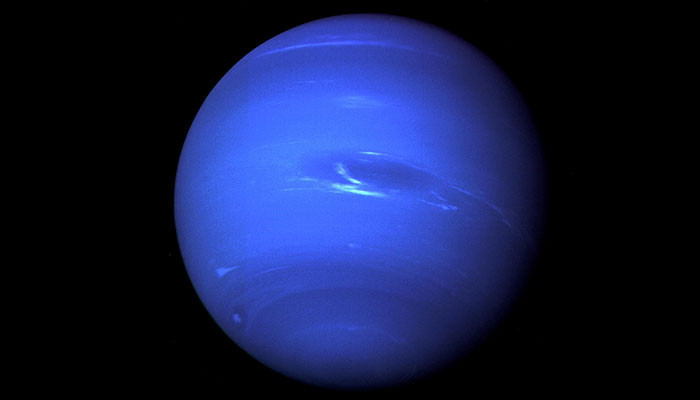
Recent NASA James Webb Space Telescope observations have uncovered evidence of a violent episode in Neptune's distant past, detailed in a study led by planetary scientist Ryleigh Davis of the University of California, San Diego, and published in the journal Science Advances. Researchers detected clay minerals on the small inner moons Proteus, Larissa, and Galatea—materials that form only where liquid water meets rock deep inside a much larger world. Because these moons are too small and cold for such chemistry, the minerals point to a catastrophic collision that shattered an ancient icy world and allowed today's moons and rings to re-form from the wreckage. The findings show how a single event can reconfigure an entire planetary system.
Using the James Webb Space Telescope, a team led by planetary scientist Ryleigh Davis of the University of California, San Diego, examined Neptune's inner moons and dusty rings. They found magnesium-rich clay minerals on Proteus, Larissa, and Galatea—materials that require prolonged contact between liquid water and rock. The moons themselves are far too small and frigid to sustain those conditions, so the clay must have come from elsewhere.
Davis, who worked on the study while at Caltech, said similar minerals are known on the dwarf planet Ceres, which orbits in the asteroid belt, and in some meteorites. Their presence on Neptune's inner moons suggests these bodies are not primordial but re-accreted from the debris of a larger progenitor whose deep interior was exposed in a collision.
The discovery is scientifically significant because interiors of large icy moons are usually hidden beneath thick water-ice shells and reachable only through models. As Davis noted, Neptune's inner moons may be the only place in the solar system where such interior material can be observed directly, since the ancient catastrophe essentially turned those worlds inside out.
Neptune, located about 30 times farther from the Sun than Earth, has 16 known moons, yet its satellite system is dominated by a single captured object. The leading culprit is Triton, the planet's largest moon. A bit larger than Pluto but smaller than Earth's moon, Triton orbits Neptune in the opposite direction of the planet's spin. Unlike the regular, prograde satellites of Jupiter, Saturn, and Uranus, this retrograde motion strongly indicates that Triton did not form with Neptune but was captured from elsewhere.
Researchers believe Triton originated in the Kuiper Belt, the distant realm of icy bodies that also includes Pluto. Sometime in the first billion years after the solar system formed roughly 4.5 billion years ago—a chaotic period when the giant planets were still migrating—Neptune's gravity captured the interloper. Triton has nitrogen ice, methane ice and carbon dioxide on its surface, as well as a thin nitrogen atmosphere, making it compositionally similar to Pluto.
Once captured, Triton's mass stirred up Neptune's original moons, causing most to collide with one another in what Davis described as a celestial demolition derby. The debris then re-coalesced into the inner moons and faint, dusty rings seen today.
Triton now makes up more than 99% of the mass of Neptune's entire satellite system. That extreme dominance explains why Neptune is the only giant planet lacking an orderly family of large, regular moons like those at Jupiter, Saturn, and Uranus.
Among the chaos, one body may have survived: Nereid, Neptune's outermost known moon. Nereid displays one of the most elliptical orbits of any moon in the solar system, carrying it far from Triton's strongest gravitational influence at times. That distance may have allowed it to escape the collisions that shattered the inner moons.
Separate compositional studies suggest Nereid is chemically distinct from the inner moons and more consistent with a primordial satellite. Researchers believe it could be the sole survivor of Neptune's original moon system.
Nereid's relatively undisturbed character stands in contrast to Proteus, Larissa, and Galatea, which bear signs of reprocessed, excavated material. This difference supports the idea of a selective catastrophe that spared only the most distant moon.
The story of Neptune's moons reminds us that the early solar system was turbulent, not a calm assembly of planets. As Davis put it, the capture is a vivid example of how a single random event can fundamentally alter a planetary system's architecture.
The team also noted a less likely alternative: another Pluto-sized Kuiper Belt world may have passed close to Neptune and been torn apart by its gravity, scattering deep interior material across the inner system. Either way, a single encounter reshaped Neptune's satellites.
The findings may also inform studies of exoplanets. Captured bodies can dominate and reshape satellite systems elsewhere in the galaxy, and chemical anomalies on small moons can serve as natural probes of material usually buried deep inside destroyed icy worlds.
Neptune's serene appearance today masks a violent past. Thanks to the James Webb Space Telescope, scientists can read the chemical signatures of a billion-year-old catastrophe in which a captured interloper—most likely Triton—shattered an ancient moon system and gave rise to the moons and rings we see now. The work highlights the unpredictable, dynamic nature of planetary formation and underscores the value of advanced observatories in uncovering histories hidden at the edge of the solar system. It is also a reminder that even cold, distant worlds can preserve records of dramatic upheaval, and that continued investment in facilities such as Webb is essential for reading them.
Originally reported by geo.tv. Adapted for our readers.
Keep reading
AI Trends & News
Microsoft opens Surface Laptop Ultra pre-orders from US$2,599.99. Explore its launch date, NVIDIA RTX Spark features and implications for Nigerian businesses.
Science & Technology
DJI’s IBC recognition puts pocket gimbal and panoramic capture in the spotlight. Here is how creators can assess framing, editing effort and recording workflows.
Business News
App store steering is about more than permission to add a link. Explore fees, renewal terms, customer experience and the UK consultation.
TAMFIS NIG LTD
Electrical and instrumentation engineering, bid preparation and consulting, IT and software.

