
AI Trends & News
Surface Laptop Ultra Pre-orders Open: Price, Release Date and AI Features
Microsoft opens Surface Laptop Ultra pre-orders from US$2,599.99. Explore its launch date, NVIDIA RTX Spark features and implications for Nigerian businesses.
TAMFIS NIG LTDRC 8067447CAC ACTIVEFinima, Bonny Island, Rivers State

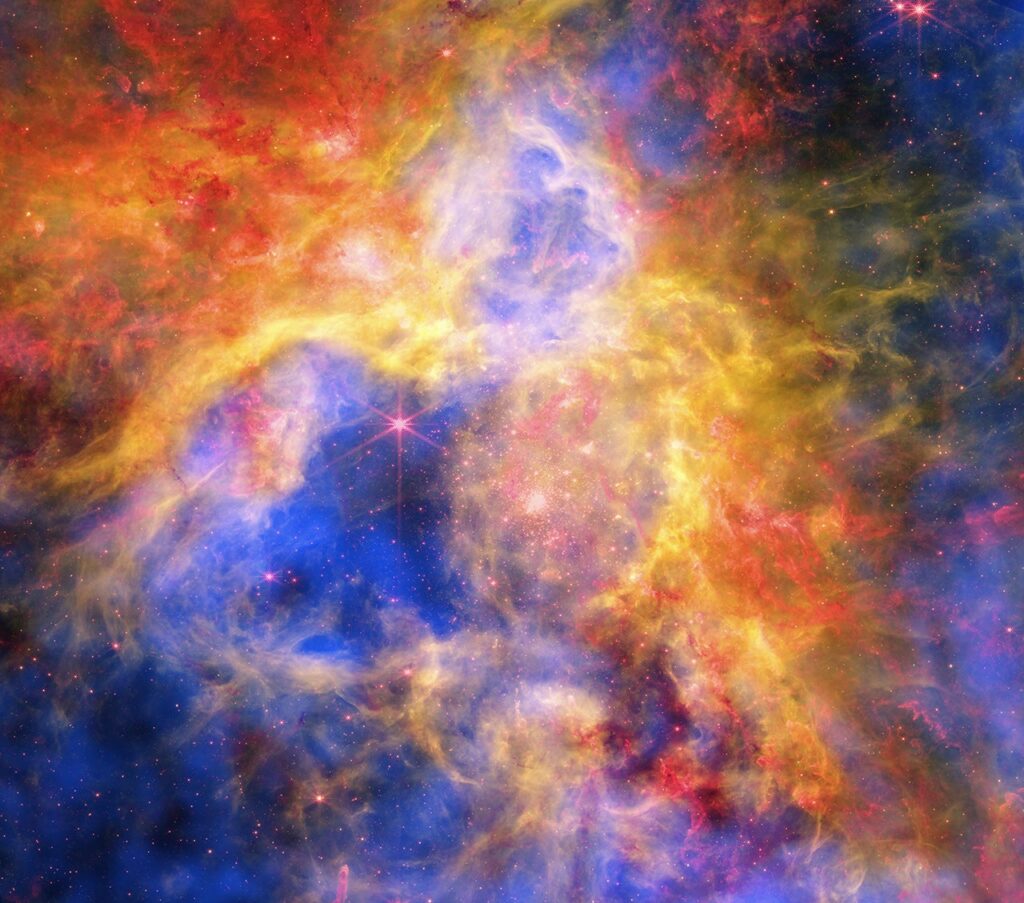
NASA has unveiled a vivid new image of the Tarantula Nebula, combining data from three of its most powerful space observatories to create a detailed view of one of the Milky Way's nearest stellar nurseries. Located in the Large Magellanic Cloud about 160,000 light-years from Earth, this nebula—also known as 30 Doradus—is a hotbed of young, massive star formation. The composite image, built from X-ray, infrared and optical observations, not only showcases the nebula's beauty but also helps solve a long-standing mystery about where the energy from these stars actually goes.
The new composite layers data from three NASA observatories. Blue comes from the Chandra X-ray Observatory, detecting gas heated to millions of degrees by stellar winds and shock waves—akin to sonic booms from young, massive stars. Red represents infrared data from the James Webb Space Telescope, revealing thousands of newly formed stars and the cool dust clouds that will eventually coalesce into future stars and planets. Green shows optical data from the Hubble Space Telescope, highlighting warmer hydrogen gas and individual stars visible through the nebula's structure. Rather than a simple overlay, the image shows complex interactions: in some areas only Chandra's X-ray layer is visible, while in others it blends with Webb's red or Hubble's green. In the central region, all three datasets overlap, producing a full spectrum from red through orange, yellow, green to blue. This multi-wavelength approach allows scientists to study different physical processes simultaneously. Chandra, managed by NASA's Marshall Space Flight Center, has observed the Tarantula Nebula repeatedly over its mission lifetime. Webb penetrates dust clouds that obscure visible light, while Hubble offers high-resolution optical detail. Aligning data from telescopes with different resolutions, fields of view and observational dates requires sophisticated image processing techniques that account for varying sensitivities and observational epochs.
For years, astronomers expected that intense stellar winds from the Tarantula Nebula's young, massive stars would heat surrounding gas to temperatures high enough to produce strong X-ray emissions. Observations showed significantly less X-ray-emitting gas than predicted. This discrepancy prompted researchers to investigate where the energy was going and what processes might be 'taming' the nebula's expected energy output. The research team, led by Jennifer Rodriguez of The Ohio State University, analysed combined data from Chandra, Hubble, Webb and the retired Spitzer Space Telescope to identify three primary mechanisms for energy loss. First, up to half of the hot gas appears to be leaking through the boundaries of the nebula's gas and dust structures, escaping into interstellar space. This leakage occurs particularly in regions where the nebula's shell walls are thin or disrupted by stellar activity. Second, mixing occurs between cold gas near the nebula's edges and the hotter interior gas, reducing the overall temperature through turbulent entrainment at interfaces. Third, thermal conduction—direct heat transfer between hot and cool gas particles without mixing—plays a significant role, particularly in dense regions where particles are in close contact. This process resembles how a frying pan transfers heat from its burner to food through direct contact, equalising temperatures without blending the substances. In the Tarantula Nebula, conduction happens where hot, X-ray-emitting gas interfaces with cooler, denser material in the shell walls, especially in regions compressed by stellar radiation pressure.
The findings refine scientific models of how stellar nurseries evolve and regulate their own growth. By losing energy through these channels, the Tarantula Nebula may self-limit the rate of new star formation, preventing runaway conditions that could disperse the gas too quickly. This natural regulation mechanism helps explain why star formation rates in observed galaxies are often lower than theoretical maximums. The research, published in the Astrophysical Journal, involved collaborators from Columbia University, San Diego State University and the Space Telescope Science Institute, demonstrating the collaborative nature of modern astrophysics. The study highlights the value of multi-sensor data fusion. Combining X-ray, infrared and optical data—each revealing different physical phenomena—creates a more complete picture than any single instrument could provide. This principle applies to sectors like autonomous vehicles fusing lidar, radar and camera data; precision agriculture combining satellite, drone and soil sensor readings; and smart manufacturing integrating vibration, thermal and acoustic sensors for predictive maintenance. NASA's image processing techniques represent advanced forms of data fusion increasingly commercialized through geospatial analytics platforms, medical imaging software and industrial IoT solutions.
NASA's latest view of the Tarantula Nebula does more than showcase celestial beauty—it provides tangible insights into how energy moves and dissipates in extreme environments. By revealing that stellar energy escapes through leakage, mixing and conduction rather than solely producing expected X-ray emissions, the research refines our understanding of stellar ecosystems. For business leaders, technologists and consumers, this work underscores the growing importance of integrated sensing and multi-source data analysis in solving complex problems, whether in space or on Earth. As space-based observatories continue to push the boundaries of detector technology and data fusion, their innovations often find unexpected applications in terrestrial industries—from improving energy efficiency in manufacturing to enhancing the precision of autonomous systems. The Tarantula Nebula study serves as a reminder that exploring the universe not only expands human knowledge but also drives practical advancements that shape how we live, work and innovate in an increasingly interconnected world.
Originally reported by science.nasa.gov. Adapted for our readers with AI assistance.
Keep reading
AI Trends & News
Microsoft opens Surface Laptop Ultra pre-orders from US$2,599.99. Explore its launch date, NVIDIA RTX Spark features and implications for Nigerian businesses.
Science & Technology
DJI’s IBC recognition puts pocket gimbal and panoramic capture in the spotlight. Here is how creators can assess framing, editing effort and recording workflows.
Business News
App store steering is about more than permission to add a link. Explore fees, renewal terms, customer experience and the UK consultation.
TAMFIS NIG LTD
Electrical and instrumentation engineering, bid preparation and consulting, IT and software.

