
Business
Nigeria’s Economic Performance: Domestic Debt Rise and Agriculture Trade Shift in Q2 2026
Nigeria's economic landscape in the second quarter of 2026 presents a mixed picture of fiscal press...
TAMFIS NIG LTDRC 8067447CAC ACTIVEFinima, Bonny Island, Rivers State

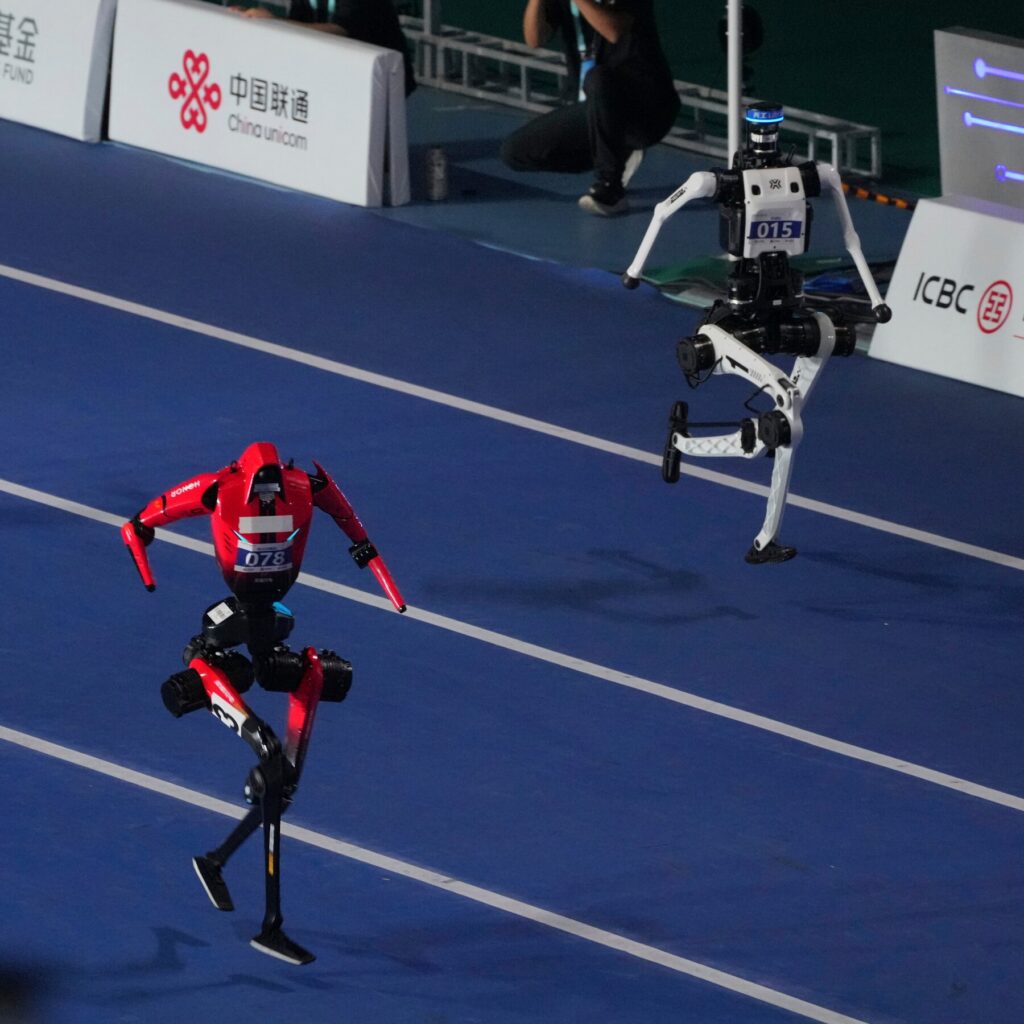
Humanoid robots from China have reached a striking milestone: they can now deliver performances that exceed the benchmarks once thought to represent the absolute peak of human physical capability. Sprinting records that stood for years as symbols of biological excellence are being challenged by machines built from metal, motors, and software. The spectacle is impossible to ignore. A headline about a machine outrunning the fastest human beings on the planet captures something primal about competition, progress, and the relationship between bodies and technology. Yet the same development that makes headlines in sports and technology circles also raises a deeper question. Can a robot that moves with superhuman speed also stock a warehouse shelf, navigate a chaotic living room, or assist a nurse in a busy hospital corridor? According to experts, the answer is far from settled. China’s humanoid robots are achieving superhuman feats of athleticism, but how that translates into the real world is still an open question.
Humanoid robots developed in China have begun to turn athletic benchmarks on their head. Tasks and records that were once treated as the ceiling of human physical achievement are now being used as yardsticks for machines. Among the most attention-grabbing examples, at least in recent public discussion, are performances on the 100-meter sprint benchmark long associated with Usain Bolt, the Jamaican runner whose mark has stood as a symbol of peak human speed. When a robot matches or exceeds that kind of standard, it naturally generates excitement. It also changes the public conversation about what humanoid machines are capable of doing with their bodies.
The term 'superhuman' gets used loosely in marketing, but in robotics it has a precise meaning. A machine is superhuman at a task when it can consistently outperform the best-trained human beings under a clear set of rules. Sprinting is an ideal domain for this comparison because the goal is simple, the course is flat, and success is measured in seconds. Robots can be optimized for exactly those conditions. They do not fatigue in the same way biological tissue does. They can repeat the same motion with mechanical precision. Their control systems can process sensor data and adjust limb positions faster than conscious human reflexes allow. Under controlled circumstances, these advantages compound. The result is a machine that crosses a finish line faster than any person alive.
Athletic achievement, however, is not the same as practical competence. A sprinting robot operates in a carefully structured environment: a level surface, defined boundaries, predictable footing, and no unexpected obstacles. The real world is messier. Floors slope, carpets bunch, people step into pathways, doors swing, and lighting changes. A machine that can run in a straight line may struggle to sidestep a cooler left in a hallway or to regain balance on a wet tile floor. Experts emphasize that the skills required for warehouse work, elder care, disaster response, or home assistance are different in kind from raw speed. They demand improvisation, social awareness, fine manipulation, and the ability to interpret ambiguous situations. None of those capabilities are automatically delivered by the hardware that makes a fast runner.
Several factors explain why athletic robots do not instantly become useful workers. First, laboratory and competitive demonstrations are usually optimized for a single metric. Engineers may sacrifice battery life, durability, cost, or versatility in exchange for a faster time or a more dramatic leap. A robot built to break a sprint record may have little in common with one built to fold laundry or patrol a factory floor. Second, the environments where humanoid robots would actually be deployed are full of edge cases. A control system trained on smooth surfaces may fail on gravel, grass, or stairs. A gait tuned for speed may be unsafe around children or fragile objects. Third, real-world usefulness depends on economics as much as engineering. A fast robot that costs too much to build, maintain, or power is not a practical product, no matter how impressive its videos look.
Even with those caveats, the progress is worth taking seriously. Hitting superhuman athletic benchmarks is not a gimmick; it pushes the boundaries of what the underlying technology can do. Solving the balance, power, and control problems required for high-speed bipedal movement creates knowledge that can eventually be applied elsewhere. Better motors, more efficient batteries, lighter materials, and smarter control algorithms tend to benefit the whole field, not just sprinters. The public attention also matters. Demonstrations that capture the imagination can accelerate investment, attract engineering talent, and encourage policymakers to think about how robots should be regulated. In that sense, a headline about a robot challenging a human sprint record is about more than sports. It is a signal that the entire category of humanoid machines is moving from research curiosity to cultural and economic reality.
So should we be impressed? The honest answer is yes, but with perspective. Watching a machine challenge the fastest human runner on Earth is a genuinely remarkable display of engineering. It shows that humanoid robots have entered a new phase of physical capability. Yet the same display also reminds us that headline metrics are not the same as deployed utility. The path from a record-breaking run to a reliable coworker, caregiver, or helper is long, uneven, and full of questions that speed alone cannot answer. China’s humanoid robots are achieving superhuman feats of athleticism. But how that translates into the real world is still an open question, experts said. That open question is what makes the next chapter worth watching.
Originally reported by nytimes.com. Adapted for our readers with AI assistance.
Keep reading
Business
Nigeria's economic landscape in the second quarter of 2026 presents a mixed picture of fiscal press...
Business
Liverpool manager Andoni Iraola is confronting a significant selection headache as two key forwards, Cod...
News
Health News tamfitronics [Editor’snote:[Editor’snote: This transcript was generated using both transcription ...
TAMFIS NIG LTD
Electrical and instrumentation engineering, bid preparation and consulting, IT and software.