
News
RUSSIA versus NATO and BRICS vs. NATO Military SWOT
Recall that Poland’s Minister Sikorski’s core claim is partially supported by the numbers, but the framing “quite quickly” and “without the U.S.” does not…
TAMFIS NIG LTDRC 8067447CAC ACTIVEFinima, Bonny Island, Rivers State

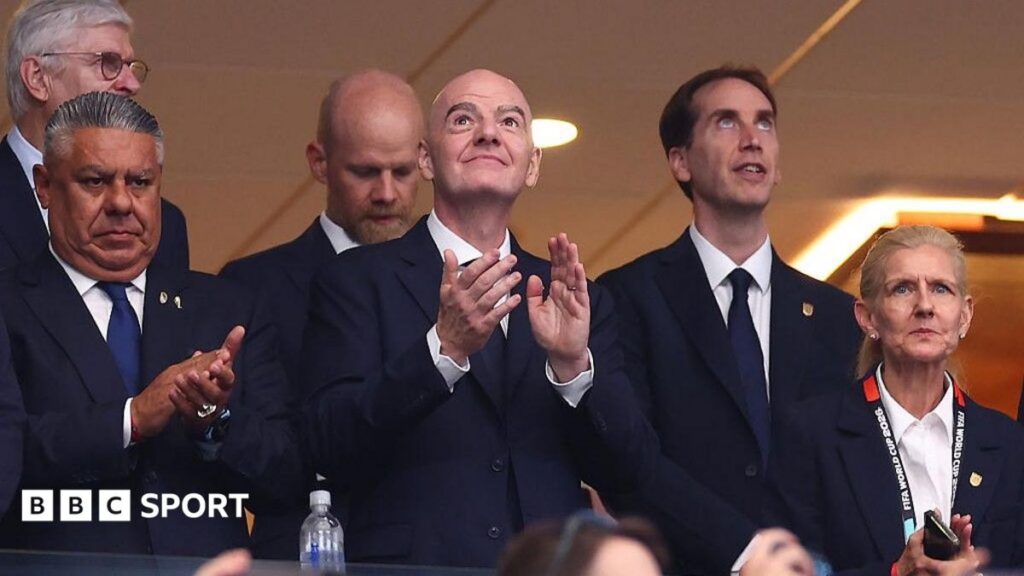
FIFA, football’s global governing body, has unveiled a contentious plan to create a commercial subsidiary that would sell stakes in its flagship competitions, including the men’s and women’s World Cups and the Club World Cup. This move has triggered alarm among key football stakeholders, notably UEFA and the English Football Association (FA), who fear that private investment could unduly influence the sport’s most prestigious tournaments. The proposal’s release without prior consultation with senior officials has deepened the controversy, leading to emergency meetings and discussions of a possible boycott. This article explores the details of FIFA’s plan, the reactions from European and North American football bodies, and the broader implications for the sport’s governance and future.
FIFA announced plans to establish a commercial subsidiary to oversee its major competitions, including the men’s and women’s World Cups and the Club World Cup. The subsidiary would allow external investors to purchase stakes, injecting significant private capital into these events. FIFA aims to use the funds to boost global football development, pledging to increase development funding to $10 billion and offering member associations access to up to $20 million each in one-off capital.
However, the details of the proposal remain vague, with FIFA yet to provide comprehensive information on the structure, conditions, or governance mechanisms surrounding the subsidiary. The announcement came as a surprise to many within the football community, including senior FIFA vice-presidents and confederation leaders, who were reportedly not consulted before the plan’s public release.
The English Football Association expressed deep concern over FIFA’s plan, highlighting the lack of transparency and due process. An FA spokesperson stated that they were completely unaware of the proposal and had no substantive details regarding its content or conditions. The FA criticized the governance approach leading to the announcement and emphasized the need for full disclosure before further comment.
This reaction underscores the FA’s unease about the potential consequences of allowing private investors to gain influence over football’s premier competitions. The FA’s stance reflects broader worries about maintaining the sport’s integrity and ensuring that decisions benefit the game rather than commercial interests alone.
UEFA, representing 55 European football associations, reacted swiftly and strongly against FIFA’s plan, condemning it as a step that “crossed a line.” The confederation took the unusual step of publicly responding to reports before FIFA’s official announcement, signaling the depth of its disapproval.
UEFA has scheduled an emergency virtual meeting to discuss the situation and formulate a collective response. Given the intensity of opposition, discussions are expected to consider drastic measures, including the possibility of boycotting FIFA competitions if the plan proceeds without adequate consultation and safeguards.
UEFA’s influence is significant despite representing only a quarter of FIFA’s 211 member nations. Its members include many of the world’s top teams, which are crucial to the value and prestige of FIFA’s tournaments. UEFA’s potential withdrawal would severely undermine these events.
Concacaf, the governing body for North and Central America, also voiced strong concerns about the lack of due process surrounding FIFA’s proposal. Having recently hosted the 2026 World Cup, Concacaf expressed disappointment that such a significant plan was designed and publicly shared without prior consultation with relevant governance bodies.
The organization emphasized the collective responsibility of FIFA, confederations, and member associations to act in football’s best interests. Concacaf’s statement reflects a shared apprehension among regional bodies about the potential for commercial interests to overshadow the sport’s governance and integrity.
One of the major concerns raised by FIFA’s plan is the potential expansion of tournaments such as the men’s and women’s World Cups and the Club World Cup. There are ongoing discussions about increasing the World Cup to 64 teams by 2030, involving six host countries across three confederations. Such expansion would have significant implications for the already congested football calendar.
European club competitions have recently expanded, putting additional strain on players and scheduling. Further enlargement of FIFA’s tournaments could exacerbate these challenges, raising questions about player welfare and the balance between international and club football.
The possibility of private investors influencing decisions about tournament size and scheduling adds another layer of complexity, fueling fears that commercial considerations might override sporting logic.
A senior figure within English football likened the threat posed by FIFA’s plan to the European Super League (ESL) proposal in 2021, which sparked widespread outrage and was abandoned within 48 hours. The ESL controversy centered on concerns that a breakaway league would undermine domestic competitions and concentrate power and wealth among a few elite clubs.
While FIFA’s plan differs in nature, the comparison highlights the scale of disruption and resistance it could provoke within the football community. Unlike the ESL, which was quickly shelved, FIFA appears determined to pursue its commercial strategy, suggesting a prolonged period of tension and negotiation ahead.
The commercial proposal adds to an already difficult relationship between FIFA and UEFA. Previous disputes include UEFA’s strong opposition to FIFA’s idea of holding the World Cup every two years, a suggestion championed by FIFA’s chief of global football development, Arsène Wenger, in 2021.
UEFA president Aleksander Čeferin notably boycotted the recent World Cup final, protesting various controversial decisions, including political interference in disciplinary matters. These incidents underscore the growing friction between the two bodies over governance, competition formats, and the sport’s direction.
The current commercial plan could further deepen this divide, with UEFA and other confederations demanding greater involvement in decision-making processes.
FIFA’s proposal to commercialize its major competitions by selling stakes to private investors has ignited a significant crisis within global football governance. The lack of prior consultation and clarity has alienated key stakeholders, particularly UEFA and the English FA, who fear that the plan threatens the integrity, scheduling, and traditional governance of the sport. With emergency meetings underway and boycott discussions on the table, the football world faces a pivotal moment. The resolution of this dispute will shape the balance of power between FIFA, confederations, and member associations, and determine how football navigates the competing demands of commercial growth and sporting values in the years ahead.
Originally reported by bbc.co.uk. Adapted for our readers with AI assistance.
Keep reading
News
Recall that Poland’s Minister Sikorski’s core claim is partially supported by the numbers, but the framing “quite quickly” and “without the U.S.” does not…
News
Thousands of young protesters in Delhi continue to demand education reforms and the resignation of Education Minister Dharmendra Pradhan after a police crackdown. The…
News
Facing a looming financial collapse, Thames Water’s main lenders have offered the UK government a ‘golden share’ and increased local authority involvement to avoid…
TAMFIS NIG LTD
Electrical and instrumentation engineering, bid preparation and consulting, IT and software.