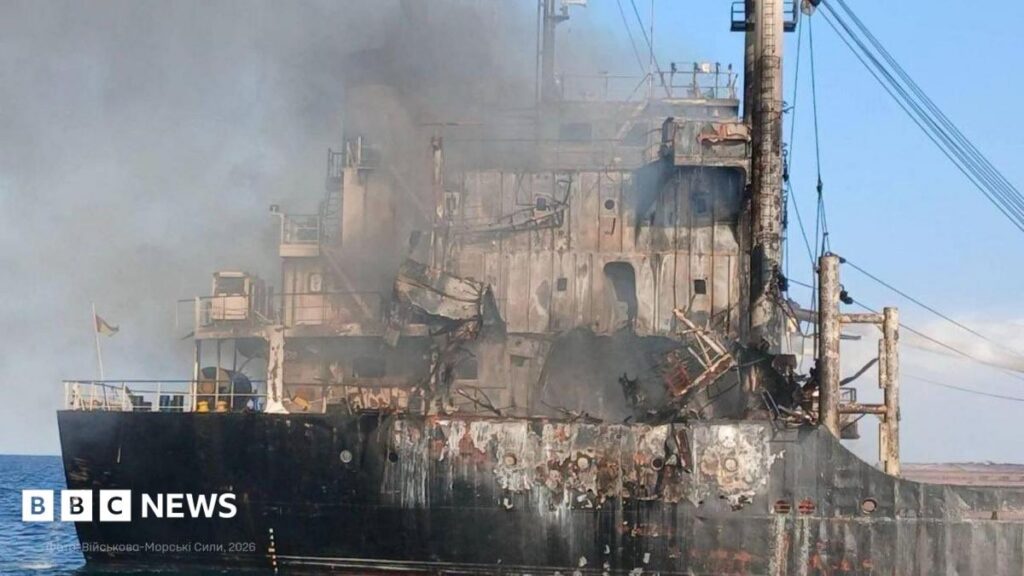
Ten killed as Russian attacks on merchant ships in Black Sea intensify
Ten killed as Russian attacks on merchant ships in Black Sea intensify
Editor’s note: The following is AI-generated commentary and context on this topic, not original reporting.
Ten killed as Russian attacks on merchant ships in Black Sea intensify underscores how the war has evolved into a contest fought as much through logistics, morale and political resilience as through territory gained or lost on any given day.
Ten killed as Russian attacks on merchant ships in Black Sea intensify is another entry in the long and difficult record of the war in Ukraine, a conflict that continues to shape security policy, energy markets and political alliances well beyond the immediate battlefield.
In the specific case of “Ten killed as Russian attacks on merchant ships in Black Sea intensify,” the details below place the story in a wider frame rather than repeating claims that have not been independently verified.
Since the full-scale invasion began, the conflict has evolved through several distinct phases, from the initial assault to a protracted war of attrition involving long-range strikes, drone warfare and shifting front lines. Both sides have adapted tactics and technology considerably over that period.
International support for Ukraine, in the form of military aid, financial assistance and diplomatic backing, has remained a significant factor shaping the country’s capacity to sustain its defence, even as the political appetite for continued support has fluctuated among allied governments.
Domestic politics inside Ukraine have continued to function throughout the war, including debate over military strategy, leadership decisions and the balance between civilian oversight and command authority. That has, at times, produced visible tension between political and military leadership.
The war’s economic and humanitarian toll has been immense, with millions displaced, significant infrastructure damage, and ongoing strain on energy and logistics networks on both sides of the front line.
Why It Matters
Developments in the war carry consequences well beyond Ukraine’s borders, affecting energy markets, defence spending across Europe, and the broader question of how the international community responds to large-scale conflict. Domestic political and military dynamics inside Ukraine also influence how sustainable the country’s war effort will prove over time.
Who Is Affected
Civilians and communities directly in the path of the conflict.
Military personnel and leadership on both sides.
Allied governments providing financial and military support.
The global economy, particularly energy and grain markets, which remain sensitive to developments in the war.
Factors Shaping the Situation
The pace and scale of continued international military and financial support.
Domestic political dynamics within Ukraine’s government and military leadership.
Battlefield conditions and the evolving use of drone and long-range strike technology.
Diplomatic efforts, where they exist, aimed at shaping the conflict’s eventual resolution.
Reaction and Context
Reaction to developments in the war typically comes from Ukrainian officials, Russian state and independent commentary, and international observers and allied governments monitoring the situation’s implications for regional and global security.
Ukrainian officials generally frame developments in terms of resilience and continued resistance.
International observers assess the wider implications for regional security and alliance support.
Independent analysts examine how the development fits into the broader trajectory of the conflict.
The Bigger Picture for the Conflict
Individual developments, whether military, political or diplomatic, need to be understood within the broader arc of a war that has already lasted far longer than many initial assessments anticipated. Analysts continue to debate the balance between attrition, technological adaptation and political endurance in determining how the conflict eventually resolves. International alliances and the durability of support from partner nations remain a significant variable shaping what options are realistically available to Ukraine’s leadership going forward.
Long-Term Considerations
Whatever the near-term outcome, the war’s long-term consequences, for regional security architecture, for Ukraine’s reconstruction, and for the broader relationship between Russia and Western governments, are likely to be felt for years after any eventual resolution. Historians and policy analysts will likely be studying this period for a long time to come.
Reading War Coverage Carefully
Reporting on an active conflict is inherently difficult: access is restricted, information from combatants on either side can be shaped by propaganda considerations, and the fog of war makes real-time verification genuinely hard even for experienced correspondents. Readers are generally best served by relying on established international news organisations with journalists and stringers on the ground, cross-referencing claims from official Ukrainian and Russian sources against independent verification where it exists, and treating any single, unverified claim, especially around casualty figures or battlefield outcomes, with appropriate caution until confirmed by multiple sources.
Outlook
The months ahead are likely to bring further shifts in both the military and political dimensions of the conflict, shaped by decisions taken in Kyiv, Moscow and allied capitals alike. Analysts continue to caution against short-term predictions given how often the war’s trajectory has shifted in response to new developments on the ground and in international diplomacy.
What Happens Next
The trajectory of the war will continue to depend on a combination of battlefield developments, the scale and consistency of international support, and the internal political and military decisions taken by Ukraine’s leadership in the weeks ahead.
How the Situation Is Usually Assessed
Independent assessments of developments in the war typically draw on a combination of official statements from involved governments, reporting from journalists on the ground, and analysis from defence and foreign policy research institutions, all of which can vary considerably in their read of the same event.
A Note on This Coverage
This piece is intended as background and analysis rather than original war reporting, so specific casualty figures, troop movements and direct quotes are deliberately left to primary journalistic and official sources. Established international news organisations with correspondents on the ground remain the most reliable references for exact, verified detail.
In Short
Ten killed as Russian attacks on merchant ships in Black Sea intensify is, at its core, a story about how a specific event connects to larger, ongoing questions in its field. The details above are offered as background rather than a substitute for primary reporting, and readers wanting the fullest, most current picture should keep an eye on official statements and established news coverage as the story continues to unfold in the days ahead.
As with most stories of this kind, the full picture will likely become clearer with time, as more information emerges and the immediate reaction gives way to more considered analysis. Readers who want to follow the story closely should expect further updates as circumstances develop and official responses are issued.
Ultimately, how this story is remembered will depend on what follows in the days and weeks ahead, and readers are encouraged to look out for further reporting as the situation develops. Context like this is often just as important as the headline itself in understanding what actually happened and why it matters.
For now, Ten killed as Russian attacks on merchant ships in Black Sea intensify stands as a snapshot of a moment that is still unfolding, and it is one worth revisiting as further details come to light. It is a useful illustration of how quickly a single event can generate wider debate about the issues surrounding it.
Originally reported by bbc.co.uk. Adapted for our readers with AI assistance.
Thousands of young protesters in Delhi continue to demand education reforms and the resignation of Education Minister Dharmendra Pradhan after a police crackdown. The…
Facing a looming financial collapse, Thames Water’s main lenders have offered the UK government a ‘golden share’ and increased local authority involvement to avoid…
Facing record-breaking temperatures and severe drought, Thames Water has introduced a hosepipe ban impacting over 10 million customers across parts of southern England to…