Accurate level measurement is fundamental to the safe and efficient operation of industrial processes worldwide. From monitoring hydrocarbon storage in oil depots to managing chemical reactions in nuclear facilities, precise level detection enables effective inventory control, process optimisation, and adherence to stringent safety regulations. This article examines the core technologies used for level measurement across diverse applications, highlighting their operating principles, advantages, limitations, and suitability for specific industrial environments. Drawing from established engineering practices and manufacturer guidelines, it provides actionable insights for engineers, plant managers, and procurement specialists seeking to implement reliable measurement solutions in sectors including oil & gas, power generation, manufacturing, and water treatment.
Core Principles of Level Measurement Technologies
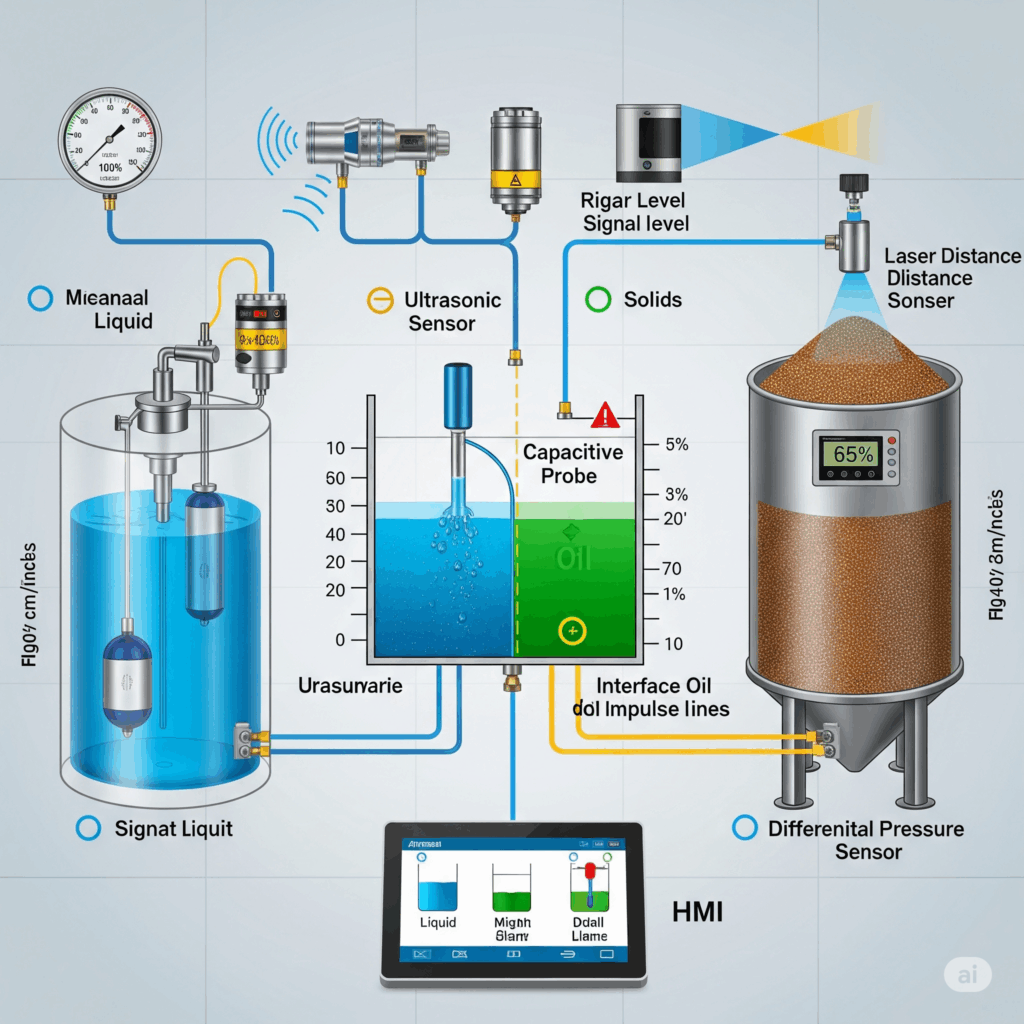
Level measurement technologies operate on various physical principles to determine the height or position of a substance within a container. Differential pressure (DP) measurement infers level from the hydrostatic pressure exerted by a liquid column, making it particularly effective for pressurised tanks where consistent fluid density allows accurate pressure-to-level conversion. This method relies on impulse lines connecting a DP transmitter to the tank's bottom and a reference point, often incorporating condensate pots to prevent measurement errors in vapour-filled systems.
Radar level measurement, encompassing both Frequency-Modulated Continuous Wave (FMCW) and pulse radar variants, utilises microwave signals emitted toward the material surface. The time-of-flight of the reflected signal determines the distance to the surface, thereby calculating level. This technology excels in challenging environments due to its immunity to temperature fluctuations, pressure variations, and vapour interference, rendering it ideal for hydrocarbon storage in oil & gas tank farms and chemical reactors where process conditions can be extreme.
Ultrasonic level measurement employs high-frequency sound waves directed at the surface, with the echo return time used to calculate distance. While cost-effective and suitable for open tanks and bulk solids handling industries like cement and grain storage, its performance can be degraded by foam, vapour, and dust accumulation, which scatter or absorb the ultrasonic signals. Guided wave radar (GWR) offers a robust alternative in such conditions, as microwaves propagate along a probe (rod or cable) and reflect from the surface, providing reliable measurements even in the presence of foam, vapour, or turbulent flow.
Specialised Measurement Techniques for Complex Applications
Capacitance level sensors detect changes in the dielectric constant between a probe and the tank wall, which varies with the level of the material. This allows for interface level detection in applications such as oil-water separators and powder level monitoring in hoppers. However, these sensors require fluid-specific calibration and can be compromised by coating build-up on the probe, necessitating regular maintenance or alternative technologies in sticky or scaling environments.
Displacer measurement relies on buoyancy forces acting on a suspended displacer within a fluid, with the resulting force translated into level via a torque tube or transmitter. This mechanical approach is well-suited for interface level detection and applications requiring simplicity, though it is prone to wear, drift, and inaccuracy during rapid level changes, limiting its use in dynamic processes. Nuclear level measurement, meanwhile, uses gamma radiation emitted from a source through the tank wall; the intensity detected on the opposite side varies with the level of intervening material. While highly effective in corrosive or harsh environments such as reactor vessels and bitumen tanks, it demands strict radiation safety protocols, regulatory compliance, and involves higher initial and operational costs.
Overcoming Common Measurement Challenges
Industrial level measurement faces several recurring challenges that can compromise accuracy and reliability. Foam accumulation on the surface adversely affects ultrasonic and standard radar systems, as it scatters or absorbs signals; mitigation strategies include employing guided wave radar or radar systems with foam compensation algorithms. Vapour interference primarily impacts ultrasonic sensors, which can be addressed by switching to radar or differential pressure techniques less susceptible to gaseous media.
Turbulence disrupts displacer and ultrasonic measurements due to fluctuating force readings or signal noise, where guided wave radar or signal averaging techniques improve stability. Solids with high dust content, such as in cement or grain silos, attenuate ultrasonic waves, making radar or guided wave radar preferable for consistent performance. Capacitance sensors are vulnerable to coating build-up from viscous or scaling materials, requiring scheduled cleaning protocols or substitution with less sensitive technologies like guided wave radar to maintain long-term accuracy.
Instrument Selection Criteria and Industry-Specific Applications
Selecting the appropriate level measurement instrument involves evaluating multiple factors. The nature of the fluid or material—whether liquid, slurry, solid, or multi-phase—dictates technology suitability, as does the process environment, including pressure, temperature, and corrosiveness. Mounting constraints (top, bottom, or side installation), accessibility for maintenance, required measurement range, and accuracy objectives (inventory tracking versus process control) further refine the choice. Safety and regulatory considerations, particularly regarding radiation use in nuclear techniques, must also be assessed.
In the oil & gas sector, radar level measurement—especially FMCW radar—is widely adopted for tank farms due to its high accuracy, resilience to vapour and temperature changes, and compatibility with hydrocarbon storage. Features such as antenna purge systems and integrated temperature/pressure compensation enhance reliability. Nuclear power plants employ diverse instrumentation for reactor vessel level monitoring, combining differential pressure, guided wave radar, and nuclear sensors to ensure redundancy and continuous monitoring through independent signal paths.
For silo and bin level monitoring in manufacturing and energy applications, ultrasonic sensors work effectively for general bulk solids, while guided wave radar provides superior accuracy in dusty environments through dust-immune probes and echo-mapping calibration. In oil-water separation and sludge management, capacitance and displacer technologies are commonly used to track interface levels between immiscible fluids, enabling efficient separation processes in upstream production and wastewater treatment plants.
What this means
Level measurement remains a cornerstone of industrial process control, underpinning safety, efficiency, and regulatory compliance across global sectors. The evolution from traditional mechanical systems to advanced radar, nuclear, and guided wave technologies reflects the growing demand for reliability in increasingly complex and hazardous environments. By matching technology choice to the specific challenges of each application—be it hydrocarbon storage, nuclear reactor monitoring, solids handling in silos, or interface detection in separators—industries can achieve optimal performance and risk mitigation. As automation and digital integration advance, the role of precise, dependable level data will only grow in importance, reinforcing the need for informed selection, proper installation, and ongoing maintenance of measurement systems.
The Sindh government's decision to reduce school and college timings by one hour until further notice highlights ongoing efforts to balance educational continuity with…