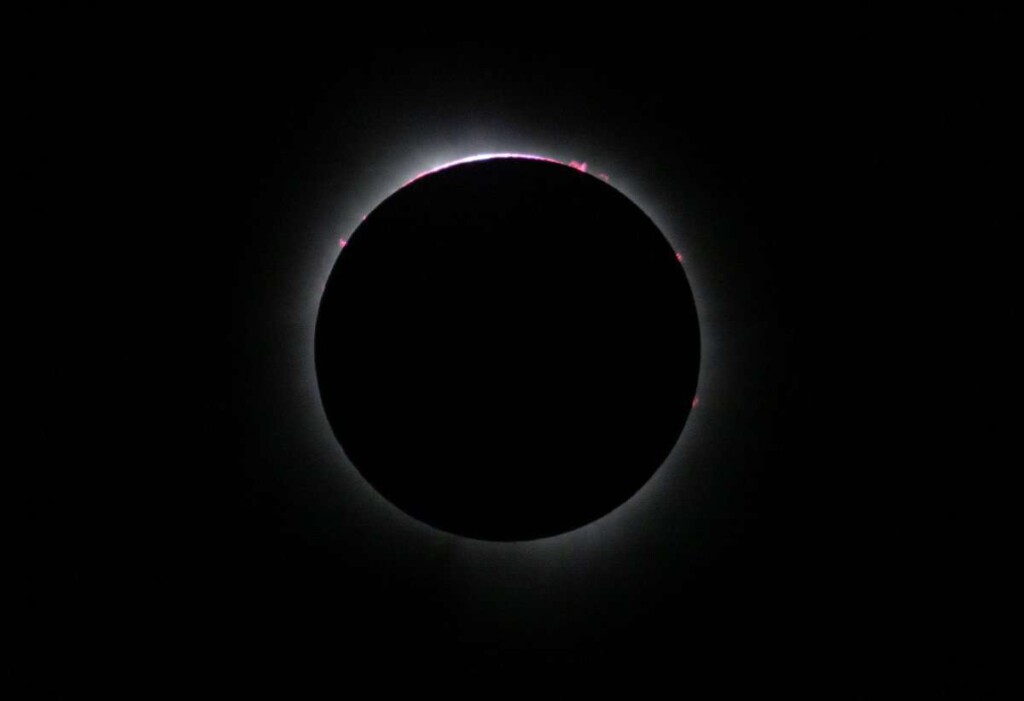
More than 100,000 people from around the world gathered April 8 in Russellville, Arkansas, to observe an astronomical syzygy – the alignment of the Sun, Moon, and Earth – creating a solar eclipse with totality lasting 4 minutes and 12 seconds.
Team members from NASA’s Marshall Space Flight Center and others traveled to Arkansas to provide educational opportunities related to the eclipse. Experts from NASA’s Stennis Space Center, Kennedy Space Center, and NASA Headquarters, along with representatives of the Arkansas Air National Guard and the Paris Observatory in Meudon, France, joined the Marshall team.
“I’ve done outreach before, but nothing on this scale,” said Patrick Koehn, heliophysics research and analysis lead at NASA Headquarters. “The logistics were on another level, it was impressive to see it come together, and I’m thrilled we engaged so many people.”
In the days leading up to the eclipse, NASA hosted presentations and outreach activities for the public and gave talks for students at Arkansas Tech University and the Russellville School District. Attendees were also given an opportunity to meet retired NASA astronaut Mike Massimino, who signed autographs and greeted the crowds.
Marshall Heart Director Joseph Pelfrey also attended this celestial ride, giving remarks on the Russellville watch party in regards to the eclipse and the work of Marshall’s Heliophysics and Planetary Science Branch.
“Attributable to our collaboration with the metropolis of Russellville, we helped host one amongst the agency’s most a success eclipse events,” Pelfrey said. “Other folk came from across the nation and the field to portion the ride with us. It modified into once unparalleled to understanding my first total solar eclipse alongside the Marshall physique of workers in Arkansas.”
Russellville modified into once one amongst the cities featured in NASA’s are living eclipse broadcast, 2024 Total Solar Eclipse: Throughout the Eyes of NASA. The three-hour broadcast lined the route of the eclipse across 15 states, from Texas to Maine, garnering greater than 1,000,000 are living viewers. Currently, the published has greater than 13 million views. Russellville modified into once illustrious for its sure skies, providing spectators with one amongst primarily the most seen sightings of the eclipse.
The 2024 solar eclipse modified into once especially spectacular attributable to the prominences seen throughout totality. Solar safe cameras captured the fiery red arcs around the fringe of the Moon and Solar.
“This was my first total solar eclipse, and it was an incredible experience,” said Bob Loper, research astrophysicist at Marshall. “It was remarkable to witness phenomena I’ve spent my career studying – actually seeing solar prominences of the Sun was an experience I’ll never forget.”
Chad Summers has been appointed as the director of the Test Laboratory for the Engineering Directorate at NASA’s Marshall Space Flight Center, effective April 21.
An integral section of the Engineering Directorate, the Test Laboratory comprises an extensive range of specialized capabilities NASA uses to conduct testing for spaceflight hardware evaluation, development, qualification, acceptance, and anomaly resolution. As director, Summers will provide executive leadership for all aspects of the Laboratory, including personnel, budget, infrastructure, and operations for testing.
Summers has been the executive of the Structural Design and Evaluation Division at Marshall since 2019. In that role, he supervised a division of civil service and contractor engineers to ensure the successful design, development, and integration of large, complex launch vehicles and spacecraft systems to meet NASA’s Human Exploration and Science Mission objectives. From 2018 to 2019, Summers was the division’s deputy chief.
From 2015 to 2018, he was chief of the Systems Requirements and Verification department. Summers led the Systems Design and Definition department from 2011 to 2015. From 2007 to 2011, he was chief of the Systems Requirements, Interfaces, and Verification department. Summers was deputy chief of the Engine Systems and Major Propulsion Systems department from 2004 to 2007.
Summers has nearly 30 years of ride at NASA and worked at both Kennedy Pickle Heart and Stennis Pickle Heart before coming to Marshall in 2001 as a take a look at operations supervisor within the Subsequent Generation Launch Skills Venture Space of job.
He has got several of the agency’s perfect awards, at the side of NASA’s Excellent Management Medal, Distinctive Service Medal, Marshall Director’s Commendation, and quite so much of Neighborhood Success and Particular Service awards.
A native of Titusville, Florida, Summers earned his bachelor’s degree in mechanical engineering from the University of Central Florida. He lives in Huntsville with his wife, Jennifer.
NASA will maintain fun the Thirtieth anniversary of theHuman Exploration Rover Fretwhen the opponents returns to the U.S. Pickle & Rocket Heart’s Aviation Fret Course in Huntsville April 19-20. The occasion is free and launch to the general public with rover excursions occurring every day from 7:30 a.m. to a few p.m. or till the closing rover completes the obstacle course.
NASA selected 72 student teams in October to begin an engineering design project to develop human-powered rovers that will compete on the course near the agency’s Marshall Space Flight Center.
The general public is invited to watch more than 600 college students from around the world attempt to navigate a complex obstacle course by piloting a human-powered vehicle of their own design and manufacturing.
Participatingteamsrepresent 42 colleges and universities and 30 high schools from 24 states, the District of Columbia, Puerto Rico, and 13 other countries from around the world. NASA’shandbookcontains full proposal guidelines and task challenges.
To conclude the 2024 season, NASA will host an in-person awards ceremony on April 20 at 5 p.m. at the Pickle Camp Operations Center at the rocket center. NASA and industry representatives will present numerous awards recognizing team achievements throughout the past eight-month-long engineering design project, including awards for best rover design, best pit crew, best social media presence, and many other accomplishments.
The Human Exploration Rover Challenge tasks high school, college, and university students worldwide to design, build, and test their lightweight, human-powered rovers on a course simulating lunar and Martian terrain, all while completing mission-focused science projects. Eligible teams compete to be among the top three finishers in their divisions, and to earn awards for best vehicle design, best rookie team, and more.
The mission every 365 days attracts a total bunch of college students from around the field and reflects the targets of NASA’sArtemis marketing campaignthat would perchance per chance well also simply land the first girl and first person of coloration on the Moon.
The occasion modified into once launched in 1994 as the NASA Gargantuan Moonbuggy Scamper – a collegiate opponents to commemorate the twenty fifth anniversary of theApollo 11 lunar touchdown.It expanded in 1996 to contain excessive college teams, evolving again in 2014 into the NASA Human Exploration Rover Fret. Since its inception, greater than 15,000 college students maintain participated. Many dilapidated opponents now work within the aerospace trade, at the side of with NASA.
The Human Exploration Rover Challenge is managed by NASA’s Southeast Regional Office of STEM Engagement at Marshall and is one of eightArtemis Student Challenges. NASA’sOffice of STEM Engagementuses challenges and competitions to further the agency’s goal of encouraging students to pursue degrees and careers in science, technology, engineering, and mathematics.
Groups at NASA’s Marshall Space Flight Center executed a new payload adapter test article and readied it for structural testing, slated for delivery later this spring. This marks a valuable milestone on the way to the hardware’s debut on the upgraded Block 1B configuration of NASA’s SLS (Space Launch System) rocket with Artemis IV.
The composite payload adapter is an evolution from the Orion stage adapter used in the Block 1 configuration of the first three Artemis missions.
Before the Orion spacecraft is stacked atop NASA’s SLS (Space Launch System) rocket before theArtemis II mission, engineers will put it through a series of rigorous tests to ensure it is ready for lunar flight. In preparation for testing, teams at the agency’s Kennedy Space Center have made significant upgrades to the altitude chamber where testing will occur.
Several of the tests take place inside one of two altitude chambers in the high bay of theNeil A. Armstrong Operations and Checkout (O&C) Building at Kennedy. These tests, which began on April 10, include electromagnetic interference and electromagnetic compatibility testing, which assess the spacecraft’s response to internally and externally generated electromagnetic energy and confirm that all systems perform as expected during the mission.
To prepare for the tests, the west altitude chamber was upgraded to test the spacecraft in a vacuum environment that simulates an altitude of up to 250,000 feet. These upgrades restored altitude chamber testing capabilities for the Orion spacecraft at Kennedy. Earlier vacuum testing on the Orion spacecraft for Artemis I took place at NASA’s Glenn Research Center. Teams also installed a30-ton cranein the O&C to lift and lower the Orion crew and service module stack into the chamber, lift and lower the chamber’s lid, and move the spacecraft across the high bay.
On April 4, teams loaded the Artemis II spacecraft into the altitude chamber. This event marks the first time since the Apollo testing that a spacecraft designed for human exploration of space has entered the chamber for testing. After testing is complete, the spacecraft will return to the Final Assembly and Systems Testing, or FAST, cell in the O&C for additional work. Later this summer, teams will bring Orion back into the altitude chamber to conduct a test that simulates as closely as possible the conditions in the vacuum of deep space.
In the beginning, to test environmental and life support systems on the lunar and command modules during the Apollo Program, the interior of each altitude chamber measured 33 feet in diameter and 44 feet high and was designed to simulate the vacuum equivalent of up to 200,000 feet in a high-altitude atmosphere. Both chambers were rated for astronaut crews to operate flight systems during tests.
After Apollo, the chambers were used for leak tests on pressurized modules delivered by the Space Shuttle Program for the International Space Station.
Additional upgrades to the west chamber include a new oxygen deficiency monitoring system that provides real-time monitoring of oxygen levels and a new airflow system. New LED lights replaced the old lighting system, and equipment from the Apollo era was removed. A pressure control system was added to the chamber that provides precise control of pressure levels. Two new pumps remove air from the chamber to create a vacuum. New guardrails and service platforms replaced the older platforms inside the chamber.
A new control room overlooks the upgraded chamber. It contains several workstations and communication equipment. The chamber control and monitoring system was upgraded to manage operation of the fully remotely operated hardware and subsystems that make up the vacuum testing capability.
“It was different to handbook a various and distinctive physique of workers to re-spark off a ability for attempting out the NASA’s next era spacecraft that might lift humans succor to the Moon,” said Marie Reed, West Altitude Chamber Reactivation Venture Supervisor. “The physique of workers of greater than 70 aerospace professionals, integrated folk from NASA, Lockheed Martin, Artic Slope Compare Corps, Jacobs Engineering, and each self-discipline condominium doable. This project required long hours of dedication and distinctive coordination to permit the a success turn-around and activation in time for this Artemis II spacecraft attempting out.”
NASA’sArtemis IImission will lift four astronauts aboard the agency’s Orion spacecraft on an roughly 10-day take a look at flight around the Moon and succor to Earth, the first crewed flight beneath Artemis that might take a look at Orion’s life abet systems sooner than future missions. Below theArtemismarketing campaign, NASA will return humanity to the lunar surface, this time sending humans to search out the lunar South Pole recount.
Engineers at NASA’s Jet Propulsion Laboratory are conducting final tests and preparing the agency’sEuropa Clipper spacecraft for the next phase of its journey: launching from NASA’s Kennedy Space Center. Europa Clipper, which will orbit Jupiter and focus on the planet’s ice-encased moon Europa, is expected to depart JPL later this spring. Its launch window opens Oct. 10.
Members of the media wore “bunny suits” – protective garments to prevent contamination of the spacecraft – to observe Europa Clipper up close in JPL’s historicSpacecraft Assembly Facility on April 11. Project Manager Jordan Evans, Launch-to-Mars Mission Manager Tracy Drain, Project Staff Scientist Samuel Howell, and Assembly, Test, and Launch Operations Cable Harness Engineer Luis Aguila were on the clean room floor, while Deputy Project Manager Tim Larson, and Mission Designer Ricardo Restrepo were in the gallery above to oversee the mission and its objectives.
Planning for the mission began in2013 and Europa Clipper was formallyconfirmed by NASA as a mission in 2019. The journey to Jupiter is expected to take about six years, with flybys of Mars and Earth. Arriving at the gas giant in 2030, the spacecraft will orbit Jupiter while conducting dozens of flybys of Europa, coming as close as 16 miles from the moon’s surface to gather data with its advanced suite ofscience instruments. The mission will help scientists study the ocean beneath the moon’s icy shell, determine Europa’s surface composition and geology, and search for any potential plumes of water vapor that may be venting from the crust.
“After over a decade of hard work and problem-solving, we’re so proud to showcase the nearly complete Europa Clipper spacecraft to the world,” Evans said. “As key components arrived from institutions around the globe, it’s been exciting to see the pieces come together into a greater whole. We can’t wait to get this spacecraft to the Jupiter system.”
At the event, a cutaway model showing the moon’s layers and a globe of the moon helped journalists understand why Europa is such an appealing object of study. Present with the information were Project Staff Scientist and Assistant Science Systems Engineer Kate Craft from the Johns Hopkins Applied Physics Laboratory in Laurel, Maryland, and, from JPL, Project Scientist Robert Pappalardo, Deputy Project Scientist Bonnie Buratti, and Science Communications Lead Cynthia Phillips.
Beyond Earth, Europa is considered one of the most promising potentially habitable environments in our solar system. While Europa Clipper is not a life-detection mission, its primary science goal is to determine whether there are locations beneath the moon’s icy surface that could support life.
When the main section of the spacecraft arrives at Kennedy Space Center in a few months, engineers will begin preparing Europa Clipper for launch on a SpaceX Falcon Heavy rocket, attaching its large solar arrays and carefully tucking the spacecraft inside the fairing that rides atop the rocket. Then Europa Clipper will be ready to begin its journey through space.
Europa Clipper’s three primary science objectives are to determine the thickness of the moon’s icy shell and its surface interactions with the ocean below, to investigate its composition, and to characterize its geology. The mission’s detailed exploration of Europa will help scientists better understand the astrobiological potential for habitable worlds beyond our planet.
Managed by Caltech in Pasadena, California, JPL leads the development of the Europa Clipper mission in partnership with the Johns Hopkins Applied Physics Laboratory (APL) for NASA’s Science Mission Directorate. APL designed the primary spacecraft structure in collaboration with JPL and NASA’s Goddard Space Flight Center. The Planetary Missions Program Office at NASA’s Marshall Space Flight Center executes program management of the Europa Clipper mission.
The subject of this image from the NASA/ESAHubble Space Telescopeis the spiral galaxy IC 4633, located 100 million light-years away from us in the constellation Apus. IC 4633 is a galaxy rich in star-forming activity and hosts an active galactic nucleus at its core. From our point of view, the galaxy is tilted mostly toward us, giving astronomers a clear view of its billions of stars.
However, we cannot fully resolve the details of this galaxy – at least in visible light – because it is partially obscured by a patch of dark dust (lower-right third of the image). This dark nebula is part of the Chamaeleon star-forming region, itself located only about 500 light-years from us, in a nearby region of our Milky Way galaxy. The dark clouds in the Chamaeleon region cover a large area of the southern sky, encompassing their namesake constellation but also extending into nearby constellations, such as Apus. The cloud is well-studied for its reservoir of young stars, particularly the cloud Cha I, which bothHubbleand the NASA/ESA/CSAJames Webb Space Telescopehave imaged.
The cloud overlapping IC 4633 lies east of the well-known Cha I, II, and III, and is overall commonly called MW9 and the South Celestial Serpent. Classified as an integrated flux nebula (IFN) – a cloud of gas and dust within the Milky Way galaxy that’s not close to any single giant star and is only faintly lit by the combined light of the galaxy’s stars – this extensive, narrow path of faint gas that snakes over the southern celestial pole is far more subdued in appearance than its neighbors. Hubble has no trouble resolving the South Celestial Serpent, despite the fact that this image captures only a small section of it.
NASA has confirmed itsDragonflyrotorcraft mission to Saturn’s organic-rich moon Titan. The decision allows the mission to proceed to completion of final design, followed by the construction and testing of the entire spacecraft and science instruments.
“Dragonfly is a spectacular science mission with broad public interest, and we are excited to take the next steps on this mission,” said Nicky Fox, associate administrator, Science Mission Directorate at NASA Headquarters. “Exploring Titan will push the boundaries of what we can achieve with rotorcraft beyond Earth.”
In early 2023, the mission efficientlyhanded the full success criteriaof its Preliminary Construct Overview. Within the period in-between, on the different hand, the mission modified into once asked to build an updated funds and time desk to suit into primarily the most recent funding atmosphere. This updated plan modified into once supplied andconditionally authorisedin November 2023, pending the end result of the fiscal 365 days 2025 funds job. Within the intervening time, the mission modified into once authorized to proceed with work on last mission invent and fabrication to be certain that that the mission stayed on time desk.
With the launch of the president’s fiscal 365 days 2025 funds request, Dragonfly is confirmed with a total lifecycle stamp of $3.35 billion and a launch date of July 2028. This reflects a stamp magnify of about two events the proposed stamp and a extend of greater than two years from when the mission modified into once initially selected in 2019. Following that different, NASA had to tell the project to replan quite so much of events attributable to funding constraints in fiscal years 2020 via 2022. The project incurred extra costs attributable to the COVID-19 pandemic, provide chain will increase, and the outcomes of an in-depth invent iteration. To make amends for the delayed arrival at Titan, NASA also supplied extra funding for a heavy-steal launch vehicle to shorten the mission’s cruise section.
The rotorcraft, targeted to arrive at Titan in 2034, will fly to dozens of promising sites on the moon, studying prebiotic chemical processes common to both Titan and the early Earth before life developed. Dragonfly marks the first time NASA will fly a vehicle for science on another planetary body. The rotorcraft has eight rotors and flies like a large drone.
Dragonfly is being designed and built under the direction of the Johns Hopkins Applied Physics Laboratory (APL) in Laurel, Maryland, which manages the mission for NASA. Elizabeth Turtle of APL is the principal investigator. The team includes key partners at NASA’s Goddard Space Flight Center; Lockheed Martin Space in Littleton, Colorado; NASA’s Ames Research Center; NASA’s Langley Research Center; Penn State University in University Park, Pennsylvania; Malin Space Science Systems in San Diego, California; Honeybee Robotics in Pasadena, California; NASA’s Jet Propulsion Laboratory; CNES (Centre National d’Etudes Spatiales) in Paris; the German Aerospace Center (DLR) in Cologne, Germany; and JAXA (Japan Aerospace Exploration Agency) in Tokyo.
Dragonfly is the fourth mission in NASA’s New Frontiers Program, managed by NASA’s Marshall Space Flight Center for the agency’s Science Mission Directorate.
Author of the article: Published Sep 18, 2026 11 minute read Article content Kyndryl Canada has been engaged to deliver a commercialization strategy and…
The National Agency for Science and Engineering Infrastructure (NASENI) on Friday 4th September 2026, marked three years of institutional transformation under its Executive Vice…
Municipal Administration Minister P. Narayana speaks to residents after laying the foundation stone for the slum redevelopment project at Velampeta, near Lakshmi Nagar in…